LINEAR MOMENTUM
3. CONSERVATION OF MOMENTUM
1.3 Conservation of Momentum
It is important we realize that momentum is conserved during collisions, explosions, and other events involving objects in motion. To say that a quantity is conserved means that it is constant throughout the event. In the case of conservation of momentum, the total momentum in the system remains the same before and after the collision.
The principle of conservation of momentum states that
In any system of colliding bodies, the total momentum is always conserved provided there is no net external force acting on the system.
OR
The total momentum of an isolated or closed system of colliding bodies remains constant.
OR
If two or more bodies collide in a closed system, the total momentum after the collision is equal to the total momentum before the collision.
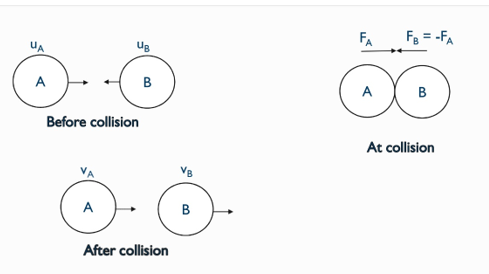
From Newton’s third law
FA = - FB
From the 2nd law
mA aA = -mB aB
The equation for conservation of momentum becomes:
mA vA - mA uA = -(mB vB - mB uB)
mAuA + mB uB = mA vA + mB vB
1.3.1 Examples
1. A ball P of mass 0.25kg loses one-third of its velocity when it makes a head-on collision with an identical ball Q at rest. After the collision, Q moves off with a speed of 2ms-1 in the original direction of P. Calculate the initial velocity of P.
2. An arrow of mass 0.3kg is fired with a velocity of l0m/s into a wooden block of mass 0.7kg. Calculate the final K.E. after impact, given that the wooden block can freely move.
3. A sub machine gun of mass 20kg fires a bullet of mass l00g due South with a velocity of 250ms-1. What is the recoil velocity of the gun?