PROPERTIES OF MATTER
7. ARCHIMEDE'S PRINCIPLE
1.7 Archimedes’ Principle
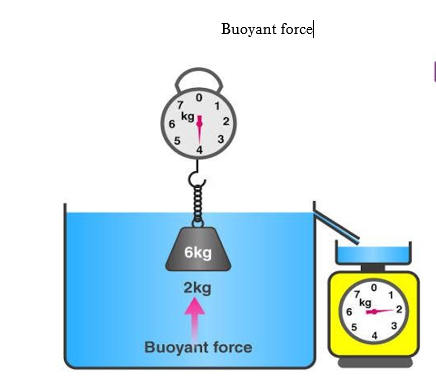
Archimedes’ principle states that when a body is completely or partially immersed in a fluid, the fluid exerts an upward force on the body equal to the weight of the fluid displaced by the body.
1.7.1 Upthrust
Any object placed in a fluid such as water or air experiences an upwards force. This is what makes it possible for something to float in water. Upthrust arises from the pressure which a fluid exerts on an object. The deeper you go, the greater the pressure. So there is more pressure on the lower surface of an object than on the upper surface, and this tends to push it upwards. If upthrust is greater than the object’s weight, it will float up to the surface
When a balloon floats in equilibrium in air, its weight (including the gas inside it) must be the same as the weight of the air displaced by the balloon.
A fish’s flesh is denser than water, yet a fish can float while submerged because it has a gas-filled cavity within its body. This makes the fish’s average density the same as water’s, so its net weight is the same as the weight of the water it displaces.
A body whose average density is less than that of a liquid can float partially submerged at the free upper surface of the liquid. The greater the density of the liquid, the less of the body is submerged. When you swim in seawater density your body floats higher than in fresh water (1000 kg/m3).