Writing for the Mass Media
1. Application of news values in story writing.
News Values
Journalists commonly use six values to determine how newsworthy a story or elements of a story are. Knowing the news values can help a journalist make many decisions, including:
• What information to give first in a news article, and in the lede(LEADS)
• Which articles to display on a newspaper’s front page
• What questions to ask in an interview
The six news values are:
1. Timeliness- Recent events have a higher news value than less recent ones.
2. Proximity- Stories taking place in one’s hometown or community are more newsworthy than those taking place far away.
3. Prominence- Famous people and those in the public eye have a higher news value than ordinary citizens.
4. Uniqueness/oddity- A story with a bizarre twist or strange occurrences. “Man bites dog” instead of“dog bites man.”
5. Impact- Stories that impact a large number of people may be more newsworthy than those impacting a smaller number of people.
6. Conflict- “If it bleeds, it leads.” Stories with strife, whether it’s actual violence or not, are more interesting.
The newsworthiness of a story is determined by a balance of these six values. There is no set formula to decide how newsworthy a story is, but in general, the more of these six values a story meets, the more newsworthy it is.
Libel
Libel is defined as the published defamation of a person’s character based on misleading or inaccurate facts. Newspaper reporters can often run into issues of libel because it is their job to write truthful articles about people that might not always be flattering.
Even though we live in a country with a free press, journalists cannot write anything they want. Reporters do not have the right to state something about a person that could damage their reputation and that is untruthful.
One of the easiest ways to protect oneself from libel is to make sure to always do accurate reporting and to attribute all information in an article. If you write something about someone that you’re unsure about, just ask yourself if it’s true, and how you know it’s true. Rumors, gossip, and information you received from an anonymous or unreliable source are all dangerous to report, and they could run you the risk of a libel case.
Lede
The lede (or lead) of a news article is the first sentence, usually written as one paragraph, that tells the most
important information of the story. When writing a lede, it is helpful to use the “tell a friend” strategy. Imagine you
had to sum up to a friend, in one sentence, what your story is about. How would you sum up quickly what
happened? A story’s lede answers the “Five W’s” in a specific order: Who? What? When? Where? Why?
For example:
The Atlanta Police Department will hold a memorial service Wednesday at Holy Christ Church in Buckhead
for fallen officer Lt. James Montgomery.
WHO: The Atlanta Police Department
WHAT: will hold a memorial service
WHEN: Wednesday
WHERE: Holy Christ Church in Buckhead
WHY: for fallen officer Lt. James Montgomery
Other examples (courtesy of the Atlanta Journal-Constitution):
Gwinnett County Public Schools was awarded $250,000 early Wednesday as a finalist for what’s considered
the Nobel Prize of public education.
A man beat an Army reservist in front of a Morrow Cracker Barrel, yelling racial slurs at her as he kicked her
in the head, Morrow police said.
Inverted Pyramid
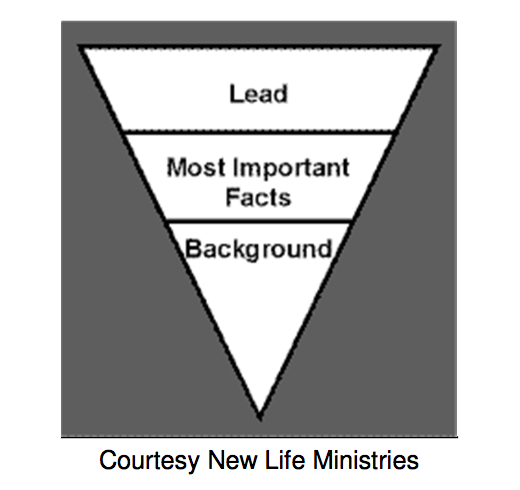
News articles are written in a structure known as the “inverted pyramid.” In the inverted pyramid format, the most newsworthy information goes at the beginning of the story and the least newsworthy information goes at the end.
After you have written your story’s lede, order the information that follows in terms of most important to least
important. There is NO formal conclusion in a journalism article the way there is in an essay or analysis paper.
Attributing information
ALL information in a news article MUST be attributed to the source where the reporter got his/her information.
The reporter must indicate in his/her article where material was obtained from – from an interview, court
documents, the Census, a Web site, etc. Direct quotes and paraphrasing can be used to attribute information
obtained in an interview with a source.
For example:
According to a police report, the suspect threatened the cashier with a gun before running away with the
money.