Urine Formation Processes
1. Urine Formation Processes
1.1. Glomerular Filtration
- Glomerular
filtration
is a special case of the capillary fluid exchange process in which water and
some solutes in the blood plasma pass from the capillaries of the glomerulus
into the capsular space of the nephron through
the pedicels of the podocytes.
- It
is a nonselective passive process and constitutes the first step of urine
formation
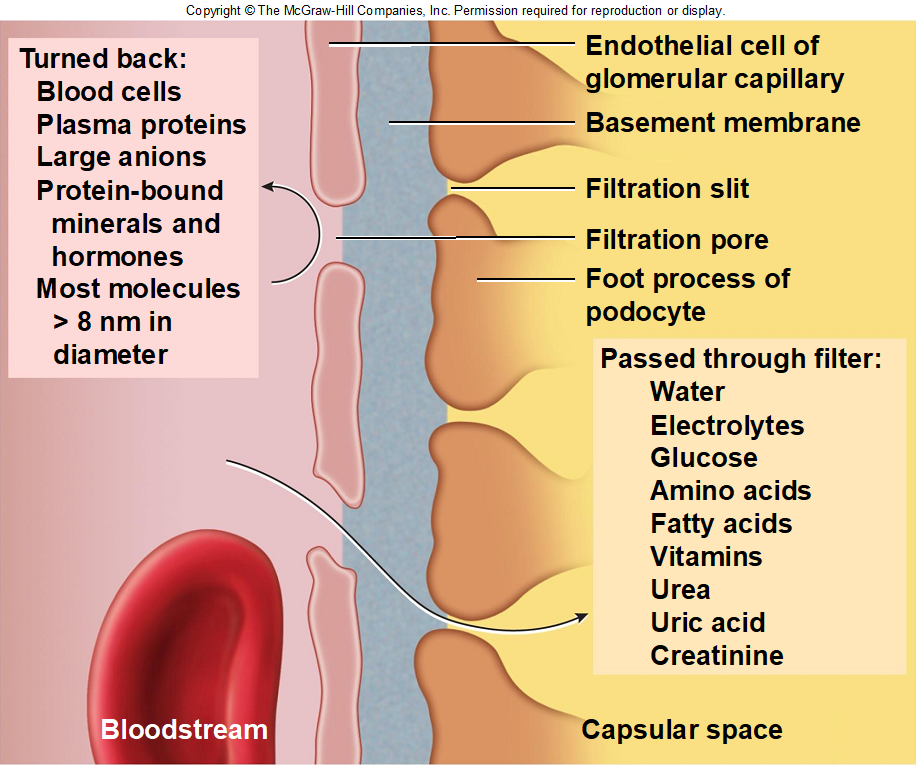
- This term reflects the fact
that the glomerular filtration barrier is an extremely fine molecular sieve
that allows the filtration of small molecules but restricts the passage of
macromolecules (e.g., the plasma proteins).
- The glomerular filtrate
normally takes an extracellular route, through holes in the endothelial cell
layer, the basement membrane, and the pores between adjacent podocytes.
- The glomerular capillaries
are relatively impermeable to proteins, so that the filtered fluid (glomerular
filtrate) is essentially protein-free and devoid of cellular elements,
including red blood cells.
- Everything else is filtered
into the nephron
- As a result, glomerular
filtrate is a plasma like fluid (an ultrafiltrate of plasma) in terms of salts
and organic molecules concentration.
- Exceptions
to this generalization include a few
low-molecular-weight substances, such as calcium and fatty acids, that are not
freely filtered because they are partially bound to the plasma proteins.
- The fluid that enters the
capsular space is called the
glomerular filtrate.
- On average, the daily
volume of glomerular filtrate in adults is 150 liters in females and 180 liters
in males.
- More than 99% of the
glomerular filtrate returns to the bloodstream via tubular reabsorption, so
only 1–2 liters are excreted as urine.
- The fraction of blood
plasma in the afferent arterioles of the kidneys that becomes glomerular
filtrate is the filtration
fraction.