Urine Formation Processes
1. Urine Formation Processes
1.2. Filtration Pressure
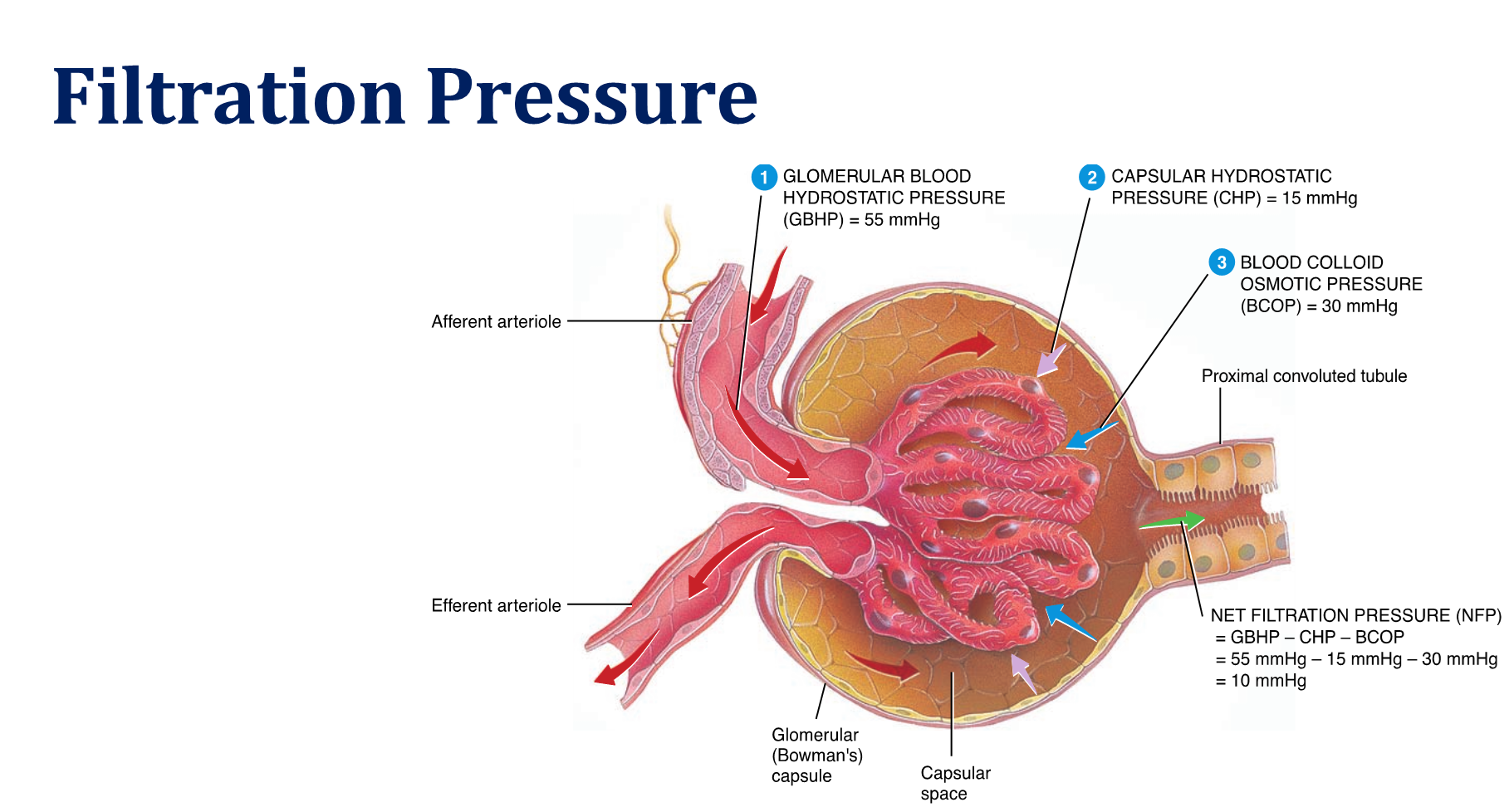
Glomerular filtration depends on three main pressures. One pressure promotes filtration and two pressures oppose filtration.
1. Glomerular Blood
Hydrostatic Pressure (GBHP), which is the main
driving force, depends on the systemic
arterial blood pressure, afferent and efferent
arteriolar resistance.
- GBHP is the blood pressure in glomerular capillaries.
- Generally, GBHP is about 55 mmHg compared to 10 to 15 in most other capillaries).
- Because afferent arteriole is larger than efferent arteriole
- Larger inlet and smaller outlet
- It promotes filtration by forcing water and solutes in blood plasma through the filtration membrane.
2. Capsular hydrostatic
pressure (CHP) is the hydrostatic pressure
exerted against the filtration membrane by fluid already in the capsular space
and renal tubule.
- CHP opposes filtration and represents a “back pressure” of about 15 mmHg.
- Due to high filtration rate and continual accumulation of fluid in the capsule
3. Blood colloid
osmotic pressure (BCOP), which is due to the presence of proteins such as albumin,
globulins, and fibrinogen in blood plasma. BCOP also opposes filtration.
- The average BCOP in glomerular capillaries is 30 mmHg.
- Net filtration pressure (NFP), the total pressure that promotes filtration, is determined as follows:
- Net Filtration Pressure (NFP) = GBHP - [CHP + BCOP]
- By substituting the values given in the previous slides, normal NFP may be calculated:
- NFP = 55 mmHg - [15 mmHg + 30 mmHg]