Thyroid and Adrenal Glands
2. Adrenal Glands
2.4. Mechanism of Action of Adrenocortical Hormones
- The adrenocortical hormones—mineralocorticoids, glucocorticoids, and androgens—are all steroid hormones synthesized from cholesterol in the adrenal cortex.
- Because of their lipid-soluble nature, they easily diffuse across cell membranes and act primarily by altering gene expression to regulate protein synthesis within target cells.
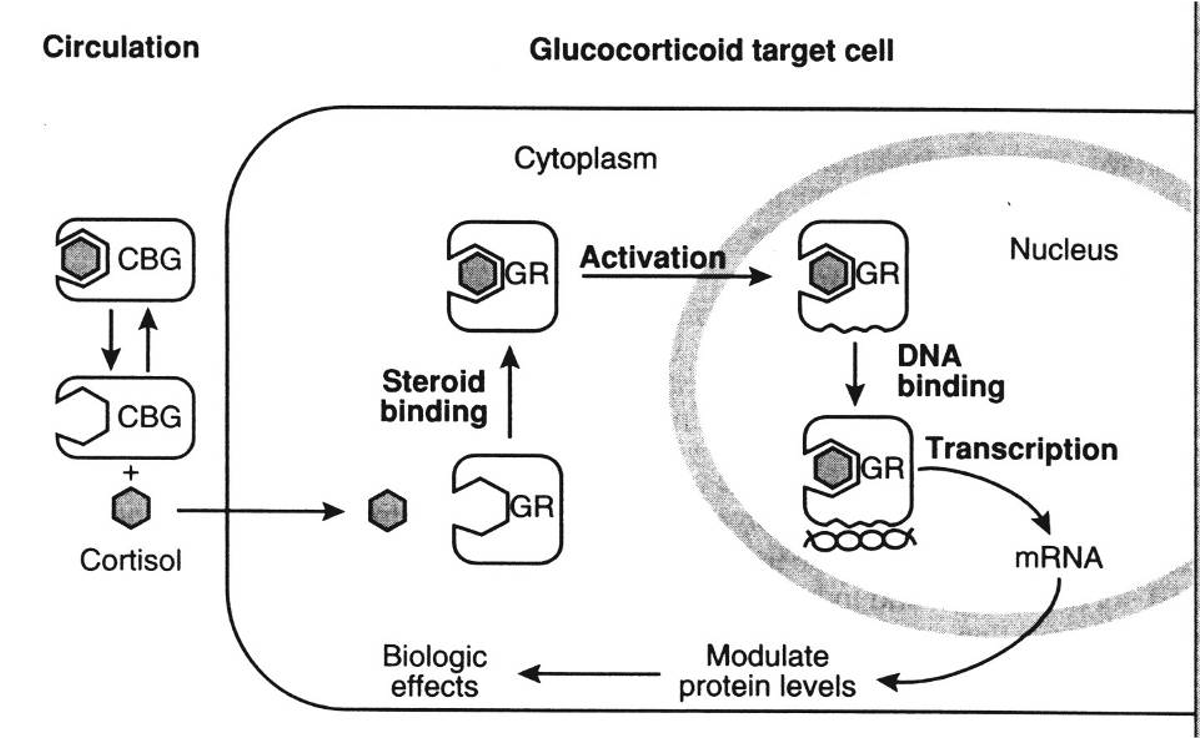
Diffusion into Target Cell:
-
Being lipid-soluble, adrenocortical hormones pass freely through the cell membrane.
-
-
Binding to Intracellular Receptors:
-
Inside the target cell, the hormone binds to a specific cytoplasmic or nuclear receptor (a member of the steroid receptor family).
-
Examples:
-
Mineralocorticoid receptor (MR) – for aldosterone
-
Glucocorticoid receptor (GR) – for cortisol
-
-
-
Hormone–Receptor Complex Formation:
-
The hormone–receptor complex undergoes conformational activation, exposing a DNA-binding domain.
-
-
Translocation to the Nucleus:
-
The activated complex enters the cell nucleus and binds to specific hormone response elements (HREs) on DNA.
-
-
Regulation of Gene Transcription:
-
The complex either stimulates or suppresses transcription of specific genes.
-
This leads to the synthesis (or inhibition) of particular mRNAs and, subsequently, proteins that mediate the hormone’s effects.
-
-
Cellular Response:
-
The newly synthesized proteins bring about long-term changes in cell function—such as enzyme production, ion transport, or metabolic regulation.
-
Because this process depends on transcription and translation, the effects of adrenocortical hormones are slow in onset but long-lasting.
-