WORK, ENERGY AND MOMENTUM
2. Relationship between work and energy conservation
Relationship between work and energy conservation
Gravitational potential energy is defined via work done by or against gravity:
- The change in GPE is equal to the negative of the work done by the gravitational force:
- When only conservative forces (like gravity) act, total mechanical energy (kinetic + potential) is conserved:
For instance, a ball dropped from height has Initial: high, zero and at impact: , .
Conservation of Energy
The law of conservation of energy states that energy cannot be created or destroyed; it can only be transformed from one form to another. In a closed (or isolated) system, the total amount of energy remains constant over time.
Energy may change from forms such as kinetic, gravitational potential, elastic, thermal, chemical, or electrical, but the sum of all energies in the system stays fixed, provided no energy enters or leaves the system.
If energy does enter or leave (for example, via heat or work), then the change in the system’s total energy equals that energy transfer, as described in the first law of thermodynamics.
Forms of energy
- Kinetic energy (energy of motion).
- Gravitational potential energy
- Elastic potential energy in springs.
- Thermal energy (heat), internal energy, and other forms in extended systems.
Conservation of mechanical energy
In many A‑level style problems, only mechanical energy (kinetic plus potential) is considered.
When all forces are conservative (no friction or drag), mechanical energy is conserved:
where subscripts and stand for initial and final states.
Example:
- A pendulum bob swings down: gravitational potential energy converts into kinetic energy, with total mechanical energy roughly constant if air resistance is small.
Non‑conservative forces and real systems
In real systems, non‑conservative forces like friction or air resistance convert mechanical energy into heat, sound, etc.
The total energy of the larger system (including the surroundings) still obeys conservation of energy, but mechanical energy alone decreases.
Linear and Angular momentum
Linear momentum and angular momentum are both measures of “how much motion” an object has, but they apply to different kinds of motion: translation (straight‑line) and rotation. Both obey conservation laws when there are no external forces or torques, and they are central in mechanics‑style problems.
Linear (translational) momentum
Linear momentum of a particle is defined as:
where is mass and is its linear velocity.
- It is a vector quantity; its direction is the same as the velocity.
- For a system of particles, the total linear momentum is the vector sum: .
Conservation of linear momentum
If the net external force on a system is zero, its total linear momentum remains constant
This is why momentum is very useful in collision problems (e.g., car crashes, particle collisions).
Angular momentum
Angular momentum describes rotational or “orbital” motion about a point or axis.
For a single particle
For a particle of mass at position relative to an origin and moving with linear momentum , the angular momentum about that origin is
In magnitude, for a case where and are perpendicular (e.g., circular orbit), this becomes
For a rigid body rotating about an axis
For a rigid body spinning with angular velocity, its angular momentum is
where is the moment of inertia about the axis and is the angular speed.
Conservation of angular momentum
If the net external torque on a system about a given axis is zero, its total angular momentum about that axis is conserved:
Consequences:
- A spinning ice skater pulling arms in reduces, so increases to keep constant.
- Planets in orbit have constant angular momentum (no external torque), which leads to Kepler’s second law (equal areas swept in equal times).
How linear and angular momentum are linked
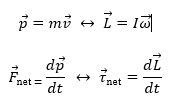
Angular momentum can be thought of as the “rotational cousin” of linear momentum: replace mass with moment of inertia and linear velocity with angular velocity.
Many rotational formulas are direct analogues of their translational counterparts; for example,