MAGNETISM
3. Biot–Savart Law and Ampère’s Law
The Biot Savart Law is used to determine the magnetic field intensity H near a current-carrying conductor or we can say, it gives the relation between magnetic field intensity generated by its source current element. The law was stated in the year 1820 by Jean Baptisle Biot and Felix Savart. The direction of the magnetic field follows the right-hand rule for the straight wire. Biot Savart law is also known as Laplace’s law or Ampere’s law.
Consider a wire carrying an electric current I and also consider an infinitely small length of a wire dl at a distance x from point A.
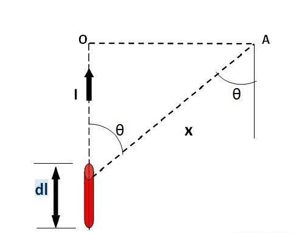
Biot Savart Law states that; the magnetic intensity dH at a point A due to current I flowing through a small element dl is
1. Directly proportional to current (I)
2. Directly proportional to the length of the element (dl)
3. Directly proportional to the sine of angle θ between the direction of current and the line joining the element dl from point A.
4. Inversely proportional to the square of the distance (x) of point A from the element dl.
This law describes the magnetic field generated by a steady current:
Describes the magnetic field produced at a point by a small segment of current.
For a current element Idl.
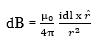
Where:
I: current through the conductor
dl: infinitesimal length vector of current
μ0: permeability of free space (4π×10−7 T.m/A)
Hence Bio-Sarvat law is applicable to center of circular loops and long straight wire at a distance the formula given by;
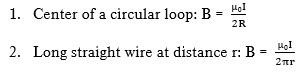
Example calculation:
1.A circular loop of radius 0.2m carries a current of 5A. Find the magnitude of the magnetic field at the center of the loop.
Ampere’s law: Ampère's Law states that the magnetic field around a conductor is directly proportional to the electric current flowing through the conductor. It relates the magnetic field along a closed loop to the total current passing through the loop. Mathematically expressed as
∮ B · dl = μ₀ Ienc.
Ampere’s law is useful in the calculation of the magnetic field in a system with high symmetry (cylindrical, planar etc). for instance;

Examples
1. A long straight wire carries a current of 10A. Calculate the magnetic field at a distance5cm from the wire.
2. A solenoid has 800turns wound over a length of 2m, and carries a current of 3A. Calculate the magnetic field inside the solenoid.
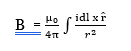
to find the total magnetic field; B