Unit 1: Exploring the Word Window
2. The MS WORD Window
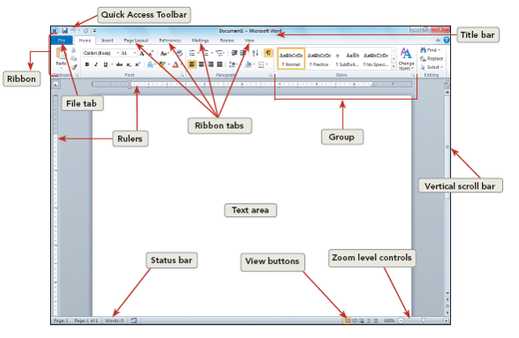
Figure 2.2 Microsoft Word Window
Quick Access toolbar provides access to common commands such as undo, redo, save, and start from the beginning. This access bar can be costumized to fit your personnel needs by clicking on the customizing Quick Access bar button at the end of the toolbar.
Title Bar - This displays the name of the current open document, when opening a new file is always displays Document1 (or 2, 3, 4 etc.) until you save and name the file.
Ruler - There are horizontal and vertical rulers that display when you are in Print Layout View. The horizontal ruler shows the placement of margins, indents, and tabs. You can also show and hide these rulers by using the View Ruler button.
Text Area - This is where your text, images, etc will be displayed.
Scroll Bars - Use these with your mouse to move up, down, right or left within the document.
Status Bar - This displays the page number, page count, document view buttons, and zoom control. It will also display current mode of operation and can be customized to include other functions.
View Buttons - This is used to switch between views such as Print Layout, Full Screen Reading, Web Layout, Outline, and Draft View.
Screen Tips - Appear when you point to a command on the Ribbon, it includes the name of the command along with a description of what that command does.
The Ribbon is a user interface element which was introduced by Microsoft. It is located below the Quick Access Toolbar and the Title Bar. It comprises nine tabs; Home, Insert, Design tab, Page layout, References, Mailing, Review and View. Each tab has specific groups of related commands.