WEB BASIC OVERVIEW
| Site: | Newgate University Minna - Elearning Platform |
| Course: | Introduction to Web Technologies |
| Book: | WEB BASIC OVERVIEW |
| Printed by: | Guest user |
| Date: | Sunday, 5 April 2026, 5:10 PM |
Introduction to internet
Internet is a global network that connects billions of computers across the world with each other and to the World Wide Web. It uses standard internet protocol suite (TCP/IP) to connect billions of computer users worldwide. It is set up by using cables such as optical fibers and other wireless and networking technologies. At present, internet is the fastest mean of sending or exchanging information and data between computers across the world. It is believed that the internet was developed by "Defense Advanced Projects Agency" (DARPA) department of the United States. And, it was first connected in 1969.
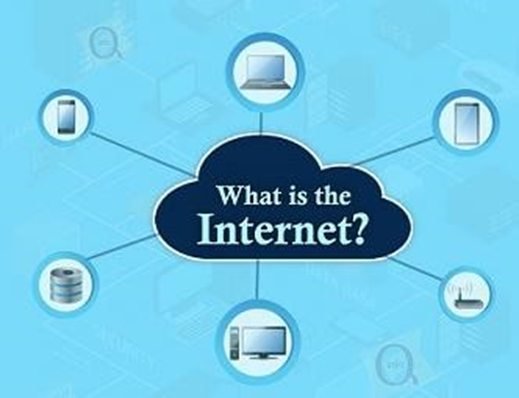
Internet is called a network as it creates a network by connecting computers and servers across
the world using routers, switches and telephone lines, and other communication devices and
channels. So, it can be considered a global network of physical cables such as copper telephone
wires, fiber optic cables, tv cables, etc. Furthermore, even wireless connections like 3G, 4G, or
Wi-Fi make use of these cables to access the Internet.
Internet is different from the World Wide Web as the World Wide Web is a network of
computers and servers created by connecting them through the internet. So, the internet is the
backbone of the web as it provides the technical infrastructure to establish the WWW and acts
as a medium to transmit information from one computer to another computer. It uses web
browsers to display the information on the client, which it fetches from web servers.
The internet is not owned by a single person or organization entirely. It is a concept based on
physical infrastructure that connects networks with other networks to create a global network
of billions of computers. As of 12 August 2016, there were more than 300 crores of internet
users across the world.
Working process of the internet
The internet works with the help of clients and servers. A device such as a laptop, which is
connected to the internet is called a client, not a server as it is not directly connected to the
internet. However, it is indirectly connected to the internet through an Internet Service Provider
(ISP) and is identified by an IP address, which is a string of numbers. Just like you have an
address for your home that uniquely identifies your home, an IP address acts as the shipping
address of your device. The IP address is provided by your ISP, and you can see what IP address
your ISP has given to your system.
A server is a large computer that stores websites. It also has an IP address. A place where a
large number of servers are stored is called a data center. The server accepts requests send by
the client through a browser over a network (internet) and responds accordingly.
To access the internet we need a domain name, which represents an IP address number, i.e.,
each IP address has been assigned a domain name. For example, youtube.com, facebook.com,
paypal.com are used to represent the IP addresses. Domain names are created as it is difficult
for a person to remember a long string of numbers. However, internet does not understand the
domain name, it understands the IP address, so when you enter the domain name in the browser
search bar, the internet has to get the IP addresses of this domain name from a huge phone
book, which is known as DNS (Domain Name Server). For example, if you have a person's
name, you can find his phone number in a phone book by searching his name. The internet uses
the DNS server in the same way to find the IP address of the domain name. DNS servers are
managed by ISPs or similar organizations.
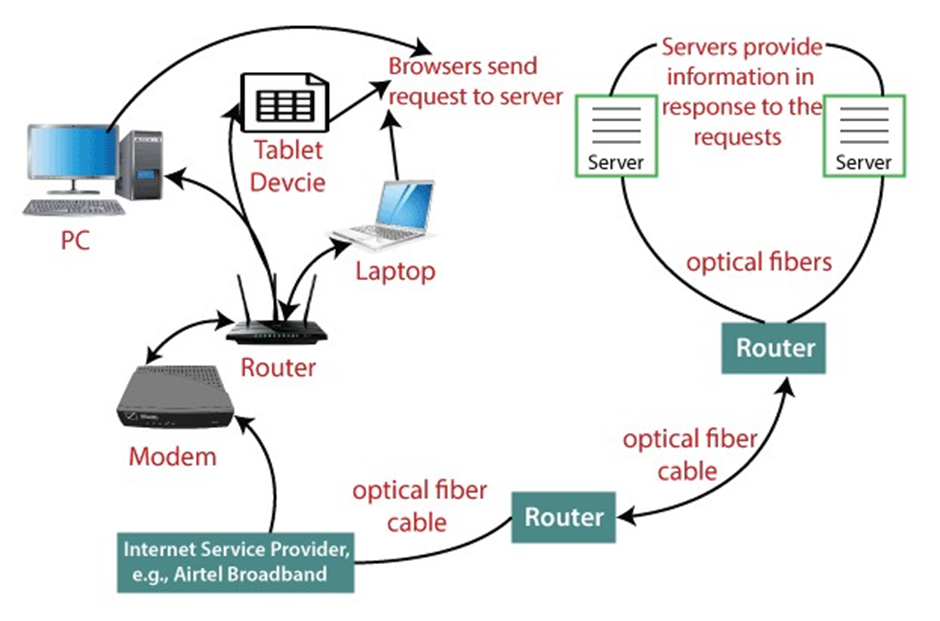
When you turn on your computer and type a domain name in the browser search bar, your
browser sends a request to the DNS server to get the corresponding IP address. After getting
the IP address, the browser forwards the request to the respective server.
Once the server gets the request to provide information about a particular website, the data
starts flowing. The data is transferred through the optical fiber cables in digital format or in the
form of light pulses. As the servers are placed at distant places, the data may have to travel
thousands of miles through optical fiber cable to reach your computer.
The optical fiber is connected to a router, which converts the light signals into electrical signals.
These electrical signals are transmitted to your laptop using an Ethernet cable. Thus, you
receive the desired information through the internet, which is actually a cable that connects you
with the server.
Furthermore, if you are using wireless internet using wifi or mobile data, the signals from the
optical cable are first sent to a cell tower and from where it reaches to your cell phone in the
form of electromagnetic waves.
The internet is managed by ICANN (Internet Corporation for Assigned Names and Numbers)
located in the USA. It manages IP addresses assignment, domain name registration, etc.
The data transfer is very fast on the internet. The moment you press enter you get the
information from a server located thousands of miles away from you. The reason for this speed
is that the data is sent in the binary form (0, 1), and these zeros and ones are divided into small
pieces called packets, which can be sent at high speed.
The History of internet
The forerunner of the Internet, the ARPANet, went live for the first time in 1969. The TCP/IP,
open networking protocol suite, was adopted by the ARPANet in 1983, and the National
Science Foundation Network (NSFN) developed the network to link university computer
science departments across the US in 1985.
When the hypertext transfer protocol (HTTP) was developed in 1989, it enabled different
computer platforms to connect to the same Internet sites, which dramatically improved
communications over the network. The Mosaic Web browser was developed in 1993.
Over the years of its existence, the Internet has remained a constant growth and development.
For instance, IPv6 was created to provide for a significant future rise in the number of IP
addresses that could be used. In a related development, the Internet of Things (IoT) refers to
the rapidly developing environment where nearly any entity or device can be given a unique
identifier (UID) and the capability to communicate data automatically over the Internet
The World Wide Web
The World Wide Web (abbreviated WWW or the Web) is an information space where
documents and other web resources are identified by Uniform Resource Locators (URLs),
interlinked by hypertext links, and can be accessed via the Internet. English scientist
TimBerners-Lee invented the World Wide Web in 1989. He wrote the first web browser
computer program in 1990 while employed at CERN in Switzerland. The Web browser was
released outside CERN in 1991, first to other research institutions starting in January 1991 and
to the general public on the Internet in August 1991. The World Wide Web has been central to
the development of the Information Age and is the primary tool billions of people use to interact
on the Internet. Web pages are primarily text documents formatted and annotated with
Hypertext Markup Language (HTML). In addition to formatted text, web pages may contain
images, video, audio, and software components that are rendered in the user's web browser as
coherent pages of multimedia content. Embedded hyperlinks permit users to navigate between
web pages. Multiple web pages with a common theme, a common domain name, or both, make
up a website. Website content can largely be provided by the publisher, or interactively where
users contribute content or the content depends upon the users or their actions. Websites may
be mostly informative, primarily for entertainment, or largely for commercial, governmental,
or non-governmental organizational purpose.
WWW is another example of client/server computing. Each time a link is followed, the client
is requesting a document (or graphic or sound file) from a server (also called a Web server)
that's part of the World Wide Web that "serves" up the document. The server uses a protocol
called HTTP or Hyper Text Transport Protocol. The standard for creating hypertext documents
for the WWW is Hyper Text Markup Language or HTML. HTML essentially codes plain text
documents so they can be viewed on the Web
Difference between the World Wide World and the Internet
The World Wide Web (also known as the Web) and the Internet are fundamentally dissimilar
from one another because the Web is a collection of information that can be accessed using the
Internet, whereas the Internet is a global network of networks that offers access to almost all
types of information. In other words, the Web is a service that was added to the Internet's
foundation.
The Web is the part of the Internet that gets the greatest traffic. One unique aspect of this is
hypertext, a rapid cross-referencing method. The majority of websites feature text that
highlights keywords or phrases by being a different color than the rest of the text. When a user
selects one of these words or phrases, they will be sent to the chosen website or page. Buttons,
graphics, and even particular areas of images are also utilized as hyperlinks.
On the Internet, there are billions of pages of information. The most popular web browsers are
Google Chrome, Firefox, and Internet Explorer. A web browser is used to surf the internet or
do online browsing. A certain Web site's look may vary slightly depending on the browser
being used. A certain browser's later or more updated versions have the potential to render
more complicated features like music files, sound, animation, and virtual reality.
Uniform Resource Locators, or URLs
A Uniform Resource Locator, or URL is the address
of a document found on the WWW. Browser interprets the information in the URL in order to
connect to the proper Internet server and to retrieve your desired document. Each time a click
on a hyperlink in a WWW document instructs browser to find the URL that's embedded within
the hyperlink. The elements in a URL: Protocol://server's address/filename
What are Domains?
Domains divide World Wide Web sites into categories based on the nature of their owner, and they form part of a site's address, or uniform resource locator (URL). Common top-level domains are:
- .com—commercial enterprises
- .mil—military site
- .org—organization site (non-profits, etc.).
- .int—organizations established by international treaty
- .net—network .biz—commercial and personal
- .edu—educational site (universities, schools, etc.)
- .info—commercial and personal
- .gov—government organizations
- .name—personal sites
MIME (Multi-Purpose Internet Mail Extensions)
MIME is an extension of the original
Internet e-mail protocol that lets people use the protocol to exchange different kinds of data
files on the Internet: audio, video, images, application programs, and other kinds, as well as the
ASCII text handled in the original protocol, the Simple Mail Transport Protocol (SMTP). In
1991, Nathan Borenstein of Bellcore proposed to the IETF that SMTP be extended so that
Internet (but mainly Web) clients and servers could recognize and handle other kinds of data
than ASCII text. As a result, new file types were added to "mail" as a supported Internet
Protocol file type. Servers insert the MIME header at the beginning of any Web transmission.
Clients use this header to select an appropriate "player" application for the type of data the
header indicates. Some of these players are built into the Web client or browser (for example,
all browsers come with GIF and JPEG image players as well as the ability to handle HTML
files); other players may need to bedownloaded. New MIME data types are registered with the
Internet Assigned Numbers Authority (IANA). MIME is specified in detail in Internet Request
for Comments 1521 and 1522, which amend the original mail protocol specification, RFC 821
(the Simple Mail Transport Protocol) and the ASCII messaging header, RFC 822.
Hypertext Transport Protocol
HTTP means HyperText Transfer Protocol. HTTP is the
underlying protocol used by the World Wide Web and this protocol defines how messages are
formatted and transmitted, and what actions Web servers and browsers should take in response
to various commands. For example, when you enter a URL in your browser, this actually sends
an HTTP command to the Web server directing it to fetch and transmit the requested Web page.
The other main standard that controls how the World Wide Web works is HTML, which covers
how Web pages are formatted and displayed. HTTP is called a stateless protocol because each
command is executed independently, without any knowledge of the commands that came
before it. This is the main reason that it is difficult to implement Web sites that react
intelligently to user input.
HTTPS
A similar abbreviation, HTTPS means Hyper Text Transfer Protocol Secure.
Basically, it is the secure version of HTTP. Communications between the browser and website
are encrypted by Transport Layer Security (TLS), or its predecessor, Secure Sockets Layer
(SSL)
Client-Server Model
The client-server architecture is a common design pattern used in computer networking,
including the internet. In this architecture, there are two types of software components: clients
and servers.
A server is a computer program or device that provides a service to one or more client
programs. A client is a computer program or device that requests services or resources from a
server.
In the context of the internet, a client is typically a web browser or a mobile app, while a server
is a web server or an application server.
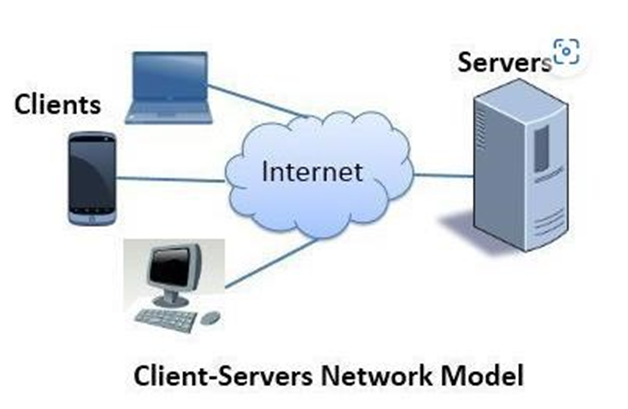
When a client wants to access a resource or service on the internet, it sends a request to the
server. The server processes the request and sends back a response to the client, typically in the
form of HTML, JSON, or some other format that the client can understand.
This client-server model is what enables the internet to function as a distributed system. By
breaking up tasks into smaller components and having specialized servers handle each
component, the internet can provide a wide range of services and resources to millions of users
around the world.
Overall, the client-server architecture is an essential part of how the internet works and is what
enables users to access and interact with the vast array of resources available on the web.