Introduction to Chemistry of Lipids
| Site: | Newgate University Minna - Elearning Platform |
| Course: | General and Medical Biochemistry I |
| Book: | Introduction to Chemistry of Lipids |
| Printed by: | Guest user |
| Date: | Friday, 23 October 2026, 5:50 PM |
Description
Lipids comprises heterogeneous group of compounds which are insoluble in water but soluble in non-polar organic solvents such us benzene, chloroform, and ether, present in all living organisms.
The group includes fats, oils, waxes and related compounds.
General Functions of Lipids
i. They are efficient energy sources.
ii. Serve as thermal insulators.
iii. They are structural components of the cell membrane.
iv. Serve as precursors for hormones (steroid hormones).
v. They also dissolve the vitamins, which are fat-soluble and assist their digestion.
Table of contents
- 1. Classification of Lipid
- 2. Classification base on composition
- 2.1. Fatty acid
- 2.2. Properties of fatty acid
- 2.3. Nomenclature of fatty acid
- 2.4. Polyunsaturated fatty acid
- 2.5. Functions of Fatty acid
- 2.6. classification and function of lipoprotein
- 2.7. Very low density lipoproteins (VLDL)
- 2.8. Low density lipoprotein (LDL)
- 2.9. High density lipoprotein (HDL)
- 2.10. Triacylglycerols
- 2.11. Digestion and absorption of lipids
- 2.12. Rancidity
- 2.13. Types of Rancidity
1. Classification of Lipid
Classification: - There are two ways of classification i.e.,
1. Classification base on composition
2. Classification based structure
2. Classification base on composition
I. Simple lipids: - These are esters of fatty acids with different alcohols.
Fats and oils: - These are esters of fatty acids with glycerol.
Waxes: - Esters of fatty acids with high molecular weight monohydric alcohols
II. Complex lipids: - Esters of fatty acids and alcohols together with some other head
groups.
A. Phospholipids: - Esters of the above type containing phosphoric acid residue.
a) Glycerophospholipids: - The alcohol is glycerol
b) Sphingophospholipids: - The alcohol is sphingosine.
B. Glycolipids: - Lipids containing fatty acid, sphingosine and carbohydrate residues.
C. Others: - Include sulfolipids, amino lipids and lipoproteins, which are modified forms of lipids
III. Derived lipids: Include the hydrolytic products of the simple and complex lipids. Eg. Fatty acids, cholesterol etc.
The simplest naturally occurring lipids are triacylglycerols formed by esterification of fatty acids with glycerol. Biological membranes are made up of phospholipids, glycolipids and proteoglycans.
Answer this**Which of the following is used in the reaction called saponification?
2.1. Fatty acid
FATTY ACIDS
Fatty acids are building block of most lipids, made of long chain organic acids having one polar carboxyl group (head) and a non-polar hydrocarbon chain (tail).
These are aliphatic carboxylic acids containing long hydrocarbon chains ranging from C-4 to C-24.
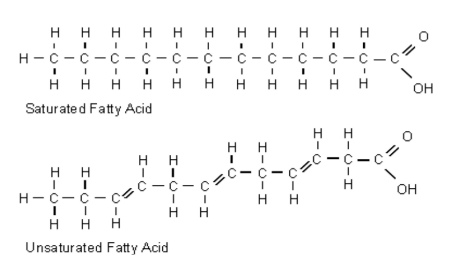
Based on the bonds that exist within the hydrocarbon chains, fatty acids can be saturated or unsaturated.
• Saturated fatty acid is a long-chain carboxylic acid containing only C-C single bonds.
• Unsaturated fatty acid is a long-chain carboxylic acid containing one or more C-C double bonds
• Unsaturated fatty acids occur mostly in cis form e.g oleic acid rather than trans form e.g elaidic acid.
2.2. Properties of fatty acid
Fatty acids are amphipathic, because of the Hydrophobic tail and Hydrophilic (–COOH) head
• The longer the hydrocarbon chain the higher the melting point of the fatty acid and the greater the number of double bonds in the fatty acid the lower the melting point of the fatty acid
• Unsaturated fatty acids have substantially lower melting points than saturated fatty acids.
Essential and non-essential fatty acids
• Essential fatty acids are the ones that cannot be synthesized in the body and thus are obtained from the diet e.g. ω-3 and ω-6 fatty acids.
• Non-essential fatty acids can be synthesized in
the human system and therefore do not come
only from diet.
2.3. Nomenclature of fatty acid
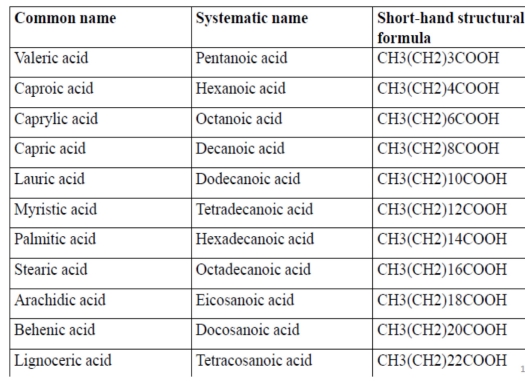
Systemic or IUPAC name of a fatty acid is formed by replacing the ending –e of alkane with suffix – oic acid to form a carboxylic acid
• Examples: 16C fatty acid: hexadecanoic acid (hexadecane), and 18C fatty acid: octadecanoic acid (octadecane)
• Fatty acid can also be named using α, β, γ, δ, ε, ζ,
η, θ to describe the carbon positions
The carboxyl carbon is only assigned C-1 while
from C-2 can now take α and C-3, β and so on. The terminal carbon atom in a fatty acid molecule
is considered as ω-carbon or the n-carbon atom.
2.4. Polyunsaturated fatty acid
Polyunsaturated fatty acids are categorized into three series based on the omega nomenclature.
• ω-9 fatty acids e.g. oleic acid
• ω-6 fatty acids e.g. linoleic acid and arachidonic acid
• ω-3 fatty acids e.g. α-linoleic acid (18:3;9,12,15) and timnodonic acid
Blood and Lipid
Cholesterol and triglycerides are the major blood lipid as well as the phospholipids.
• Cholesterol is an important lipid found in the cell membrane. It is a sterol formed from the combination of steroid and an alcohol.
• The fluidity of the cell membrane is owed to
cholesterol. Cholesterol is insoluble in the blood
and so must be carried by a specific protein (lipoprotein) to
facilitate its movement in the blood.
2.5. Functions of Fatty acid
1. The fluidity of membrane depends on length and degree of unsaturated fatty acids. Membrane phospholipid (PL) contains essential fatty acids.
In case of deficiency of essential fatty acid (EFA), other fatty acids replace them in the membrane; as a result, membrane gets modified structurally and functionally.
2. They are required for the synthesis of Phospholipid, cholesterol ester and lipoproteins
3. Poly unsaturated fatty acids are released from membranes, diverted for the synthesis of prostaglandins, leukotriens and thromboxanes.
4. They act as fat mobilizing agents in liver and protect liver from accumulating fats (fatty liver).
2.6. classification and function of lipoprotein
Cholesterol and other lipids are carried on plasma lipoproteins.
• Cholesterol and cholesteryl esters, like triacylgycerols and phospholipids are relatively insoluble in water, but must be transported within the body.
• Therefore, they are carried in the blood plasma as lipoproteins.
• Lipoproteins are spherical complexes with hydrophobic lipids in the core and hydrophilic amino side chains at the surface which interacts with the aqueous environment.
• Chylomicrons: are the largest lipoproteins and the least dense which contain a high proportion of triglyceride.
• The apolipoproteins of chylomicrons are apoB-48,
apoE, and apoC-II.
2.7. Very low density lipoproteins (VLDL)
Excess fatty acids and carbohydrates are converted to triacylglycerols in the liver and packaged with specific apolipoproteins into VLDL.
• These lipoproteins are transported in the blood
from the liver to muscle and adipose tissue,
where activation of lipoprotein lipase by apoC-II
causes the release of free fatty acids from the
VLDL triglycerides
Biological importance
VLDL acts as a carrier molecule, transporting triglycerides and cholesterol from the liver to peripheral tissues throughout the body, essentially delivering energy-rich fats to cells that need them for storage or usage, thus playing a key role in lipid metabolism and overall energy balance.
2.8. Low density lipoprotein (LDL)
Further removal of triglycerides from the VLDL yields LDL which is very rich in cholesterol and cholesteryl esters and also apoB-100 as the major apolipoprotein.
• LDL facilitates the movement of cholesterol to the
extrahepatic tissues that have specific plasma
membrane receptors that recognize apoB-100.
- LDL carries cholesterol to cells in the body, where it's used for cell repair.
Plaque formation
- LDL is involved in the formation of plaque in arteries, which can lead to heart disease, strokes, and other vascular diseases
Immune system
LDL interferes with the quorum sensing system of Staphylococcus aureus, which helps the bacteria infect
2.9. High density lipoprotein (HDL)
High density lipoprotein (HDL) contains apoA-I, apoC-I, apoC-II and other apolipoproteins, as well as the enzyme lecithin-cholesterol acyl transferase (LCAT), which catalyzes the formation of cholesteryl esters from lecithin (phosphatidylcholine) and cholesterol.
• It facilitates the transport of fatty acids from
extrahepatic tissues to the liver
Biological significance
Cholesterol transport
- HDL carries cholesterol from peripheral tissues to the liver, where it's excreted from the body
- HDL delivers cholesterol to the adrenals, ovaries, and testes, which are important for steroid hormone synthesis
- HDL has anti-inflammatory properties in endothelial cells and leukocytes
- HDL reduces pro-inflammatory processes in vascular smooth muscle
- HDL is anti-thrombotic through actions on endothelium and platelets
2.10. Triacylglycerols
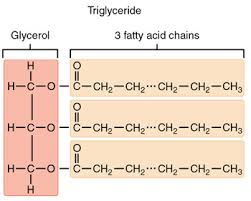
These are esters of fatty acids with the alcohol glycerol, which are storage forms of lipids (depot lipids).
Triacylglycerols also known as triacylglycerides, exist as simple or mixed types depending on the type of fatty acids that form esters with the glycerol. Both saturated and/or unsaturated fatty acids can form the ester linkage with the backbone alcohol. Eg. Tripalmitate, Triolein.
2.12. Rancidity
Rancidity also called Rancidification, is a condition that is produced by the aerial oxidation of unsaturated fat present in foods and also other products that are marked by unpleasant flavours or odours. When unsaturated components of a fatty material are exposed to sunlight, they can be converted into hydroperoxides, which break down into esters, volatile aldehydes, ketones, alcohols, and hydrocarbons, some of which have unpleasant odours.
How does a food become rancid?
Rancidity, in general terms, is always used for food products that have oil and fatty acids in them. Fatty acids are generally composed of fats, cholesterol and steroids.
These are mostly carboxylic acids that consist of a long aliphatic chain. They are either saturated which means there is only a single linkage between the carbon atoms or unsaturated that comprises multiple linkages between the carbon atoms.
2.13. Types of Rancidity
Hydrolytic Rancidity
Oxidative Rancidity
Microbial Rancidity
This type of rancidity takes place when the microorganisms such as bacteria use their enzymes to break down the chemical structures of fat.