KINEMATICS AND NEWTONIAN MECHANICS
| Site: | Newgate University Minna - Elearning Platform |
| Course: | General Physics I |
| Book: | KINEMATICS AND NEWTONIAN MECHANICS |
| Printed by: | Guest user |
| Date: | Monday, 28 September 2026, 3:55 AM |
Description
The course motion helps students understand how things move and the forces that affect them. It covers important ideas like speed, acceleration, and Newton’s laws of motion, using simple math and real-life examples. Students learn about different types of motion, such as objects falling, cars driving, and planets orbiting. Through theory experiments, simulations, they develop problem-solving skills and see how motion is part of everyday life. This course also prepares them for more advanced studies in science, engineering, and technology.
1. KINEMATICS OF MOTION
2.1 Kinematics of Motion
Kinematics is the branch of mechanics that describes how objects move, without considering why they move. (i.e. force). It deals with concept such;
1. Position: the location of objects at a given time given as coordinate x(t), y(t), etc
2. Displacement: change in position = it is a vector.
3. Distance: total path length travelled; it is a scalar.
Motion is defined as the change in position of an object with time.
Dynamics deals with the study of the motion of objects and the forces acting on them.
Types of motion:
1. Rotational (circular) Motion; wheels of a moving car, rotation of the blades of fan
2. Translational (Linear) Motion; a car moving from point A to point B
3. Random Motion; flight pattern of a bee, movement of dust particles
4. Oscillatory Motion; swinging pendulum etc.
5. Relative motion; A person is moving in a car, nearby objects move backward, thus they are stationary relative to the earth.
Definition
Force: Force is an agent that produces acceleration in the body on which it acts.
Or it is a phenomenon that change or tends to change the position of the body at rest or in uniform motion.
Force is a vector quantity as it has both direction and magnitude.
For example,
(i) To move a football, we have to exert a push i.e., kick on the football
(ii) To stop football or a body moving with same velocity, we have to apply push in a direction opposite to the direction of the body.
SI unit of force is Newton.
Dimension formula: [MLT-2]
Types of force
1. Contact force: These are forces that act on a body directly h a medium. Examples are push, pull, friction, pressure etc.
2. Non-Contact (Field) force: These are forces that act through spaces without making direct contact with the body. Examples are gravitational force, electrostatic force and magnetic force.
Example calculations:
1. A car starts from rest and accelerates uniformly at 2.5m/s2 for 10s. calculate
a. the final velocity of the car,
b. the distance it travels during this time
2. A stone is dropped from a height of 45m. Neglect air resistance and take g = 9.8ms2. find
a. the time it takes to reach the ground
b. its speed just before it hits the ground
2. NEWTON'S LAW OF MOTION
Introduction
Isaac Newton was a brilliant scientist who helped explain how things move on Earth and in space. His three laws of motion changed the way people understood the physical world. By building on the ideas of earlier scientists like Galileo and Kepler, Newton demonstrated that motion can be predicted using mathematical principles. His discoveries marked a major shift from old ways of thinking to modern science.
Forces are what cause objects to move. A force can be a push or a pull, like when you push a door open or when gravity pulls an object down. Some forces are strong, like a cannon firing a cannonball, while others are weak, like a mosquito landing on your arm. When multiple forces act on an object, they combine to create a net force, which determines how the object moves. If forces push in opposite directions, the more potent force will win out. Scientists use a system of positive and negative signs to keep track of forces and movement, making calculations easier and more accurate.
Newton’s laws help explain motion everywhere, from a ball rolling on the ground to a satellite orbiting Earth. Forces can come from inside a system (internal forces) or from outside (external forces). For example, when an object hangs from a rope, the force of gravity pulls it down while the rope pulls it up, keeping it in place. Understanding these forces helps us predict how objects will move, making Newton’s laws essential to physics and engineering.
Sir Isaac Newton gave three fundamental laws. These laws are called Newton's laws of motion.
Newton’s First Law:
a. A body at rest tends to remain at rest.
b. A body in motion tends to remain in motion at a constant velocity unless acted on by a net external force.
Inertia: is the tendency of an objects to resist changes in its state of motion.
Newton’s Second Law:
The rate of change of momentum of a body is directly proportional to the applied force, and the change takes place in the direction of the applied force.
Or
Acceleration produced in a body is directly proportional to the force applied.
Let a body of mass m moving with a velocity u. Let a force F be applied so that its velocity changes from u to v in t seconds.
Initial momentum = mu
Final momentum after time t second = mv
Total change in momentum = mv-mu.
Thus, the rate of change of momentum will be
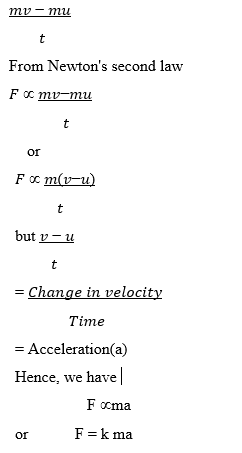
Where k is constant of proportionality, for convenience let k = 1.
Then F = ma
Unit for Force is Newton (N)
Newton’s Third law:
To every action there is an equal and opposite reaction or action and reaction are equal and opposite.
When a body exerts a force on another body, the other body also exerts an equal force on the first, in opposite direction.
From Newton's third law these forces always occur in pairs.
FAB (force on A by B) = -FBA (force on B by A).
Common forces in Newtonian Mechanics
1. Weight (w): Gravitational force on a mass, W = mg directed downward
2. Normal force(N): perpendicular contact force exerted by surface
3. Friction: opposes motion. There are two main types
a. Static friction: acts when objects are not moving
b. Kinetic friction: acts when objects are sliding
4. Tension(T): pulling force in a rope, string, or cable
Examples:
1. A block of mass 5kg rest on a horizontal frictionless surface. A horizontal force of 20N is applied. Find
a. The acceleration of the block
b. Its speed after 4s if it starts from rest.
3. MOMENTUM
Linear Momentum (p) The quantity of motion contained in the body is linear momentum. It is given by the product of mass and the velocity of the body. It is a vector and its direction is the same as the direction of the velocity. momentum = mass x velocity
p = mv
For example, a fast-moving cricket ball has more momentum than a slow-moving one. But a slow-moving heavy roller has more momentum than a fast cricket ball.
Units of momentum:
The SI unit is kg · m/s, i.e., kg · m/s-1.
Dimension formula = [M1L1T-1].
Examples
1. A body of mass 3kg moves with a velocity of 10ms-1. Calculate the momentum of the body.
2. Calculate the momentum of each of the following objects:
a) a 0.50kg stone travelling at a velocity of 20ms−1
b) a 2000kg bus travelling at 20ms−1 on a road
c) an electron travelling at 2.0 × 10⁷ms−1. (The mass of the electron is 9.1 × 10⁻³¹ kg.)
3. A force of 100N is used to kick a football of mass 0.8kg. Find the velocity with which the ball moves if it takes 0.8s to be kicked.
Change in momentum
Unbalanced force causes an object to move or accelerate, either speeding up or slowing down. If the force acts opposite to the motion of the object, it slows down, but if it acts in the same direction as that of the object, it increases the motion. Therefore, either way forces changes in the velocity of the object. When this occurs, we say that the momentum of the object changes. Change in momentum can be dangerous; for example, if a car were to have an accident, it has the tendency to reduce the large momentum of passengers to zero momentum, such as injuries, death, tiredness etc.
Impulse
Impulse is usually associated with collision. When a body collides with another, each receives an impulse or blow. The impulse consists of a large varying force acting for a very short time.
Impulse is defined as the product of the average force acting on a particle and the time during which it acts.
If a force F acts for a short time t, impulse I is given by
I = F x t
The unit of impulse is Newton-second (Ns). Impulse is a vector. It has the same direction as the direction of the force.
a. A racket hitting a ball
b. A football player colliding with another player.
c. A car moving at a constant velocity
d. An object moving in a projectile motion
Examples
1. A stationary ball is hit by an average force of 50N for a time of 0. 03s.What is the impulse experienced by the ball?
2. A ball of mass 5.0kg hits a smooth vertical wall normally with a speed of 2ms-1 and rebounds with the same speed. Determine the impulse experienced by the ball.
Conservation of Momentum
It is important we realize that momentum is conserved during collisions, explosions, and other events involving objects in motion. To say that a quantity is conserved means that it is constant throughout the event. In the case of conservation of momentum, the total momentum in the system remains the same before and after the collision.
The principle of conservation of momentum states that
In any system of colliding bodies, the total momentum is always conserved, provided there is no net external force acting on the system.
OR
The total momentum of an isolated or closed system of colliding bodies remains constant.
OR
If two or more bodies collide in a closed system, the total momentum after the collision is equal to the total momentum before the collision.
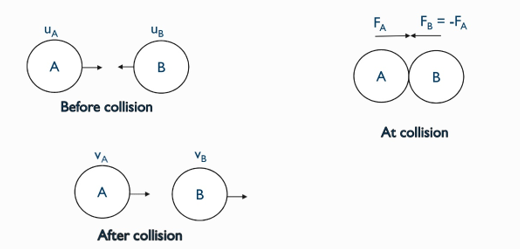
From Newton’s third law
FA = - FB
From the 2nd law
mA aA = -mB aB
The equation for conservation of momentum becomes:
mA vA - mA uA = -(mB vB - mB uB)
mAuA + mB uB = mA vA + mB vB
Examples
1. A ball P of mass 0.25kg loses one-third of its velocity when it makes a head-on collision with an identical ball Q at rest. After the collision, Q moves off with a speed of 2ms-1 in the original direction of P. Calculate the initial velocity of P.
2. An arrow of mass 0.3kg is fired with a velocity of l0m/s into a wooden block of mass 0.7kg. Calculate the final K.E. after impact, given that the wooden block can freely move.
3. A sub-machine gun of mass 20kg fires a bullet of mass l00g due South with a velocity of 250ms-1. What is the recoil velocity of the gun?
A collision occurs when two or more objects come into contact with each other and exchange energy or momentum. There are two principal types of collisions: elastic and inelastic collisions.
Elastic collision
In an elastic collision, the total kinetic energy of the colliding objects is conserved. This means that the objects bounce off each other without any loss of kinetic energy. Thus on such collision, both the momentum and the kinetic energy are conserved.
In a perfectly elastic collision, relative speed of approach = relative speed of separation.
Let us consider two bodies of masses m1 and m2 moving with initial velocities u1 and u2 before collision and with final velocities v1 and v2 after collision in the same direction. If the collision is perfectly elastic, we can write two equations from the principles of conservation of momentum and conservation of kinetic energy. Hence
m1u1 + m2u2 = m1v1 + m2v2
½m1u12 + ½m2u22 = ½m1v12 + ½m2v22
Two examples of collisions that are often very nearly perfectly elastic are the collisions of billiard balls and of molecules and atoms. In a perfectly elastic head-on collision between two bodies, the relative velocity of the two bodies is unchanged in magnitude but reversed in direction.
Inelastic collision
In an inelastic collision, the kinetic energy decreases after collision but the momentum is still conserved. The colliding bodies stick together and move as a unit after collision. This means that the velocities of the two bodies after collision are
v1 = v2 = v
from conservation of linear momentum, we have
m1u1 + m2u2 = m1v1 + m2v2 = (m1 + m2)v
the kinetic energy of the system before collision is given by
KE1 = ½m1u12 + ½m2u22
And after collision, the kinetic energy is
KE2 = ½m1v12 + ½m2v22 = ½(m1 + m2)v2
For a completely inelastic collision, the kinetic energy before collision is greater than the kinetic energy after collision.
Examples
1. A bullet of mass 120g is fired horizontally into a fixed wooden block with a speed of 20ms-1. The bullet is brought to rest in the block in 0.1s by a constant resistance. Calculate the
(i) magnitude of the resistance.
(ii) distance moved by the bullet in the wood
2. A tractor of mass 5.0 x 10³kg is used to tow a car of mass 2.5 x 10³kg. The tractor moved with a speed of 3.0ms-1 just before the towing rope becomes taut. Calculate the
(i) speed of the tractor immediately the rope becomes taut.
(ii) loss in KE of the system just after the car has started moving.
(iii) impulse in the rope when it jerks the car into motion.
1. A 2kg object is moving with a velocity of 3m/s. What is its momentum? A) 2 kg m/s B) 3 kg m/s C) 4 kg m/s D) 6
2. A 5 kg object is moving with a velocity of 4 m/s. What is its kinetic energy? A) 8 J B) 16 J C) 20 J D) 40 J
3. A 1 kg object is moving with a velocity of 5 m/s. If its velocity is doubled, what is its new momentum? A) 2.5 kg m/s B) 5 kg m/s C) 10 kg m/s D) 20 kg m/s
4. A 3 kg object is moving with a velocity of 6 m/s. What is its kinetic energy? A) 54 J B) 72 J C) 108 J D) 216 J
5. An object with a mass of 0.5 kg is moving with a velocity of 2 m/s. If its velocity is halved, what is its new momentum? A) 0.25 kg m/s B) 0.5 kg m/s C) 1 kg m/s D) 2 kg m/s
6. A 4 kg object is moving with a velocity of 10 m/s. If its velocity is tripled, what is its new kinetic energy? A) 100 J B) 300 J C) 400 J D) 900 J
7. An object with a mass of 2 kg is moving with a velocity of 8 m/s. If its velocity is halved, what is its new kinetic energy? A) 8 J B) 16 J C) 32 J D) 64 J
8. A 1 kg object is moving with a velocity of 4 m/s. If its velocity is doubled, what is its new kinetic energy? A) 4 J B) 8 J C) 16 J D) 32 J
9. A 6 kg object is moving with a velocity of 2 m/s. What is its momentum? A) 3 kg m/s B) 6 kg m/s C) 12 kg m/s D) 24 kg m/s
10. An object with a mass of 2 kg is moving with a velocity of 5 m/s. If its velocity is tripled, what is its new momentum? A) 5 kg m/s B) 10 kg m/s C) 15 kg m/s D) 30 kg
Exercises
1. Will two bodies have to be in physical contact to exert a force upon one another? Give reasons if yes or no.
2. Analyze this statement whether there is acceleration or not and state the reason?
A ball going round ball going round in a circle at constant speed?
3. Why is kinematics related to motion?
5. A motorcycle moving at a constant velocity suddenly accelerates at a rate of 4.0 m/s^2 to a speed of 35 m/s in 5.0 s. What was the initial speed of the motorcycle?
6. According to newton's first law, a body in motion remains in motion a constant velocity. However, when you slide and object across a surface, the object slows down and stop. Why?