LINEAR MOMENTUM
| Site: | Newgate University Minna - Elearning Platform |
| Course: | General Physics I |
| Book: | LINEAR MOMENTUM |
| Printed by: | Guest user |
| Date: | Monday, 6 April 2026, 10:29 AM |
Description
Linear Momentum as a course in physics aims to help students understand how objects behave when they are in motion and how they interact with each other, especially in terms of force, mass, and velocity.
1. LINEAR MOMENTUM
1.1 Linear Momentum (p) The quantity of motion contained in the body is linear momentum. It is given by the product of mass and the velocity of the body. It is a vector and its direction is the same as the direction of the velocity. momentum = mass x velocity
p = mv
For example, a fast-moving cricket ball has more momentum than a slow-moving one. But a slow-moving heavy roller has more momentum than a fast cricket ball.
1.1.2 Units of momentum:
The SI unit is kg · m/s, i.e., kg · m/s-1.
Dimension formula = [M1L1T-1].
1.1.3 Examples
1. A body of mass 3kg moves with a velocity of 10ms-1. Calculate the momentum of the body.
2. Calculate the momentum of each of the following objects:
a) a 0.50kg stone travelling at a velocity of 20ms−1
b) a 2000kg bus travelling at 20ms−1 on a road
c) an electron travelling at 2.0 × 10⁷ms−1. (The mass of the electron is 9.1 × 10⁻³¹ kg.)
3. A force of 100N is used to kick a football of mass 0.8kg. Find the velocity with which the ball moves if it takes 0.8s to be kicked.
1.1.4 Change in momentum
Unbalanced force causes an object to move or accelerate, either speeding up or slowing down. If the force acts opposite to the motion of the object, it slows down, but if it acts in the same direction as that of the object, it increases the motion. Therefore, either way forces changes in the velocity of the object. When this occurs, we say that the momentum of the object changes. Change in momentum can be dangerous; for example, if a car were to have an accident, it has the tendency to reduce the large momentum of passengers to zero momentum, such as injuries, death, tiredness etc.
2. IMPULSE
1.2 Impulse
Impulse is usually associated with collision. When a body collides with another, each receives an impulse or blow. The impulse consists of a large varying force acting for a very short time.
Impulse is defined as the product of the average force acting on a particle and the time during which it acts.
If a force F acts for a short time t, impulse I is given by
I = F x t
The unit of impulse is Newton-second (Ns). Impulse is a vector. It has the same direction as the direction of the force.
a. A racket hitting a ball
b. A football player colliding with another player.
c. A car moving at a constant velocity
d. An object moving in a projectile motion
1.2.1 Examples
1. A stationary ball is hit by an average force of 50N for a time of 0. 03s.What is the impulse experienced by the ball?
2. A ball of mass 5.0kg hits a smooth vertical wall normally with a speed of 2ms-1 and rebounds with the same speed. Determine the impulse experienced by the ball.
3. CONSERVATION OF MOMENTUM
1.3 Conservation of Momentum
It is important we realize that momentum is conserved during collisions, explosions, and other events involving objects in motion. To say that a quantity is conserved means that it is constant throughout the event. In the case of conservation of momentum, the total momentum in the system remains the same before and after the collision.
The principle of conservation of momentum states that
In any system of colliding bodies, the total momentum is always conserved provided there is no net external force acting on the system.
OR
The total momentum of an isolated or closed system of colliding bodies remains constant.
OR
If two or more bodies collide in a closed system, the total momentum after the collision is equal to the total momentum before the collision.
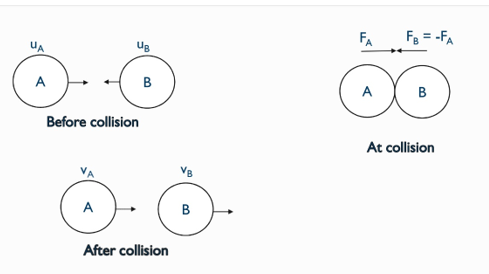
From Newton’s third law
FA = - FB
From the 2nd law
mA aA = -mB aB
The equation for conservation of momentum becomes:
mA vA - mA uA = -(mB vB - mB uB)
mAuA + mB uB = mA vA + mB vB
1.3.1 Examples
1. A ball P of mass 0.25kg loses one-third of its velocity when it makes a head-on collision with an identical ball Q at rest. After the collision, Q moves off with a speed of 2ms-1 in the original direction of P. Calculate the initial velocity of P.
2. An arrow of mass 0.3kg is fired with a velocity of l0m/s into a wooden block of mass 0.7kg. Calculate the final K.E. after impact, given that the wooden block can freely move.
3. A sub machine gun of mass 20kg fires a bullet of mass l00g due South with a velocity of 250ms-1. What is the recoil velocity of the gun?
4. COLLISION
A collision occurs when two or more objects come into contact with each other and exchange energy or momentum. There are two principal types of collisions – the elastic and the inelastic collisions.
1.4.1 Elastic collision
In an elastic collision, the total kinetic energy of the colliding objects is conserved. This means that the objects bounce off each other without any loss of kinetic energy. Thus on such collision, both the momentum and the kinetic energy are conserved.
In a perfectly elastic collision, relative speed of approach = relative speed of separation.
Let us consider two bodies of masses m1 and m2 moving with initial velocities u1 and u2 before collision and with final velocities v1 and v2 after collision in the same direction. If the collision is perfectly elastic, we can write two equations from the principles of conservation of momentum and conservation of kinetic energy. Hence
m1u1 + m2u2 = m1v1 + m2v2
½m1u12 + ½m2u22 = ½m1v12 + ½m2v22
Two examples of collisions that are often very nearly perfectly elastic are the collisions of billiard balls and of molecules and atoms. In a perfectly elastic head-on collision between two bodies, the relative velocity of the two bodies is unchanged in magnitude but reversed in direction.
1.4.2 Inelastic collision
In an inelastic collision, the kinetic energy decreases after collision but the momentum is still conserved. The colliding bodies stick together and move as a unit after collision. This means that the velocities of the two bodies after collision are
v1 = v2 = v
from conservation of linear momentum, we have
m1u1 + m2u2 = m1v1 + m2v2 = (m1 + m2)v
the kinetic energy of the system before collision is given by
KE1 = ½m1u12 + ½m2u22
And after collision, the kinetic energy is
KE2 = ½m1v12 + ½m2v22 = ½(m1 + m2)v2
For a completely inelastic collision, the kinetic energy before collision is greater than the kinetic energy after collision.
1.4.3 Examples
1. A bullet of mass 120g is fired horizontally into a fixed wooden block with a speed of 20ms-1. The bullet is brought to rest in the block in 0.1s by a constant resistance. Calculate the
(i) magnitude of the resistance.
(ii) distance moved by the bullet in the wood
2. A tractor of mass 5.0 x 10³kg is used to tow a car of mass 2.5 x 10³kg. The tractor moved with a speed of 3.0ms-1 just before the towing rope becomes taut. Calculate the
(i) speed of the tractor immediately the rope becomes taut.
(ii) loss in KE of the system just after the car has started moving.
(iii) impulse in the rope when it jerks the car into motion.