1. Definition of Sound
| Site: | Newgate University Minna - Elearning Platform |
| Course: | Communication in English |
| Book: | 1. Definition of Sound |
| Printed by: | Guest user |
| Date: | Saturday, 4 April 2026, 5:06 PM |
Table of contents
- 1. INTRODUCTION
- 2. CLASSIFICATION OF ENGLISH SOUNDS
- 3. MONOTHONGS AND THEIR PRONUNCIATION GUIDE SYMBOLS APPROX. SCHEME KEY WORDS
- 4. DIPHTHONG
- 5. THE THREE CARDINAL THINGS EACH TO BEAR IN MIND WHILE DISCUSSING VOWEL AND CONSONANT SOUNDS
- 6. CLASSIFICATION OF THE CONSONANTS
- 7. CONSONANT SOUNDS AND THEIR PRONUNCIATION GUIDE
- 8. SOUND CONTRAST
- 9. SPEECH ORGANS AND THEIR FUNCTIONS
1. INTRODUCTION
Phonemes are set of sounds used in a particular language. We use Letters in writing but pronounce sound as a set of phonetic symbol which came from a Letter. English language has 26 alphabets which metamorphosed to 44 sounds, which are broadly divided into two classes – VOWEL and consonant sounds.
DEFINITION OF SOUND
Sound could be defined as wave in motion. It is an acoustic vibration. It is an organised noise since is taken to mean an irritating and uncoordinated sound. In a layman’s notion, sound is anything we hear.2. CLASSIFICATION OF ENGLISH SOUNDS
We should note that the term Phonology means the classification and study of sound system of a language while Phonetics is the study of the production or articulation of sound. English language is classified into Vowel and Consonant sound.
ENGLISH PHONEMES
Phonemes are set of sounds used in a particular language. English sounds are broadly divided in to two- vowel and consonant and they are forty four (44) in number. There are 20 vowels which are divided into two camps: Monothongs and Diphthong. Monothongs are those represented by a single phonetic symbol and are pronounced as a unit of sound. Within the monothongs, we have Short and Long vowels. The Long vowels have colon (:) attached to them while the short do not have colon. Monothongs are twelve (12) in number. Diphthongs are those sounds that are represented by two phonetic symbols but are pronounced as a single unit of sound. The tongue moves (glide) from pronouncing one sound to the second sound. They are eight in number.3. MONOTHONGS AND THEIR PRONUNCIATION GUIDE SYMBOLS APPROX. SCHEME KEY WORDS
1. ee been, people, machine
2. e pin, babies, pretty, build
3. eh hen, bread, many, bury,
4. eh cat, cattle, man, panic,
5. ah cut, touch, blood, son,
6. aah car, heart, last, park,
7. or lock, squash, gone,
8. oor torn, raw, court, walk,
9. uh put, wolf, good, would,
10. uuh food, who, group, true,
11. ehr girl, bird, word, nurse,
12. eh adjust, colour, mother,
4. DIPHTHONG
1. eh e make, stay, eight,
2. ah e buy, high, climb, ride
3. eh uh go, sow, though, foe,
4. or e e boy, coil, noise, joy,
5. ah uh owl, now, town, round,
6. e eh cheer, yea, weird,
7. eh eh fair, care, their, where,
8. uh eh poor, sure, tour, during
5. THE THREE CARDINAL THINGS EACH TO BEAR IN MIND WHILE DISCUSSING VOWEL AND CONSONANT SOUNDS
1. VOWEL: These include: Height of the tongue, Shape of the Lip and the Movement of the Jaw. The height of the tongue include: the Tip, Central and the Back. The Shape of the Lips include: Rounded, Spread, Protruded and Close. The Movement of Jaw has to do with the Jaw moving either up or down when a sound is pronounced.
CONSONANT: These include: Place of Articulation, Manner of Articulation and State of Glottis. The Place of Articulation shows where the organs meet, this could be complete or partial obstruction. The Manner of Articulation tells us how the organs meet, and the name of the sound so produced. The State of Glottis, tells us about the state of vocal cord when a sound is produced. That is if the vocal cord vibrates or not. When it vibrates, the sound is said to be voiced and voiceless when the vocal does not vibrate.6. CLASSIFICATION OF THE CONSONANTS
|
Manner of articulation |
State of the glottis |
Place of Articulation |
|
|
Voiceless |
Voiced |
||
|
STOP (PLOSIVE) |
p t k |
b d g |
BILABIAL ALVEOLAR VELAR |
|
FRICATIVE |
f θ s ʃ h |
v
x ʒ |
LABIO-DENTAL DENTAL ALVEOLAR PALATO-ALVEOLAR GLOTTAL |
|
AFFRICATE |
ʧ |
ʤ |
PALATO-ALVEOLAR |
|
LATERAL |
|
L |
ALVEOLAR |
|
LIQUID (ROLL) |
|
R |
ALVEOLAR |
|
SEMI-VOWEL |
|
w j |
BILABIAL PALATAL |
|
NASAL |
|
m n Ƞ |
BILABIAL ALVEOLAR VELAR |
7. CONSONANT SOUNDS AND THEIR PRONUNCIATION GUIDE
1. /p/ pack, shippers, wrap
2. /b/ robber, ebb, brew
3. /t/ ten, ritten, brew,
4. /d/ dog, elder, feed,
5. /k/ duck, come, cheque,
6. /g/ goat, eeg, bigger,
7. /f/ fee, effert, rough, phrase
8. /v/ verb, over, wave, off,
9. /o/ thick, with, worth,
10. /δ/
that, bathe, father, δ
11. /s/ sell, advice, juice, walk
12. /z/ zoom, rose, reason, wise,
13. /s/ fish action, patient
14. /3/ leisure, vision, prescient
15. /h/ House, who, behind,
16. /ts/ Charm, watch, culture,
17. /d3/ Jug, rage, suggest, soldier,
18. /m/ Man, room, name, common
19. /n/ Nose, rain, famine
20 // Bring, earring think, bang,
21 /l/ Life, double, dull,
22 /r/ Rise, errand, ferry
23 /j/ Youth, yam, yes, use,
24 /w/ Well, queen, require,
8. SOUND CONTRAST
SOUND CONTRAST (vowel and consonant) sound contrast is when there is a slight difference in sound of two closely related words. Two different sounds can cause slight difference in words that have almost the same spelling.
VOWEL
/e/ /ae/
Bet bat
Then than
Leg lag
/Λ/ /D/ /ae/
hut hot hat
Cut cot cat
Sung song sang
/i/ /I:/
sit seat
rid read
bid bead
/u/ /u:/
foot food
could cooled
full fool
/):/ /3:/
ward word
born burn
torn turn
end earned
yen yearn
debt dirt
CONSONANT
/p/ /b/
pad bad
park bark
pet bet
bin nib
ban nab
bomb mob
/t/ /g/
ten den
tug dug
team deem
/t/ /g/
cane gain
call gall
cold gold
/f/ /v/
fine vine
fast vast
fan va9. SPEECH ORGANS AND THEIR FUNCTIONS
Speech organs are part of mouth content and other organs used in producing sounds of any given language. The sound system makes use of different organs for different sounds. In consonant sounds, two organs must come in contact to block the flow of air but there is always a free flow of air in the production of vowel sounds.
DIAGRAMME OF SPEECH ORGAN
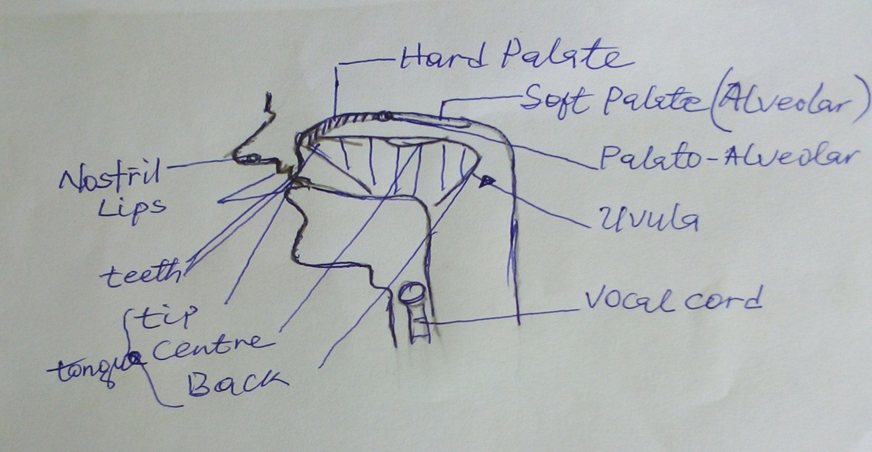
FUNCTIONS OF THE ORGANS ACCORDING TO THEIR NUMBER
1. Nostril - when the mouth is closed by upper and lower lips, thus blocking the free flow of air, the only way for air to escape is through the nose. So, nostril is used in producing nasal sounds /n,m, /.
2. Lips - the upper and the lower lips are important in sounds production. When the two come in contact, Plosive or Stop sounds are produced /p,b,m,w/. The shape of lips is also important in production of vowel sounds. It could be: rounded, spread, neutral and protruded, depending on vowel sound involved. When the upper teeth come in contact with the lower lip, the sounds produced are labio-dental sounds /f/ and /v/.
3. Teeth – that is, the upper and the lower teeth are used for production of Dental sounds when the two come in contact, i.e. / , 0/.
4. Tongue à tongue is divided into three parts and each part in used for the production of different type of sounds. Tongue is more used in the production of vowel sounds. The height of tongue also conditions the type of vowel sounds produced.
5. Alveolar - The tip of the tongue touches the Alveolar regions to produce the Alveolar sounds /t,d,s,z,l,n/. When the tip of the tongue touches the junction between the Alveolar and hard Palate, the sounds produced are called Palato-alveolar /3,d3/. Alveolar is directly behind the upper teeth.
Back of tongue produces /u, u;/ vowel sounds.
6. Hard Palate or Palate: this follows the Alveolar region. The central part of the tongue touches there to produce central vowel sound. There is no actual contact there but there is an approximation of it in vowel sound production. Example of vowel sounds /,3:,^/. Palate is also used in producing a semi vowel sound /j/ called palatal.
7. Uvula—this is used in production of velar sound when the back of tongue touches there /k, g, j/.
Vocal track- this houses the vocal cord which states the type of sounds produced i.e whether the sound is voiced or voiceless. When the vocal cord vibrates when any sound is produced, the sound is called Voiced. When it does not vibrate, it is Voiceless. All the vowel sounds are Voiced.