INTRODUCTION TO COMPUTER SCIENCE
| Site: | Newgate University Minna - Elearning Platform |
| Course: | Introduction to Computer Science |
| Book: | INTRODUCTION TO COMPUTER SCIENCE |
| Printed by: | Guest user |
| Date: | Sunday, 12 July 2026, 12:15 AM |
Table of contents
- 1. A BRIEF HISTORY OF COMPUTING: FROM ABACUS TO AI
- 2. The Era of Mobile Computing and Artificial Intelligence (Present - Future):
- 3. HISTORY OF COMPUTER
- 4. KEY COMPONENTS
- 5. First Generation Computers [1945 Up To 1955] Characteristics of first generation.
- 6. Characteristics of 2nd and 3rd Generation Computers
- 7. 4th and 5th Generation Computers
1. A BRIEF HISTORY OF COMPUTING: FROM ABACUS TO AI
Our journey through the history of computing takes us from simple tools for counting to the complex machines that power our modern world. Let's explore some key milestones:
Early Counting Tools (3000 BC - 1600s):
Abacus: This ancient device, still used in some parts of the world, uses beads to perform basic arithmetic operations.
Mechanical Calculators (17th - 19th Centuries):
Slide Rule: This manual device, invented in the 1600s, performs calculations using scales. Difference Engine (1822): Designed by Charles Babbage, this mechanical calculator aimed to create mathematical tables automatically. (Though never fully built, it laid the groundwork for future machines.)
The Dawn of Programmable Machines (19th Century):
Analytical Engine (1837): Another invention by Babbage, this machine is considered the conceptual forerunner of modern computers. It could perform various operations and store data, using punched cards for programming.
Ada Lovelace (1815-1852): Often referred to as the "first computer programmer," she wrote instructions (algorithms) for the Analytical Engine, demonstrating its potential.
The Shift to Electromechanical and Electronic Computing (Early 20th Century):
Mark 1 (1937): Built by Harvard University, this electromechanical computer used punched cards and relays for calculations.
ENIAC (1945): The Electronic Numerical Integrator and Computer, built for the US Army during WWII, was the first general-purpose electronic digital computer. It offered significant speed and processing power compared to its mechanical predecessors.
The Rise of Modern Computers (Mid-20th Century - Present):
Transistors (1947): The invention of the transistor revolutionized computing. These tiny, solid-state devices replaced bulky vacuum tubes, making computers smaller, faster, and more reliable.
Integrated Circuits (ICs) or Microchips (1950s): The ability to integrate multiple transistors onto a single chip further miniaturized computers and increased their processing power. This paved the way for the development of personal computers (PCs).
Personal Computers (1970s - Present): The introduction of affordable PCs like the Apple II and the IBM PC in the 1970s brought computing power to personal use. This era also saw the development of graphical user interfaces (GUIs) and the rise of the internet, which drastically transformed how we interact with computers.2. The Era of Mobile Computing and Artificial Intelligence (Present - Future):
The rise of smartphones and tablets: These powerful mobile devices have become an extension of ourselves, offering computing capabilities on the go.
Artificial Intelligence (AI): Advancements in AI are changing the landscape of computing. AI algorithms are now capable of complex tasks like facial recognition, natural language processing, and even self-driving cars.
Computer: A computer is basically defined as a tool or machine used for processing data to give required information.
A computer is an electronic device (machine) that accepts inputs (data), performs calculations, processes and manipulates your inputs, stores and outputs them (displays).
It is capable of:
- taking input data through the keyboard (input unit),
- storing the input data in a diskette, hard disk or other medium,
- processing it in the central processing unit (CPU) and
- giving out the result (output) on the screen or the Visual Display Unit (VDU).
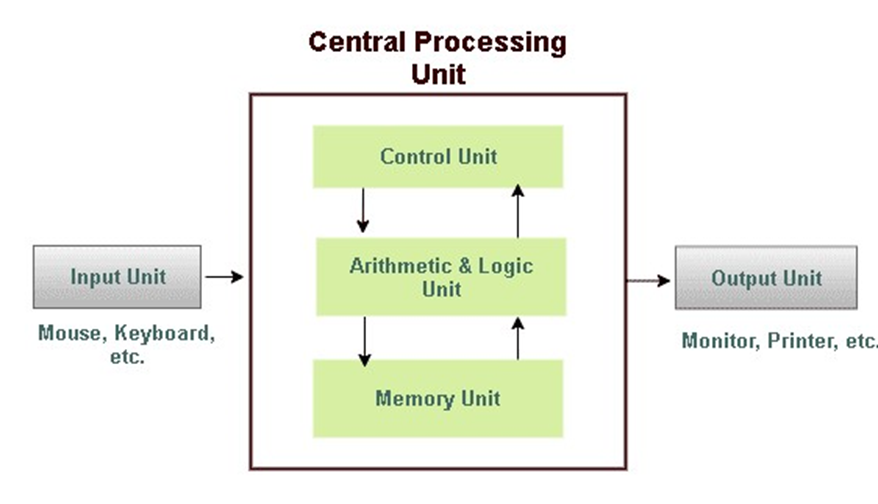
Fig. 1: A schematic block to diagram of a computer
Characteristics of a Computer
1) Speed: The computer can manipulate large data at incredible speed and response time can be very fast.
2) Accuracy: Its accuracy is very high and its consistency can be relied upon. Errors committed in computing are mostly due to human rather than technological weakness. There are in-built errors detecting schemes in the computer.
3) Storage: It has both internal and external storage facilities for holding data and instructions. This capacity varies from one machine to the other. Memories are built up in K (Kilo) modules where K=1024 memory locations.
4) Automatic: Once a program is in the computer‘s memory, it can run automatically each time it is opened. The individual has little or no instruction to give again.
5) Reliability: Being a machine, a computer does not suffer human traits of tiredness and lack of concentration. It will perform the last job with the same speed and accuracy as the first job every time even if ten million jobs are involved.
6) Flexibility: It can perform any type of task once it can be reduced to logical steps. Modern computers can be used to perform a variety of functions like on-line processing, multi- programming, real time processing etc.
3. HISTORY OF COMPUTER
Until the development of the first generation computers based on vacuum tubes, there had been several developments in the computing technology related to the mechanical computing devices. The key developments that took place till the first computer was developed are as follows—
- Calculating Machines ABACUS was the first mechanical calculating device for counting of large numbers. The word ABACUS means calculating board. It consists of bars in horizontal positions on which sets of beads are inserted. The horizontal bars have 10 beads each, representing units, tens, hundreds, etc.
- Napier’s bones was a mechanical device built for the purpose of multiplication in 1617 ad by an English mathematician John Napier.
- Slide Rule was developed by an English mathematician Edmund Gunter in the 16th century. Using the slide rule, one could perform operations like addition, subtraction, multiplication and division. It was used extensively till late 1970s. Figure 1.2 shows a slide rule.
Figure 1.2 Slide rule
- Pascal’s Adding and Subtraction Machine was developed by Blaise Pascal. It could add and subtract. The machine consisted of wheels, gears and cylinders.
- Leibniz’s Multiplication and Dividing Machine was a mechanical device that could both multiply and divide. The German philosopher and mathematician Gottfried Leibniz built it around 1673.
- Punch Card System was developed by Jacquard to control the power loom in 1801. He invented the punched card reader that could recognize the presence of hole in the punched card as binary one and the absence of the hole as binary zero. The Os and 1s are the basis of the modern digital computer.
4. KEY COMPONENTS
1. The store: A memory wheel consisting of set of counter wheels
2. The mill: An arithmetic unit capable of performing the four basic arithmetic
3. Operations. It operated on pairs of mechanical registers and produced a result stored in another register, all of which were located in the store.
4. Operation cards: These cards selected one of the four arithmetic operations by activating the mill to perform the selected function.
5. Variable cards: These cards selected the memory locations to be used by the mill for a particular operation ( a source of operand and the destination of the result ).
6. Output: was to print or a card punch device.
- Herman Hollerith’s Tabulating Machine
Herman Hollerith was a statistician, in 1880; he developed the tabulating machine commissioned by the U.S. Census Bureau.
Mark I: Developed by Howard Aiken at Harvard University in 1944, Mark I, was the first electromechanical computer. Instructions were provided by means of punched paper tape, which combined the functions of Babbage‘s operation cards and variable cards. Each instruction had the format: A1 A2 OP , where A1 and A2 are registers storing the operands and OP is the operation to be performed( e.g. +,-,x,%). Mark I, was able to do a single addition in 6 seconds and division in 12 seconds.5. First Generation Computers [1945 Up To 1955] Characteristics of first generation.
Use of vacuum tubes in electronic circuits. These tubes controlled internal operation of computers and they were very huge/ large.
1. As a result of vacuum tubes the first generation computers were very huge/large or enormous and they occupied entire large rooms.
2. They used magnetic drums as memory.
3. They had a limited main storage capacity.
4. They were slow in input and output speed.
5. They used punched cards for input and output.
6. Programming was done in machine language.
7. They were expensive to buy and operate.
8. They generated a lot of heat.
9. They required much air conditioning to cool them.
10. They required a lot of electricity (high power consumption).
Examples of 1st Generation Computers
• Electronic numerical integrator and calculator (ENIAC). It was the 1st generation computer by John Eckert and John Marchy.
• Electronic delay storage automation computer (EDVAC) developed by mu wilts at conlondge university in 1949
• Universal Automatic computer (UNIUAC) John Eckert and Muchy produced it in 1951 by universal accounting setup. Limitation of 1st Generation Computers 1. The operation speed was very low.
2. The power consumption was very high.
3. It required a large space for installation.
4. Limited primary memory.
5. Generated a lot of heat.
6. They were very heavy. (They weighed about up to 30tonnes).
Its programming ability was quite low. 2nd Generation Computer6. Characteristics of 2nd and 3rd Generation Computers
1. They used transistors for internal operations. Transistors replaced the vacuum tubes in the 1st generation computers
2. Magnetic core memory replaced the magnetic scrums as memory. Increase in main primary memory storage capacity up to 22 kilobytes of ram memory.
3. They were faster in input and output process
4. High level programming language e.g. COBOL (common business oriented language), FORTRAN (formula translator)
5. Introduction of super computers eg liver more automatic research computer (LABC) and IBM 7030
6. Magnetic tapes and disks replaced punch cards for exterior storage.
7. Computer became less expensive.
8. They generated less heat.
9. They had increased speed and reliability.
Some of the Computers In The 2nd Generation
• LDC 2600
• UNIVAC-111
• IBM-1600 Series
• IBM-1400 Series
3rd Generation Computers
Characteristics of 3rd Generation Computers
1. Use of integrated circuited. They use of integrated circuits replaced transistors of the second generation machines.
2. The software industry evolves during this time.
3. Emergence of microcomputers.
4. Introduction of operating systems.
5. Simple programming language. e.g. BASIC.
6. Low costs as compared to the 1st and 2nd generation computers.
7. Increased friendliness
8. Small in size as compared to the 1st and 2nd generation computers. Computers reduced in size.
9. Increase in memory capacity as compared to the 1st and 2nd generation computers.
Generation of less heat as compared to the 1st and 2nd generation computers.7. 4th and 5th Generation Computers
Characteristics of 4th Generation Computers
1. Introduction of microprocessors (100th of integrated circuits were built into a single silcon chip.
2. Use of large scale integrated circuits.
3. Increased storage capacity and speed.
4. Special application programmers were introduced.
5. Increased use of minicomputers and microcomputers.
6. Development of graphics user interface.(GUI), the mouse, application mathematical modeling and simulation, electric fund transfer computer, aided instructions etc.
7. Computers became more powerful and cheap enough that schools,homes and offices were able to purchase them.
Examples of 4th generation computers IBM =2033 Series.
• IBM 4200 Series.
• Pentium series like 1, 2, 3 and 4.
5th Generation Computers
Characteristics of 5th Generation Computers
1. The speed is extremely high in 5th generation computers.
2. They can perform parallel processing.
3. The concept of artificial intelligence has been introduced.
4. Extra-large scale integration are introduced.
5. They are also used in nuclear, science and space technology.
6. They have more than on processor.
7. They have a high speed of accuracy and reliability.
8. Smaller and high storage memory of data for a long time.
9. Expert systems, robots and natural language processor.
10. High sophisticated operating system.
SUMMARY
• Computer is an electronic device which accepts data as input, performs processing on the data, and gives the desired output. A computer may be analog or digital computer. Speed, accuracy, diligence, storage capability and versatility are the main characteristics of computer.
• The computing devices have evolved from simple mechanical machines, like ABACUS,
Napier‘s bones, Slide Rule, Pascal‘s Adding and Subtraction Machine, Leibniz‘s
Multiplication and Dividing Machine, Jacquard Punched Card System, Babbage‘s
Analytical Engine and Hollerith‘s Tabulating Machine, to the first electronic computer. Charles Babbage is called the father of computer.
• The evolution of computers to their present state is divided into five generations of computers, based on the hardware and software they use, their physical appearance and their computing characteristics.
• First generation computers were vacuum tubes based machines. These were large in size, expensive to operate and instructions were written in machine language. Their computation time was in milliseconds.
Second generation computers were transistor based machines. They used the stored program concept. Programs were written in assembly language. They were smaller in size, less expensive and required less maintenance than the first generation computers. The computation time was in microseconds.• Third generation computers were characterized by the use of IC. They consumed less power and required low maintenance compared to their predecessors. High-level languages were used for programming. The computation time was in nanoseconds. These computers were produced commercially.
• Fourth generation computers used microprocessors which were designed using the LSI and VLSI technology. The computers became small, portable, reliable and cheap. The Computation time is in picoseconds. They became available both to the home user and for commercial use.
• Fifth generation computers are capable of learning and self-organization. These computers use SLSI chips and have large memory requirements. They use parallel processing and are based on AI. The fifth generation computers are still being developed.