Writing for the Mass Media
| Site: | Newgate University Minna - Elearning Platform |
| Course: | Editing and Graphics of Communication |
| Book: | Writing for the Mass Media |
| Printed by: | Guest user |
| Date: | Sunday, 4 October 2026, 8:00 PM |
Description
Writing for the Mass Media
The principles of good writing listed in the preceding section apply to any type of writing. The good English theme has much in common with the good news story or the good e-mail to Mom or the informative label on a bottle of aspirin. These pieces of writing have different purposes and different audiences, and they express different ideas. But good writing is good writing.
Writing for the mass media differs from other forms of writing in several respects:
• Subject matter. Writers for the mass media must take on a wide variety of subjects and formats, including news stories, feature stories, advertisements, letters, and editorials.
• Purpose. Writing for the mass media has three major purposes: to inform, entertain, or persuade.
• Audience. Mass-media writing is often directed at a wide audience. This fact dictates not only the subject matter but also the way in which something is written.
• Writing environment. Writing for the mass media often takes place in the presence of others who are doing the same thing. The writing is frequently done under deadline pressure, and several people will often have a hand in writing and editing a particular item for the mass media.
professionalism
Those who want to make a career of writing in a media environment have to
develop personal and professional qualities and skills. One such quality is versatility.
Rarely do media professionals stay with their first job. Even more rarely do their careers involve just one type of writing. Most professionals will have a variety of
jobs throughout their career, and they will be called on to write in various forms
and structures. Developing professional agility will be a valuable asset to anyone
who pursues a writing career. This book will help students learn the basic principles
and techniques of good writing. Students will read about the importance of using
Standard English well and the vital role that a stylebook plays in their daily work.
They will also be introduced to basic forms of writing.
One of the most important forms is the inverted pyramid structure of news
writing. This structure demands that information be presented in order of its
importance rather than in chronological order. The writing must also conform to
certain journalistic conventions, such as attribution and proper identification of
persons mentioned in the story. However, different forms of writing often have
different demands. Writing for audio and video journalism—writing that is written to be heard or seen—emphasizes simplicity and efficiency. Writing effective
advertising copy requires that writers have a facility with the language so that they
can use information to impress or persuade. Writing for public relations calls for
versatility on the part of practitioners; in most public relations jobs, writers must
use the inverted pyramid, good letter-writing structures, and broadcast and advertising techniques. Writing for the World Wide Web combines all of these structures,
techniques, and forms. However, the Web has evolved into a different medium
from print or broadcasting and may require the writer to use different forms and
approaches in presenting information.
Beyond the technical requirements of the professional writer is an overriding
personal quality—honesty. There is an ethical dimension to writing for an audience
that we will deal with more extensively in later chapters, but it needs mentioning here. The professional writer has an ethical responsibility to be honest with
an audience. That is, the writer must present accurate information in an accurate
context. The writer should reveal any personal biases or connections to the information that are important for an audience’s consideration. The audience has offered its
time and attention to the writer in exchange for an honest and efficient rendering
of the information and ideas the writer has. That bargain should be honored by the writer in all instances.
1. Application of news values in story writing.
News Values
Journalists commonly use six values to determine how newsworthy a story or elements of a story are. Knowing the news values can help a journalist make many decisions, including:
• What information to give first in a news article, and in the lede(LEADS)
• Which articles to display on a newspaper’s front page
• What questions to ask in an interview
The six news values are:
1. Timeliness- Recent events have a higher news value than less recent ones.
2. Proximity- Stories taking place in one’s hometown or community are more newsworthy than those taking place far away.
3. Prominence- Famous people and those in the public eye have a higher news value than ordinary citizens.
4. Uniqueness/oddity- A story with a bizarre twist or strange occurrences. “Man bites dog” instead of“dog bites man.”
5. Impact- Stories that impact a large number of people may be more newsworthy than those impacting a smaller number of people.
6. Conflict- “If it bleeds, it leads.” Stories with strife, whether it’s actual violence or not, are more interesting.
The newsworthiness of a story is determined by a balance of these six values. There is no set formula to decide how newsworthy a story is, but in general, the more of these six values a story meets, the more newsworthy it is.
Libel
Libel is defined as the published defamation of a person’s character based on misleading or inaccurate facts. Newspaper reporters can often run into issues of libel because it is their job to write truthful articles about people that might not always be flattering.
Even though we live in a country with a free press, journalists cannot write anything they want. Reporters do not have the right to state something about a person that could damage their reputation and that is untruthful.
One of the easiest ways to protect oneself from libel is to make sure to always do accurate reporting and to attribute all information in an article. If you write something about someone that you’re unsure about, just ask yourself if it’s true, and how you know it’s true. Rumors, gossip, and information you received from an anonymous or unreliable source are all dangerous to report, and they could run you the risk of a libel case.
Lede
The lede (or lead) of a news article is the first sentence, usually written as one paragraph, that tells the most
important information of the story. When writing a lede, it is helpful to use the “tell a friend” strategy. Imagine you
had to sum up to a friend, in one sentence, what your story is about. How would you sum up quickly what
happened? A story’s lede answers the “Five W’s” in a specific order: Who? What? When? Where? Why?
For example:
The Atlanta Police Department will hold a memorial service Wednesday at Holy Christ Church in Buckhead
for fallen officer Lt. James Montgomery.
WHO: The Atlanta Police Department
WHAT: will hold a memorial service
WHEN: Wednesday
WHERE: Holy Christ Church in Buckhead
WHY: for fallen officer Lt. James Montgomery
Other examples (courtesy of the Atlanta Journal-Constitution):
Gwinnett County Public Schools was awarded $250,000 early Wednesday as a finalist for what’s considered
the Nobel Prize of public education.
A man beat an Army reservist in front of a Morrow Cracker Barrel, yelling racial slurs at her as he kicked her
in the head, Morrow police said.
Inverted Pyramid
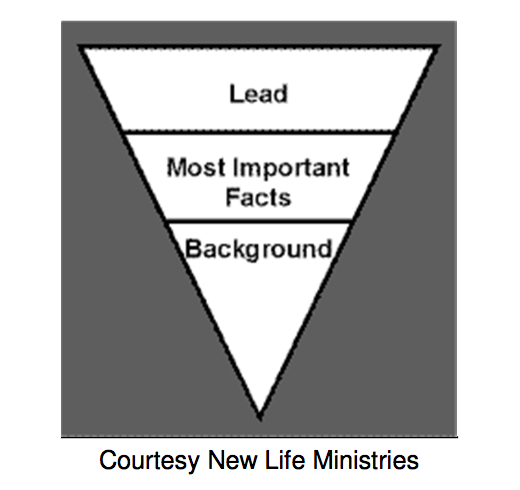
News articles are written in a structure known as the “inverted pyramid.” In the inverted pyramid format, the most newsworthy information goes at the beginning of the story and the least newsworthy information goes at the end.
After you have written your story’s lede, order the information that follows in terms of most important to least
important. There is NO formal conclusion in a journalism article the way there is in an essay or analysis paper.
Attributing information
ALL information in a news article MUST be attributed to the source where the reporter got his/her information.
The reporter must indicate in his/her article where material was obtained from – from an interview, court
documents, the Census, a Web site, etc. Direct quotes and paraphrasing can be used to attribute information
obtained in an interview with a source.
For example:
According to a police report, the suspect threatened the cashier with a gun before running away with the
money.