Urine Formation Processes
| Site: | Newgate University Minna - Elearning Platform |
| Course: | Renal and Body Fluids Physiology |
| Book: | Urine Formation Processes |
| Printed by: | Guest user |
| Date: | Saturday, 14 November 2026, 11:03 AM |
Description

1. Urine Formation Processes
- Most substances in the plasma except for proteins and blood cells are freely filtered into the Bowmans capsule.
- The filtrate is modified by tubular reabsorption of water and some solutes into capillaries and by secretion of other substances from the peritubular capillaries into the tubule
- Urinary excretion rate of a substance = Glomerular filtration rate - tubular reabsorption rate + tubular secretion rate.


a. Filtration- Water & solutes smaller than proteins are forced through the capillary walls and pores (of the glomerulus) into the renal tubule (Bowman’s capsule).
b. Reabsorption- Water, glucose, amino acids & needed ions are transported out of the filtrate into the peritubular capillary cells and then enter the capillary blood.
c. Secretion- Hydrogen ions, Potassium ions, creatinine & drugs are removed from the peritubular capillaries (blood) and secreted by the peritubular capillary cells into the filtrate.
1.1. Glomerular Filtration
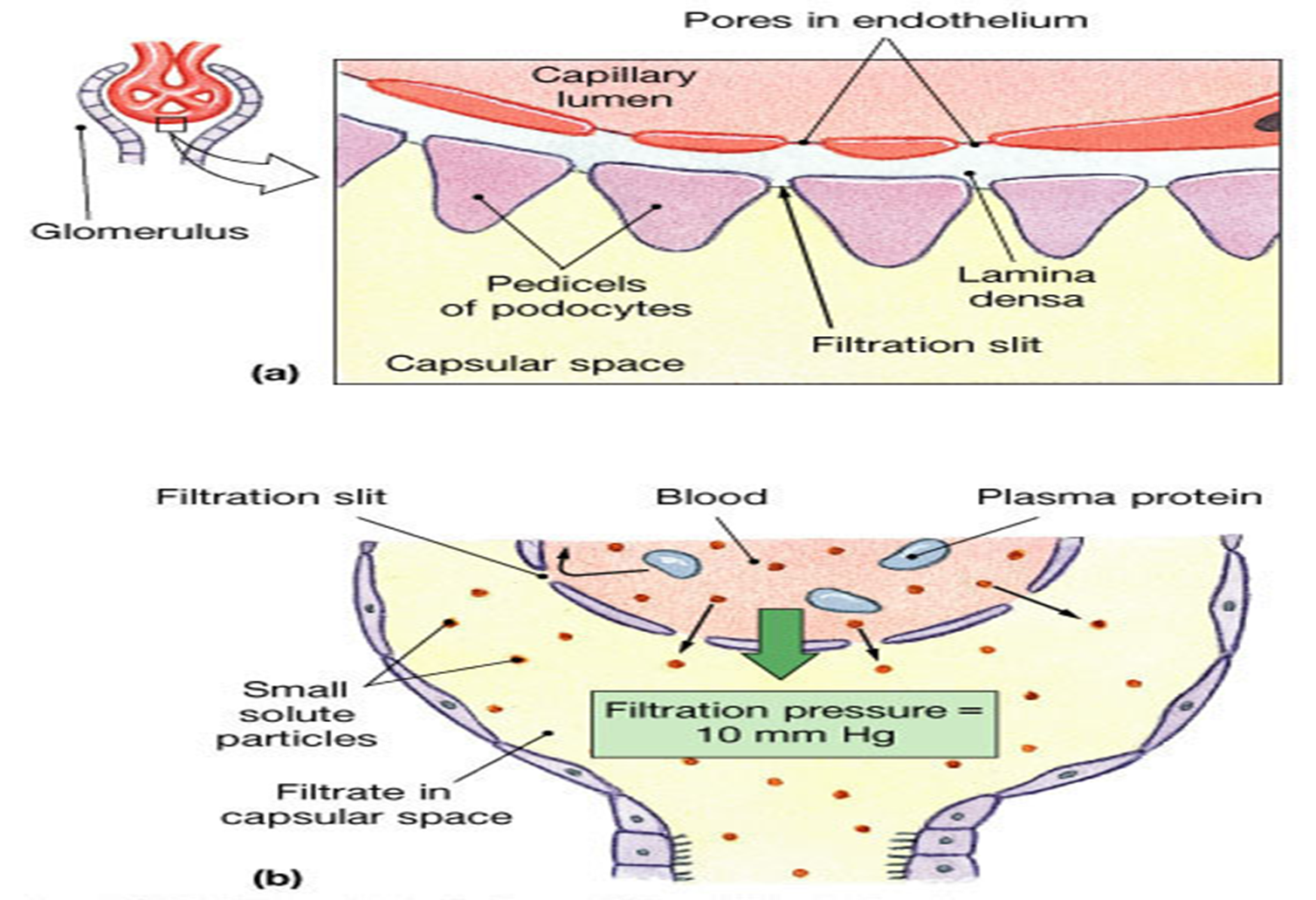
- Glomerular filtration is a special case of the capillary fluid exchange process in which water and some solutes in the blood plasma pass from the capillaries of the glomerulus into the capsular space of the nephron through the pedicels of the podocytes.
- It is a nonselective passive process and constitutes the first step of urine formation

- This term reflects the fact that the glomerular filtration barrier is an extremely fine molecular sieve that allows the filtration of small molecules but restricts the passage of macromolecules (e.g., the plasma proteins).
- The glomerular filtrate normally takes an extracellular route, through holes in the endothelial cell layer, the basement membrane, and the pores between adjacent podocytes.
- The glomerular capillaries are relatively impermeable to proteins, so that the filtered fluid (glomerular filtrate) is essentially protein-free and devoid of cellular elements, including red blood cells.
- Everything else is filtered into the nephron
- As a result, glomerular filtrate is a plasma like fluid (an ultrafiltrate of plasma) in terms of salts and organic molecules concentration.
- Exceptions to this generalization include a few low-molecular-weight substances, such as calcium and fatty acids, that are not freely filtered because they are partially bound to the plasma proteins.
- The fluid that enters the
capsular space is called the
glomerular filtrate.
- On average, the daily volume of glomerular filtrate in adults is 150 liters in females and 180 liters in males.
- More than 99% of the glomerular filtrate returns to the bloodstream via tubular reabsorption, so only 1–2 liters are excreted as urine.
- The fraction of blood plasma in the afferent arterioles of the kidneys that becomes glomerular filtrate is the filtration fraction.
1.2. Filtration Pressure
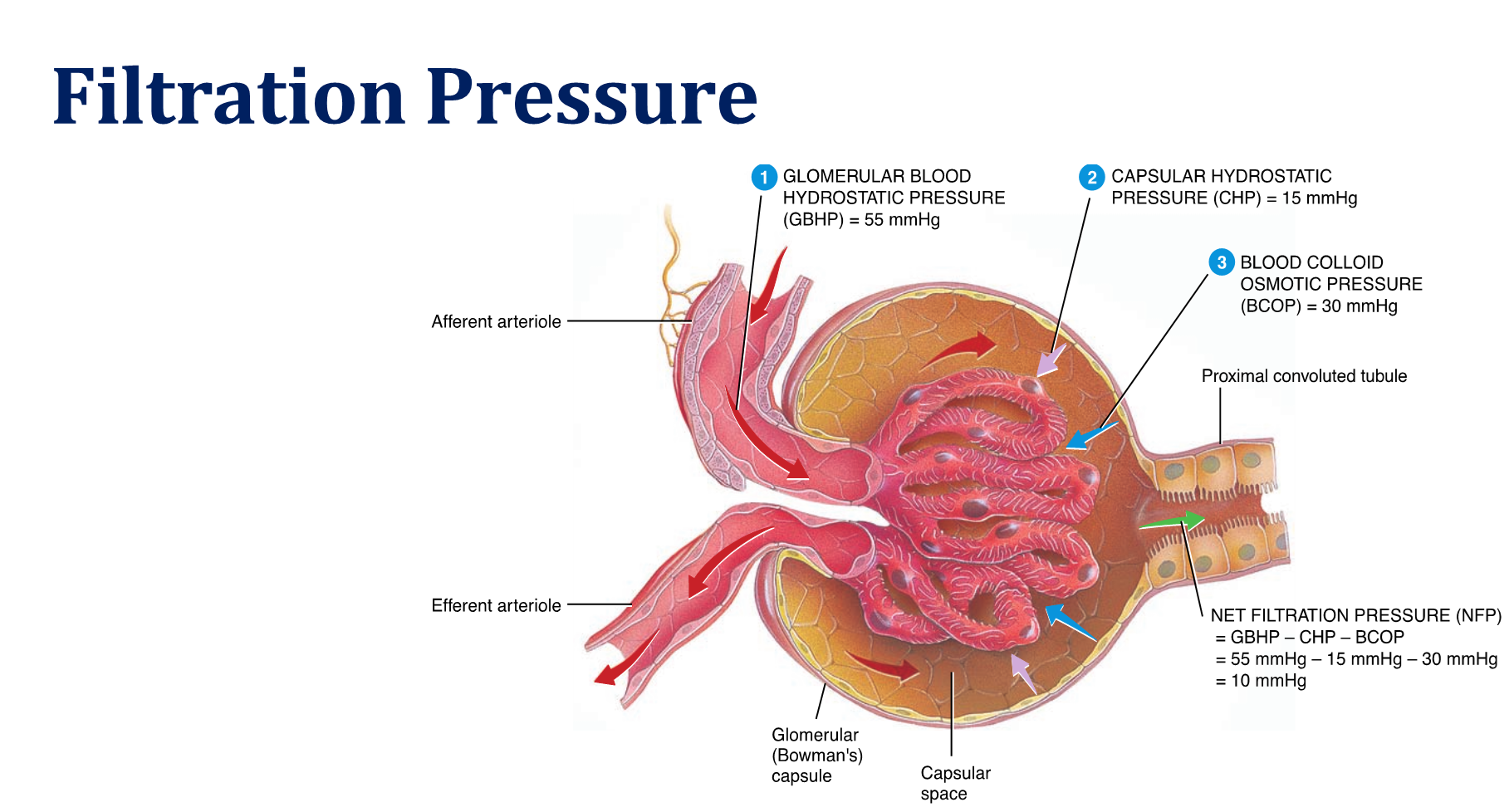
Glomerular filtration depends on three main pressures. One pressure promotes filtration and two pressures oppose filtration.
1. Glomerular Blood
Hydrostatic Pressure (GBHP), which is the main
driving force, depends on the systemic
arterial blood pressure, afferent and efferent
arteriolar resistance.
- GBHP is the blood pressure in glomerular capillaries.
- Generally, GBHP is about 55 mmHg compared to 10 to 15 in most other capillaries).
- Because afferent arteriole is larger than efferent arteriole
- Larger inlet and smaller outlet
- It promotes filtration by forcing water and solutes in blood plasma through the filtration membrane.
2. Capsular hydrostatic
pressure (CHP) is the hydrostatic pressure
exerted against the filtration membrane by fluid already in the capsular space
and renal tubule.
- CHP opposes filtration and represents a “back pressure” of about 15 mmHg.
- Due to high filtration rate and continual accumulation of fluid in the capsule
3. Blood colloid
osmotic pressure (BCOP), which is due to the presence of proteins such as albumin,
globulins, and fibrinogen in blood plasma. BCOP also opposes filtration.
- The average BCOP in glomerular capillaries is 30 mmHg.
- Net filtration pressure (NFP), the total pressure that promotes filtration, is determined as follows:
- Net Filtration Pressure (NFP) = GBHP - [CHP + BCOP]
- By substituting the values given in the previous slides, normal NFP may be calculated:
- NFP = 55 mmHg - [15 mmHg + 30 mmHg]