Introduction to Transition Metal Chemistry:
| Site: | Newgate University Minna - Elearning Platform |
| Course: | General Chemistry II |
| Book: | Introduction to Transition Metal Chemistry: |
| Printed by: | Guest user |
| Date: | Friday, 18 September 2026, 7:21 PM |
1. What are Transition Elements?
Transition elements (also known as transition metals) are elements that have partially filled d orbitals. IUPAC defines transition elements as an element having a d subshell that is partially filled with electrons, or an element that has the ability to form stable cations with an incompletely filled d orbital.
In general, any element which corresponds to the d-block of the modern periodic table (which consists of groups 3-12) is considered to be a transition element. Even the f-block elements comprising the lanthanides and the actinides can be considered as transition metals.
However, since the f-block elements have incompletely filled f-orbitals, they are often referred to as inner transition elements or inner transition metals. An illustration detailing the position of transition metals on the periodic table along with their general electronic configurations is provided below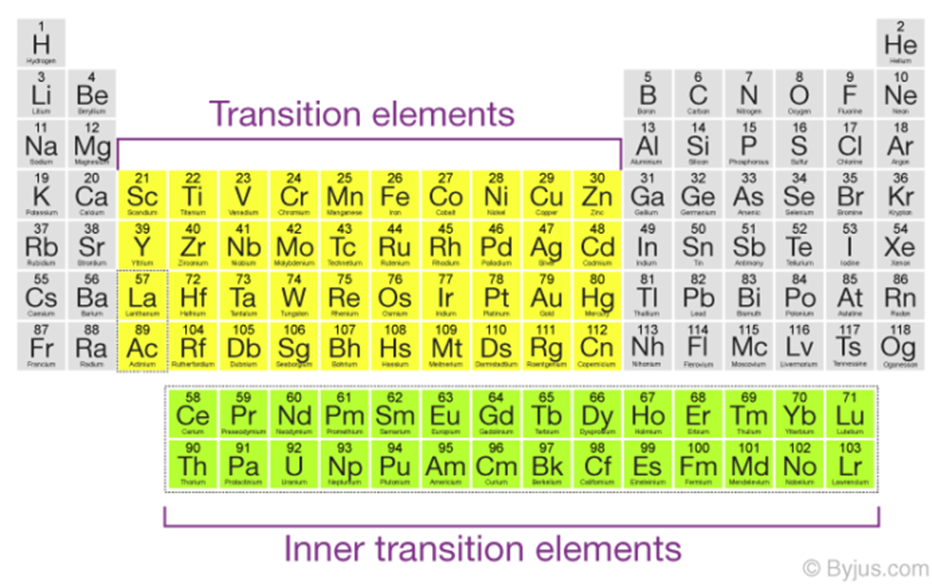
It is important to note that the element’s mercury, cadmium, and zinc are not considered transition elements because of their electronic configurations, which corresponds to (n-1)d10 ns2.
These elements have completely filled d orbitals in their ground states and even in some of their oxidation states. One such example is the +2 oxidation state of mercury, which corresponds to an electronic configuration of (n-1)d10.
1.1. Electronic Configuration of Transition Elements
The list of the first two rows of transition elements with their corresponding electronic configurations is tabulated below. It can be noted that in some of these elements, the configuration of electrons corresponds to (n-1)d5 ns1 or (n-1)d10 ns1. This is because of the stability provided by the half-filled or completely filled electron orbitals.
|
Transition Elements |
Atomic Number |
Electronic Configuration |
|
Sc |
21 |
[Ar] 3d1 4s2 |
|
Ti |
22 |
[Ar] 3d2 4s2 |
|
V |
23 |
[Ar] 3d3 4s2 |
|
Cr |
24 |
[Ar] 3d5 4s1 |
|
Mn |
25 |
[Ar] 3d5 4s2 |
|
Fe |
26 |
[Ar] 3d6 4s2 |
|
Co |
27 |
[Ar] 3d7 4s2 |
|
Ni |
28 |
[Ar] 3d8 4s2 |
|
Cu |
29 |
[Ar] 3d10 4s1 |
|
Zn |
30 |
[Ar] 3d10 4s2 |
|
Y |
39 |
[Kr] 4d1 5s2 |
|
Zr |
40 |
[Kr] 4d2 5s2 |
|
Nb |
41 |
[Kr] 4d4 5s1 |
|
Mo |
42 |
[Kr] 4d5 5s1 |
|
Tc |
43 |
[Kr] 4d5 5s2 |
|
Ru |
44 |
[Kr] 4d7 5s1 |
|
Rh |
45 |
[Kr] 4d8 5s1 |
|
Pd |
46 |
[Kr] 4d10 |
|
Ag |
47 |
[Kr] 4d10 5s1 |
|
Cd |
48 |
[Kr] 4d10 5s2 |
It can be observed that the Aufbau principle is not followed by many transition elements like chromium. The reason for this is believed to be the relatively low energy gap between the 3d and 4s orbitals, and the 4d and 5s orbitals.
1.2. General Properties of Transition Elements
As discussed earlier, the elements zinc, cadmium, and mercury are not considered transition elements since their electronic configurations are different from other transition metals. However, the rest of the d-block elements are somewhat similar in properties and this similarity can be observed along each specific row of the periodic table. These properties of the transition elements are listed below.
- Variable Oxidation States
- Can lose different numbers of d and s electrons → form multiple oxidation states.
- Example: Fe²⁺ (ferrous) & Fe³⁺ (ferric), Cu⁺ & Cu²⁺.
- Formation of Colored Compounds
- d-electrons absorb visible light → produce colored solutions.
- Example:
- Fe²⁺ (pale green)
- Cu²⁺ (blue)
- Cr³⁺ (violet/green)
- Complex Formation
- Readily form coordination complexes with ligands like H₂O, NH₃, Cl⁻.
- Example: [Fe(CN)₆]³⁻, [Cu(NH₃)₄]²⁺.
- Catalytic Properties
- Can provide surfaces or variable oxidation states for catalysis.
- Example: Fe in Haber process, V₂O₅ in Contact process.
- High Melting & Boiling Points
- Strong metallic bonding due to delocalized d-electrons.
- Good Conductors of Heat & Electricity
- Free d-electrons allow conductivity.
- Paramagnetism
- Unpaired d-electrons → magnetic behavior (Fe, Co, Ni strongly magnetic).
The atomic and ionic radii of the transition elements decrease from group 3 to group 6 due to the poor shielding offered by the small number of d-electrons. Those placed between groups 7 and 10 have somewhat similar atomic radii and those placed in groups 11 and 12 have larger radii. This is because the nuclear charge is balanced out by the electron-electron repulsions.

While traversing down the group, an increase in the atomic and ionic radii of the elements can be observed. This increase in the radius can be explained by the presence of a greater number of subshells.
Ionization enthalpy refers to the amount of energy that must be supplied to an element for the removal of a valence electron. The greater the effective nuclear charge acting on the electrons, the greater the ionization potential of the element. This is why the ionization enthalpies of transition elements are generally greater than those of the s-block elements.

In a way, the ionization energy of an element is closely related to its atomic radius. Atoms with smaller radii tend to have greater ionization enthalpies than those with relatively larger radii. The ionization energies of the transition metals increase while moving along the row (due to the increase in atomic number).
These elements also exhibit a wide variety of oxidation states and tend to form compounds that act as catalysts in many chemical processes.
1.3. 3. ROLE IN ORGANIC & INORGANIC CHEMISTRY
A. Inorganic Chemistry Roles
- Formation of Coordination Complexes:
- Eg: [Fe(CN)₆]³⁻ in cyanide poisoning tests.
- Oxidation–Reduction Reactions:
- MnO₄⁻ (permanganate) → strong oxidizing agent.
- Industrial Catalysis:
- Fe in ammonia synthesis (Haber process).
- V₂O₅ in sulfuric acid production (Contact process).
B. Organic Chemistry Roles
- Catalysts in Organic Reactions:
- Pd, Pt in hydrogenation of alkenes (used in making margarine, drugs).
- Ni in cross-coupling reactions.
- Organometallic Compounds:
- Fe(CO)₅, Cr(CO)₆ used in synthesis and as catalysts.
- Electron Transfer Agents:
- Fe²⁺/Fe³⁺ redox pairs in biological systems (cytochromes).
4. MEDICAL & HEALTH SCIENCE CONNECTIONS
✅ Iron (Fe):
- Present in hemoglobin → transports oxygen.
- Iron deficiency → anemia.
✅ Cobalt (Co):
- In Vitamin B₁₂ → essential for red blood cell formation.
✅ Copper (Cu):
- In enzymes like cytochrome oxidase for cellular respiration.
- Deficiency → anemia, bone abnormalities.
✅ Zinc (Zn):
- In enzyme catalysis, wound healing, immune function.
✅ Manganese (Mn) & Chromium (Cr):
- Cofactors in metabolism & glucose regulation.
6. QUICK EXAMPLES OF TRANSITION METAL USES
|
Metal |
Inorganic Role |
Organic/Catalytic Role |
Medical Role |
|
Fe |
Forms Fe²⁺/Fe³⁺ complexes |
Catalyst in Haber process |
Hemoglobin oxygen transport |
|
Cu |
Blue Cu²⁺ complexes |
Catalyst in organic synthesis |
Enzymes (oxidases) |
|
Zn |
Zn²⁺ complexes |
Lewis acid in synthesis |
Wound healing, enzymes |
|
Co |
Forms stable complexes |
Organometallics |
Vitamin B₁₂ |
SUMMARY
- Transition metals are versatile elements with partially filled d-orbitals.
- They show variable oxidation states, colored compounds, complex formation, and catalytic properties.
- They play vital roles in organic/inorganic chemistry AND biological systems (Fe in