MAGNETISM
| Site: | Newgate University Minna - Elearning Platform |
| Course: | General Physics II |
| Book: | MAGNETISM |
| Printed by: | Guest user |
| Date: | Monday, 2 November 2026, 9:30 PM |
1. INTRODUCTION
Magnetism is a fundamental force of nature arising from the motion of electric charges, manifesting as attractive interactions between objects. It governs phenomena from compass needles aligning with the earth magnetic field to advanced technologies like MRI machines and electronic motors.
Magnets exhibit distinct north and south poles, where like poles repel and unlike poles attract; breaking a magnet creates new pole pairs rather than isolated poles. Natural magnets like lodestone (Magnetite) were known since antiquity while electromagnets demonstrate magnetism from electric currents.
Magnetism or Electromagnetism in general, is the study of the production of a magnetic field when current is passed through a conductor.
1.1 Magnetic Fields and Lorentz Force
Magnetic fields
Magnetic fields are regions where magnetic forces can be felt, and they are generated by moving electric charges (currents) or by magnetic materials. A magnetic field is characterized by its direction and strength, represented by magnetic flux lines. It is a vector field describing the magnetic influence on moving charges, currents, and magnetic dipole.
Lorentz Force
Lorentz force is the force experienced by a charged particle when it moves through an electric field, magnetic field or both. It explains how charged particles behave in electromagnetic field. It is generally expressed as F = q(E+VxB).
Where F = Force acting on the particle (N)
Q = charge of the particle (c)
E = electric field strength (N/C)
V = Velocity of the charged particle (m/s)
B = Magnetic Flux density (T)
Components of Lorentz force
1. Electric Force: this force acts whether the particle is at rest or in motion and the direction is along the electric field for a positive charge and opposite for a negative charge.
2. Magnetic force: here the force acts only when the charged particle is moving and is the angle between the velocity and magnetic field. qvBsin . In addition, if the magnetic force acts on current carrying conductors placed in the magnetitic field B it is given by the expression F = ILBsin
Note: If V and B are in the same direction or parallel to each other, = 00 or 1800. Therefore, F = 0
If V and B are perpendicular or at right angles to each other, then = 9 00, therefore, F is maximum.
Example calculations
1. A particle of charge q and mass m moving with a velocity V enters a uniform magnetic field of strength B in the direction of the field. What is force of the field?
2. A charge of 1.6 x 10⁻¹⁹C enters a magnetic field of flux density 2.07 with a velocity of 2.5 x 10⁷ms-1 at an angle of 30° with the field. Calculate the magnitude of the force exerted on the charge by the field.
3. The force on a charge moving with velocity V in a magnetic field B is half of the maximum force when the angle between V and B is?
4. Calculate the magnitude of the force due to a magnetic field of 0.40T on an electron moving perpendicular to the field with a speed of 4.00 x 6ms-1. [e = 1.60 x 10⁻¹⁹C]
5. A charge of 1.6 X 10⁻¹⁹C moving with a velocity of 2.5 x ms-1 enters a magnetic field of flux density 2.07 at an angle of 30° with the field. Calculate the magnitude of the force on the charge.
6. A conductor of length 2.5cm carries a current of 0.9A while kept a magnetic field of magnetic flux density 0.78T. Determine maximum force acting on it?
2. MAGNETIC FIELD LINES
1.2 Magnetic field lines
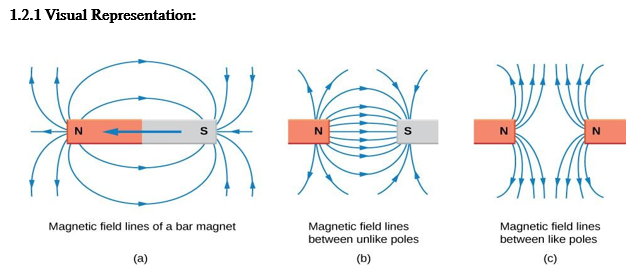
By convention, magnetic field lines point away from the north pole of a magnet and toward the south pole. Importantly, these field lines form closed loops they don’t start or stop in empty space but continue inside the magnet itself. To see these field lines, you can move a small compass around a magnet and mark the direction it points, or sprinkle iron filings around the magnet; the filings naturally arrange themselves along the field lines, revealing the invisible magnetic pattern.
1.2.2 Properties of magnetic lines of force
I. The magnetic field lines of a magnet form continuous closed loops.
II. The tangent to the field line at a given point represents the direction of the net magnetic field B at that point.
III. The larger the number of field lines crossing per unit area, the stronger is the magnitude of the magnetic field B.
IV. Their density decreases with increasing distance from the poles.
V. The magnetic field lines do not intersect with each other.
VI. They flow from the South Pole to the North Pole within a material and North Pole to the South Pole in air.
1.3 Magnetic flux: refers to the total number of magnetic field lines crossing through given surface area S held perpendicular to the direction of the magnetic field B.
1.4 Magnetic Properties of Materials: Magnetic Dipoles
Magnetic Dipole: Consists of two opposite magnetic poles separated by a distance, or practically, a current loop or spinning electron. Magnetic Dipole Moment (m):
m = I × A
- I: current; A: area vector perpendicular to loop.
- Unit: A·m²
1.4.1 Types of Magnetic Materials:
Based on the behaviour of magnetic material in a magnetic field, the materials are divided into three (3) categories:
1. Diamagnetic materials: These materials, when placed in a magnetic field, acquire magnetism opposite to the direction of the magnetic field. The magnetic dipoles in these substances tend to align opposite to the applied field and tend to repel the external field around them.
i. Diamagnetic substances tend to move from a stronger to a weaker magnetic field.
ii. When a rod of diamagnetic material is placed in a magnetic field, it aligns perpendicular to the magnetic field
iii. Permeability of the diamagnetic material is < 1. Examples; gold, Bismuth, copper, mercury, graphite, lead etc
2. Paramagnetic materials: Paramagnetic substances are those which get weakly magnetized when placed in an external magnetic field. These materials show weak attraction in magnetic field. The magnetic dipoles in the magnetic materials tend to align along the applied magnetic field. Such materials show weak feeble magnetization, and the magnetization disappears as soon as the external field is removed.
i. Permeability of paramagnetic material is > 1.
ii. The magnetization (I) of such materials dependent on the external magnetic field (B) and temperature (T) as:
Where C is the Curie constant.
Examples: sodium, liquid oxygen, salts of iron and nickel, Aluminum, platinum.
3. Ferromagnetic materials: Ferromagnetic substances are those which get strongly magnetized when placed in an external magnetic field. They exhibit the strongest attraction in magnetic field. Magnetic dipoles in these materials are arranged into domains.
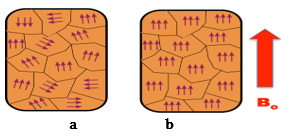
These domains are usually randomly oriented as shown in Fig. 11.1 (a) and net magnetism is zero in the absence of magnetic field. When an external field is applied, the domains reorient themselves to reinforce the external field as shown in Fig. 11.1 (b) and produce a strong internal magnetic field that is along the external field. These materials show magnetism on removal of magnetic field. Examples are iron, cobalt, nickel, neodymium and their alloys. These are usually highly ferromagnetic and are used to make permanent magnets.
3. Biot–Savart Law and Ampère’s Law
The Biot Savart Law is used to determine the magnetic field intensity H near a current-carrying conductor or we can say, it gives the relation between magnetic field intensity generated by its source current element. The law was stated in the year 1820 by Jean Baptisle Biot and Felix Savart. The direction of the magnetic field follows the right-hand rule for the straight wire. Biot Savart law is also known as Laplace’s law or Ampere’s law.
Consider a wire carrying an electric current I and also consider an infinitely small length of a wire dl at a distance x from point A.
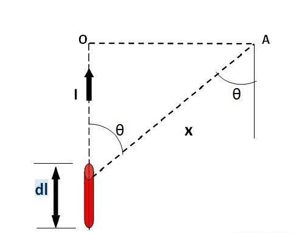
Biot Savart Law states that; the magnetic intensity dH at a point A due to current I flowing through a small element dl is
1. Directly proportional to current (I)
2. Directly proportional to the length of the element (dl)
3. Directly proportional to the sine of angle θ between the direction of current and the line joining the element dl from point A.
4. Inversely proportional to the square of the distance (x) of point A from the element dl.
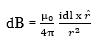
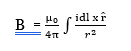
This law describes the magnetic field generated by a steady current:
Describes the magnetic field produced at a point by a small segment of current.
For a current element Idl.
Where:
I: current through the conductor
dl: infinitesimal length vector of current
μ0: permeability of free space (4π×10−7 T.m/A)
Hence Bio-Sarvat law is applicable to center of circular loops and long straight wire at a distance the formula given by;
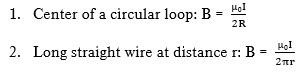
Example calculation:
1.A circular loop of radius 0.2m carries a current of 5A. Find the magnitude of the magnetic field at the center of the loop.
Ampere’s law: Ampère's Law states that the magnetic field around a conductor is directly proportional to the electric current flowing through the conductor. It relates the magnetic field along a closed loop to the total current passing through the loop. Mathematically expressed as
∮ B · dl = μ₀ Ienc.
Ampere’s law is useful in the calculation of the magnetic field in a system with high symmetry (cylindrical, planar etc). for instance;

Examples
1. A long straight wire carries a current of 10A. Calculate the magnetic field at a distance5cm from the wire.
2. A solenoid has 800turns wound over a length of 2m, and carries a current of 3A. Calculate the magnetic field inside the solenoid.
to find the total magnetic field; B