NEWTON’S LAW OF GRAVITATION
| Site: | Newgate University Minna - Elearning Platform |
| Course: | General Physics I |
| Book: | NEWTON’S LAW OF GRAVITATION |
| Printed by: | Guest user |
| Date: | Monday, 28 September 2026, 3:52 AM |
1. Introduction
Gravitational force
This is a natural force of attraction that exists between any two objects possessing mass. Every object in the universe attracts every other object, regardless of its size. Examples include; The Earth attracting objects towards its surface, Moon orbiting the Earth, Earth revolving around the Sun and artificial satellites orbiting the Earth.
Gravitational Field
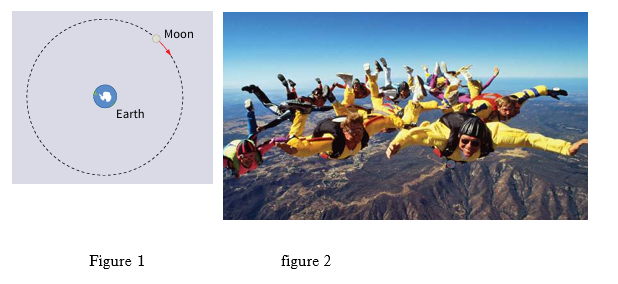
According to Newton, all masses create a gravitational field in the space around them. This field gives rise to a force on any object having mass which is placed in this field. The Moon orbits the Earth because it experiences a gravitational force due to the Earth’s gravitational field.
In physics, the idea of a field is a very general one. If an object is placed in a gravitational field, a force will act on the object because of its mass. For instance, a charged object experiences a force when it is placed in an electric field. You are probably familiar with the idea that a magnet produces a magnetic field around itself, and that this will produce a force (attractive or repulsive) on another magnet placed nearby. see figure 1 and 2 below:
Fundamental forces of nature
- Gravitational Force
- Electromagnetic Force
- Strong Nuclear Force
- Weak Nuclear Force
Although gravitational force is the weakest of these forces, it has an infinite range and dominates astronomical motions because celestial bodies possess enormous masses.
Newton's Law of Universal Gravitation
Newton used his ideas about mass and gravity to suggest a law of gravitation for two-point masses (Figure below). He considered two-point masses M and m separated by a distance r. Each point mass attracts the other with a force F. (According to Newton’s third law of motion, the point masses interact with each other and therefore exert equal but opposite forces on each other.) see figure 3.
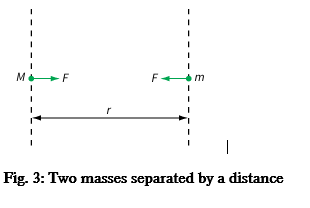
Sir Isaac Newton proposed that: Two-point masses attract each other with a force that is directly proportional to the product of their masses and inversely proportional to the square of their separation.
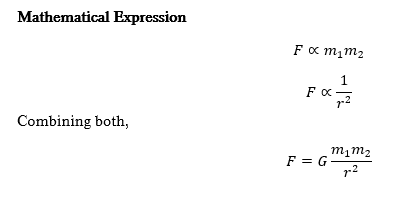
Where
F = gravitational force (N)
G = Universal Gravitational Constant
m₁ = first mass (kg)
m₂ = second mass (kg)
r = distance between their centres (m)
Characteristics of Gravitational Force
- Always attractive.
- Acts along the line joining the centres.
- Obeys the inverse square law.
- Acts over infinite distance.
- Depends on masses and separation.
EXAMPLE CALCULATION
1. Calculate the gravitational force of attraction between:
a) two objects separated by a distance of 1.0 cm and each having a mass of 100 g
b) two asteroids separated by a distance of 4.0 × 10⁹ m and each having a mass of 5.0 × 10¹⁰ kg
c) a satellite of mass 1.4 × 10⁴ kg orbiting the Earth at a distance of 6800 km from the Earth’s centre. (The mass of the Earth is 6.0 × 1024 kg).
2. Calculate the gravitational force between two masses of 20 kg and 40 kg separated by 5 m.
Gravitational Field Strength
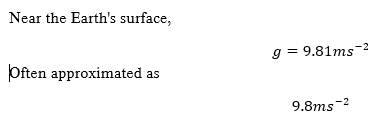
Definition: The gravitational field strength at a point is the gravitational force exerted per unit mass on a small object placed at that point. It has units of N kg−1 which is equivalent to ms−2. It is express as:
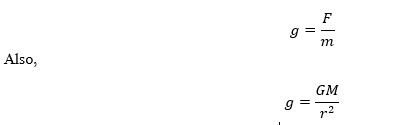
Where M = mass producing the field, r = distance from its centre
2. Kepler's Law of Planetary Motion
Johannes Kepler formulated three empirical laws describing planetary motion.
First Law (Law of Orbits)
Every planet moves around the Sun in an elliptical orbit with the Sun occupying one focus.
Alternatively:
The orbit of each planet about the sun is an ellipse with the sun at one focus. The planet’s closest approach to the sun is called aphelion and its farthest distance from the sun is called perihelion.
Second Law (Law of Equal Areas)
A line joining the planet and the Sun sweeps out equal areas during equal intervals of time. This implies that Planet moves faster when closer to the Sun and Planet moves slower when farther away. This occurs because gravitational attraction becomes stronger when the planet is nearer to the Sun.
Third Law (Law of Periods)
The square of the orbital period is directly proportional to the cube of the semi-major axis.
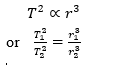
Where T = orbital period
r = orbital radius
uses of Kepler's Laws
- it is used for Satellite design
- use for Space exploration
- for Prediction of eclipses
- useful in Planetary motion
- for as Astronomy
Gravitational Potential Energy
Gravitational Potential Energy (GPE) is the energy possessed by an object because of its position in a gravitational field. 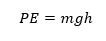
Near Earth's surface: g = 9.8ms-2
Example1: A 10 kg object is lifted through 20 m. Find the gravitational potential energy.
General Expression
Far from Earth's surface 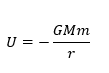
The negative sign indicates that gravitational force is attractive and work must be done to move the object infinitely far away.
Characteristics
- Depends on position placed
- Increases with height.
- Zero at infinity (by convention).
- Can be converted to kinetic energy.
Escape Velocity
Escape velocity is the minimum velocity required for an object to leave the gravitational field of a planet permanently without further propulsion. It does not depend on the mass of the escaping object and direction of launch (assuming no air resistance). it is expressed as: 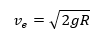
Escape Velocity contant = 11.2km/s
Factors Affecting Escape Velocity
- 1.Mass of the planet
- Radius of the planet
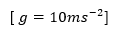
1. Find the escape velocity from a planet with a radius 6.4 x 10⁶m. Take