Introduction to Chemistry of Lipids
Lipids comprises heterogeneous group of compounds which are insoluble in water but soluble in non-polar organic solvents such us benzene, chloroform, and ether, present in all living organisms.
The group includes fats, oils, waxes and related compounds.
General Functions of Lipids
i. They are efficient energy sources.
ii. Serve as thermal insulators.
iii. They are structural components of the cell membrane.
iv. Serve as precursors for hormones (steroid hormones).
v. They also dissolve the vitamins, which are fat-soluble and assist their digestion.
2. Classification base on composition
2.10. Triacylglycerols
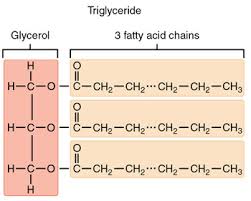
These are esters of fatty acids with the alcohol glycerol, which are storage forms of lipids (depot lipids).
Triacylglycerols also known as triacylglycerides, exist as simple or mixed types depending on the type of fatty acids that form esters with the glycerol. Both saturated and/or unsaturated fatty acids can form the ester linkage with the backbone alcohol. Eg. Tripalmitate, Triolein.