
TORQUE AND ANGULAR MOMENTUM
2. Angular momentum & Inertia
Angular momentum is the “quantity of rotation” of an object. For a spinning object with moment of inertia and angular velocity )
The bigger or , the more angular momentum; the object “wants” to keep spinning.
If you recall in the previous studies on linear momentum, you will understand that Torque changes angular momentum (just like force changes linear momentum). Furthermore, if no external torque, angular momentum does not change
Conservation of angular momentum
The law of conservation of angular momentum says if the net external torque on a system is zero, then its total angular momentum remains constant.
This means that the total angular momentum is constant and that the product of moment of inertia and angular velocity remains constant.
Mathematically:
where is moment of inertia and is angular velocity.
Moment of inertia
Moment of inertia is the rotational mass. it measures how hard it is to change an object’s spin.
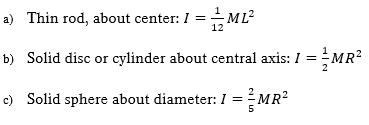
Examples
1. 1. A solid disc has a mass of 6 kg and a radius of 0.40 m. If it rotates at an angular velocity of 15 rad/s, calculate: (a) The moment of inertia of the disc. (b) The angular momentum of the disc.
2. 2. A flywheel of moment of inertia 10 kg·m² rotates at 12 rad/s. Calculate: (a) Its angular momentum. (b) The new angular velocity if its angular momentum increases to 180 kg·m²/s.
3. 3. A particle of mass 4 kg moves with a speed of 8 m/s in a circular path of radius 3 m. Calculate its angular momentum about the center of the circle.
4. 4. A uniform rod of mass 5 kg and length 2.0 m rotates about an axis passing through its center and perpendicular to its length at 10 rad/s. Calculate: (a) The moment of inertia of the rod. (b) Its angular momentum.
5. 5. A solid sphere of mass 12 kg and radius 0.25 m rotates at an angular velocity of 30 rad/s. Calculate: (a) The moment of inertia of the sphere. (b) The angular momentum of the sphere.
Exercise
Read on Gyroscope and Precession?