
Bacterial Growth
Bacterial growth refers to the increase in number of bacterial cells rather than the size of individual cells. This occurs through binary fission, an asexual process where a single bacterium divides into two identical daughter cells.
1. Phases of Bacterial Growth (Growth Curve)
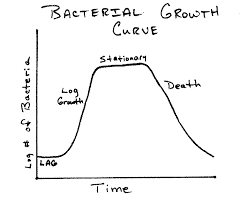
When bacteria are cultured in a closed system (e.g., a lab flask), they follow a predictable growth pattern known as the bacterial growth curve, which includes four phases:
A) Lag Phase
- Bacteria adapt to the new environment.
- No significant increase in number.
- Enzymes and metabolic pathways are activated.
B) Log (Exponential) Phase
- Rapid cell division occurs.
- Population doubles at a constant rate.
- Bacteria are most metabolically active and sensitive to antibiotics.
C) Stationary Phase
- Growth rate slows due to nutrient depletion and waste accumulation.
- The number of new cells equals the number of dying cells.
- Some bacteria form endospores for survival.
D) Death (Decline) Phase
- Cell death exceeds cell division.
- Due to toxic waste buildup and lack of nutrients.
2. Factors Affecting Bacterial Growth
Several environmental and nutritional factors influence bacterial growth:
A) Nutrients
- Carbon, nitrogen, phosphorus, sulfur, and trace elements are essential.
B) Temperature
- Psychrophiles: Thrive in cold temperatures (0–20°C).
- Mesophiles: Grow best at moderate temperatures (20–45°C, e.g., human pathogens).
- Thermophiles: Prefer high temperatures (45–80°C).
- Hyperthermophiles: Grow at extreme temperatures (>80°C).
C) pH
- Acidophiles: Thrive in acidic environments (pH < 5).
- Neutrophiles: Prefer neutral pH (pH 6.5–7.5).
- Alkaliphiles: Grow in alkaline conditions (pH > 8).
D) Oxygen Availability
- Obligate Aerobes: Require oxygen (e.g., Mycobacterium tuberculosis).
- Obligate Anaerobes: Cannot survive in oxygen (e.g., Clostridium botulinum).
- Facultative Anaerobes: Can grow with or without oxygen (e.g., Escherichia coli).
- Microaerophiles: Require low oxygen levels.
- Aerotolerant Anaerobes: Do not use oxygen but can tolerate it.
E) Water Availability
- Bacteria require water for metabolic reactions.
- Some bacteria survive in low-water conditions by forming endospores.
F) Salinity (Osmotic Pressure)
- Halophiles: Thrive in high-salt environments (e.g., Halobacterium).
3. Methods of Measuring Bacterial Growth
A) Direct Methods
- Microscopic Count – Counting cells under a microscope.
- Viable Plate Count – Counting colony-forming units (CFUs) on agar plates.
- Membrane Filtration – Used for counting bacteria in water samples.
B) Indirect Methods
- Turbidity Measurement – Using a spectrophotometer to measure cloudiness.
- Dry Weight Measurement – Weighing bacterial biomass.