
Networking technologies
Local Area Networks (LANs)
Connect devices in confined spaces like homes or offices. LANs enhance collaboration through shared resources and low-latency communication.
-
Ethernet (Wired LAN)
-
Uses twisted-pair or fiber-optic cables and switches.
-
Speeds range from 10 Mbps to 100 Gbps.
-
Ideal for stable, high-throughput needs (e.g., servers, desktops).
-
Diagram: Various end devices tied to a central switch or router. wired.com+15phoenixnap.com+15techvertu.co.uk+15en.wikipedia.org+6lifewire.com+6elprocus.com+6en.wikipedia.org+7collectionperformance.com+7nwkings.com+7
-
-
Wi‑Fi (Wireless LAN)
-
IEEE 802.11 standards (b/g/n/ac/ax).
-
Speeds vary from 11 Mbps up to ~10 Gbps.
-
Excellent for mobile/laptop access with flexible deployment.
-
Diagram: Multiple wireless clients connecting through an access point.
-
-
Bluetooth
-
Short-range (~10 m), low-power wireless (~3 Mbps).
-
Used for peripherals (headphones, keyboards, IoT).
-
-
Wired LANs
-
Traditional cabled connections ensure low latency and high reliability.
-
Wide Area Networks (WANs)
Span large regions by linking multiple LANs.
-
Leased Lines
-
Dedicated, private connections (64 Kbps–10 Gbps).
-
Used by businesses for secure, consistent site-to-site links.
-
-
T1/T3 and E1/E3 Lines
-
T1: ~1.544 Mbps; T3: up to ~45 Mbps.
-
North American digital backbones; legacy but reliable.
-
-
ISDN (BRI/PRI)
-
Combines voice and data; BRI for small sites, PRI for larger setups.
-
-
DSL (ADSL/SDSL)
-
Transmits data over phone lines; speeds up to ~100 Mbps.
-
Common in home and small business contexts.
-
-
Cable (DOCSIS)
-
Broadband over cable TV networks; can exceed 300 Mbps.
-
-
Satellite
-
Offers global coverage (~400 Kbps–100+ Mbps); higher latency and weather-sensitive.
-
 Emerging
 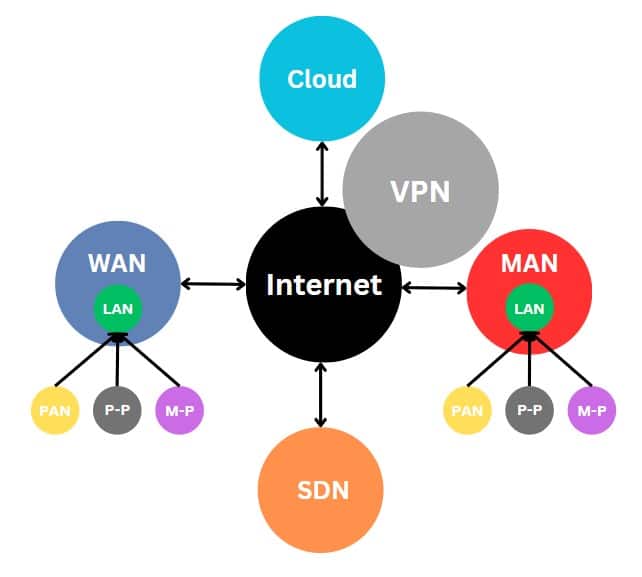 Networking Innovations
-
SDN (Software-Defined Networking)
-
Separates control and data planes for centralized, flexible traffic management.
-
Powers modern data centers and cloud networks. elprocus.com+3pubnub.com+3lifewire.com+3arxiv.org+6en.wikipedia.org+6arxiv.org+6
-
-
NFV (Network Functions Virtualization)
-
Runs network functions (e.g., firewalls, routers) as software on commodity hardware.
-
Makes scaling and deployment more agile. lifewire.com+15comparitech.com+15collectionperformance.com+15tekton.cloud
-
-
5G Wireless Networks
-
Next-gen mobile connectivity with up to 10 Gbps and ultra-low latency.
-
Supports IoT, IoT, and remote automation. en.wikipedia.org+1solveforce.com+1
-
-
IoT and Edge Computing
-
Networks of sensors and edge-nodes process data close to the source, reducing latency. solveforce.com+2nwkings.com+2hotbot.com+2
-
Technology Comparison
| Technology | Coverage | Speed | Pros | Cons |
|---|---|---|---|---|
| Ethernet | Home/Office | 100 Mbps–100 Gbps | Reliable, low latency | Requires cabling |
| Wi‑Fi | Local | Up to ~10 Gbps | Fast, flexible | Wireless interference, security issues |
| Bluetooth | Short-range | ~3 Mbps | Low power, easy peripheral link | Limited range and speed |
| Leased Lines | Regional/WAN | 64 Kbps–10 Gbps+ | Dedicated, stable | Expensive, fixed bandwidth |
| T1/T3 | Regional | 1.5–45 Mbps | Reliable legacy infrastructure | Lower speed, less flexible |
| DSL | Local/Regional | Up to ~100 Mbps | Uses phone lines | Distance-dependent speed degradation |
| Cable | Local/Regional | ~300 Mbps+ | High bandwidth, cost-effective | Shared medium, capacity variability |
| Satellite | Global | ~400 Kbps–100 Mbps+ | Wide coverage | Latency, weather sensitivity |
| 5G | Wide/Local | Up to ~10 Gbps | Ultra-fast, low latency | Infrastructure cost, coverage needed |
| SDN/NFV | Data centers | Scalable | Agile network control | Complexity, security considerations |
-
LAN technologies like Ethernet, Wi‑Fi, and Bluetooth target small-scale deployment with varying performance and flexibility needs.
-
WAN technologies connect those LANs across distances using wired or wireless means, each with specific trade-offs.
-
New trends (5G, SDN, NFV, IoT) are steering networking toward flexibility, programmability, and smarter automation.