
THERMOCHEMISTRY
Energy, Heat and Units of Energy
Thermochemistry or energetics deals with the energy changes that accompany physical and chemical processes.
Energy
• Energy is what we use when we perform work or other activities.
• It can exist in different forms such as heat, electricity, kinetic (to cause motion), potential (due to position or chemical composition of a substance) etc.
• Example of a KE is a car in motion and that of PE includes a boulder rolling down a hill or a city water tank on top of a platform
• We use energy when we walk, talk, climb, run, think, exercise emotions, eat, think etc
• When we are tired, it indicates that we do not have enough energy in our system to do any work
• Sources of energy: varies but includes the food we eat, fossils, fuel etc
• Energy can be converted from one form to another (Law of conservation of energy)
Heat and Units of Energy
• The SI unit for heat energy is the Joules (J) or Kilojoules (KJ)
• Joules (J) is a small amount of energy, so, the KJ is most often used unit for Heat energy. For example we need 105J to sleep for one hour which amounts to 100 KJ or we need to use 75000 J to heat a cup of tea (75KJ)
• The Calorie, C, is another unit of heat and is defined as the amount of heat needed to raise 1g of water by 10C.
• 1C= 4.184J
• Example: 1.0 g of propane fuel was used to cook dinner. 48000 J (48 KJ) of heat was released in that process. Calculate this amount of heat energy in calories
• Answer: 1 C = 4.184 J, then 48000 J = 48000/4.184 cal = 11,472C
= 11, 000 C
Heat (q)
Heat is the transfer of thermal energy between two bodies that are at different temperatures.
Temperature is a measure of the thermal energy
Temperature = Thermal Energy
Specific Heat and How to calculate specific heat
• Every substance has the ability to loose or gain heat energy whenever there is a change in temperature
• The amount of heat absorbed or released to reach a certain temperature varies from one substance to another one
• This capacity to absorb or release energy is a physical property and it is called the
Specific Heat (SH)
• SH is defined as the amount of heat(q) needed to raise the temperature of 1.0 g of a substance by 10C
• SH = Heat (q)/mass x ∆T = q/m x ∆T (J(Cal/g0C)
• The SH of water = 4.184J/ g0C or 1 cal/ g0C
• 4.184 J of heat will raise 1g of water by 10C
• The same amount of heat will raise 1 g of copper by 100C and 1g of Al by 50C
• This indicates that water has a higher capacity than Cu or Al and also it has a higher capacity to absorb or release heat, therefore, it keeps the body temperature constant
• Low amount of SH for Cu and Al relative to water shows that they transfer heat more efficiently than water hence they are used as cooking wares and are better heat transfer substances
Calculating Specific Heat (SH)
• What is the SH of lead if 530 J is added to raise the temperature of 35.6 g of lead by
12.5 0C?
• Answer: SH = q/m ∆T
• = 530/35.6 x 12.5 = 1.191 J/g0C
• We can calculate amount of heat (q) or the mass of a substance by the following equation
• Q = SH x m ∆T J and m = q/SH x ∆T
Measuring Heat Changes
• A calorimeter is used to measure temperature changes when a substance looses or gain heat
• A laboratory scale bomb calorimeter can be made with a Styrofoam cup (reactor) placed in another (bigger) Styrofoam cup (insulator)
• One may lag the insulator cup with glass wool
• Place a certain amount of water in the reactor and measure its temperature (Initial temp, T1).
• Heat a certain object to a known temperature and drop it inside the water and immediately cover the calorimeter.
• Stir the water continuously and measure its temperature at specific intervals
• Stir until its temperature is constant and record it as the final temperature T2
• Measure heat change by using the formula ∆T = T2 – T1
• Heat lost by the object is equal to the heat gained by the water (qobject=qwater)
• Q = SH x m x ∆T
Energy and Nutrition and Energy Values of Food Energy and Nutrition
• The food we eat produces energy for us to do work. Our body grow, sleep, respires etc as a result of energy supply from the food we eat.
• There are different types of food and all of them possesses a measure of energy
• Types of food include: Carbohydrate (main source of energy), fats and proteins (secondary source of energy if carbohydrate is not available)
• Food energy is measured in calories or kilocalories
• In nutrition unit, the calorie is written with a capital Cal. This implies that 1000 Cal
= 1 Kcal
• We can also use KJ in nutrition unit. Remember that 1 Cal= 4.184KJ= 4184J
• For example, baked potato = 120 Cal = 4.184 x 120KJ ~ 500 J
Energy Values of Food
• Energy values of food are Kcal or KJ obtained by completely burning of 1g of food
|
Food Item |
KJ/g |
Kcal/g |
|
Carbohydrate |
17 |
4 |
|
Fats |
38 |
9 |
|
Proteins |
17 |
14 |
(1) 1.0 g of iron has temperature of 210C. What is the final temperature of the `iron sample when 4.184 J is added? (SHiron = 0.492 J/g0C, SHwater= 4.184 J/g0C)
(2) Define (i) the specific heat capacity (ii) calorie
(3) 1.0 g of propane fuel was used to cook dinner. 48000 J (48 KJ) of heat was released in that process. Calculate this amount of heat energy in calories
(4) Which instrument can be used to measure specific heat capacity of a substance
(5) If you don’t have a bomb calorimeter in your laboratory, what can you do to measure the specific heat capacity of a metal object?
(6) Describe how you will use the equipment described in question 71 to measure specific heat capacity
(7) How can you determine the specific heat capacity of 1.0 g of yam?
THERMODYNAMICS
What is Thermodynamics?
Thermodynamics deals with heat, work and temperature, and their relation to energy, radiation and physical properties of matter. In other words, Thermodynamics is the scientific study of the interconversion of heat and other kinds of energy more heat is generated.
To be specific, it explains how thermal energy is converted to or from other forms of energy and how matter is affected by this process. Thermal energy is the energy that comes from heat. This heat is generated by the movement of tiny particles within an object, and the faster these particles move, the greater the heat generated.
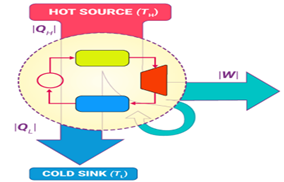
Thermodynamics is not concerned about how and at what rate these energy transformations are carried out. It is based on the initial and final states undergoing the change. It should also be noted that Thermodynamics is a macroscopic science. This means that it deals with the bulk system and does not deal with the molecular constitution of matter.
Different Branches of Thermodynamics
Thermodynamics is classified into the following four branches:
- Classical Thermodynamics
- Statistical Thermodynamics
- Chemical Thermodynamics
- Equilibrium Thermodynamics
Classical Thermodynamics
In classical thermodynamics, the behaviour of matter is analysed with a macroscopic approach. Units such as temperature and pressure are taken into consideration, which helps the individuals calculate other properties and predict the characteristics of the matter undergoing the process.
Statistical Thermodynamics
In statistical thermodynamics, every molecule is under the spotlight, i.e. the properties of every molecule and how they interact are taken into consideration to characterise the behaviour of a group of molecules.
Chemical Thermodynamics
Chemical thermodynamics is the study of how work and heat relate to each other in chemical reactions and in changes of states.
Equilibrium Thermodynamics
Equilibrium thermodynamics is the study of transformations of energy and matter as they approach the state of equilibrium.
Basic Concepts of Thermodynamics –
Thermodynamics has its own unique vocabulary associated with it. A good understanding of the basic concepts forms a sound understanding of various topics discussed in thermodynamics preventing possible misunderstandings.
Thermodynamic Systems
System
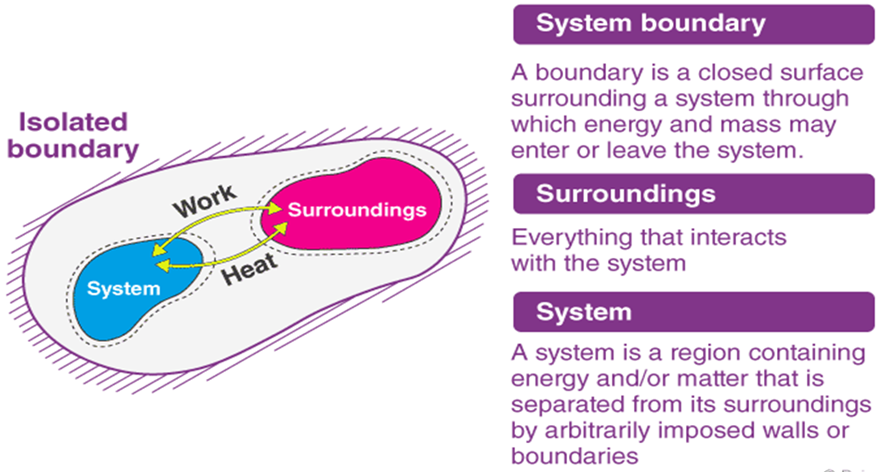
A thermodynamic system is a specific portion of matter with a definite boundary on which our attention is focused. The system boundary may be real or imaginary, fixed or deformable.
There are three types of systems:
- Isolated System – An isolated system cannot exchange energy and mass with its surroundings. The universe is considered an isolated system. Example:
☕ Hot coffee in a well-sealed thermos - Keeps heat in, and nothing gets in or out
- Closed System – Across the boundary of the closed system, the transfer of energy takes place but the transfer of mass doesn’t take place. Refrigerator, compression of gas in the piston-cylinder assembly are examples of closed systems. Example:
A covered pot of soup on a stove - The lid is on, so no steam escapes = no mass exchange.
- But heat flows from the stove into the pot = energy exchange.
- Open System – In an open system, the mass and energy both may be transferred between the system and surroundings. A steam turbine is an example of an open system. Example:
A cup of hot tea on a table - Heat escapes into the air (you can feel it).
- Steam rises (mass is escaping).
- It can also absorb moisture from the air if left long enough
|
Interactions of thermodynamic systems |
|||
|
Type of system |
Mass flow |
Work |
Heat |
|
Isolated System |
☓ |
☓ |
☓ |
|
Open System |
✓ |
✓ |
✓ |
|
Closed System |
☓ |
✓ |
✓ |
Surrounding
Everything outside the system that has a direct influence on the behaviour of the system is known as a surrounding.
Thermodynamic Process
A system undergoes a thermodynamic process when there is some energetic change within the system that is associated with changes in pressure, volume and internal energy.
There are four types of thermodynamic processes that have their unique properties, and they are:
- Adiabatic Process – A process where no heat transfer into or out of the system occurs.
- Isochoric Process – A process where no change in volume occurs and the system does no work.
- Isobaric Process – A process in which no change in pressure occurs.
- Isothermal Process – A process in which no change in temperature occurs.
A thermodynamic cycle is a process or a combination of processes conducted such that the initial and final states of the system are the same. A thermodynamic cycle is also known as cyclic operation or cyclic processes.
Thermodynamic Equilibrium
At a given state, all properties of a system have fixed values. Thus, if the value of even one property changes, the system’s state changes to a different one. In a system that is in equilibrium, no changes in the value of properties occur when it is isolated from its surroundings.
- When the temperature is the same throughout the entire system, we consider the system to be in thermal equilibrium.
- When there is no change in pressure at any point of the system, we consider the system to be in mechanical equilibrium.
- When the chemical composition of a system does not vary with time, we consider the system to be in chemical equilibrium.
- Phase equilibrium in a two-phase system is when the mass of each phase reaches an equilibrium level.
A thermodynamic system is said to be in thermodynamic equilibrium if it is in chemical equilibrium, mechanical equilibrium and thermal equilibrium and the relevant parameters cease to vary with time.
Laws of Thermodynamics
Thermodynamics laws define the fundamental physical quantities like energy, temperature and entropy that characterize thermodynamic systems at thermal equilibrium. These thermodynamics laws represent how these quantities behave under various circumstances.
There are four laws of thermodynamics and are given below:
- First law of thermodynamics
- Second law of thermodynamics
- Third law of thermodynamics
· Zeroth law of thermodynamics
First Law of thermodynamics
• The first law of thermodynamics provides the basic definition of thermodynamic energy (which is also called internal energy) associated with all thermodynamic systems. It explains the rule of conservation of energy in nature.
• The law states that energy can be transformed, i.e. changed from one form to another, but cannot be created or destroyed.
• Because energy is conserved, the internal energy of a system changes as heat flows in or out of it. Equivalently, machines that violate the first law (perpetual motion machines) are impossible. Heat is the flow of thermal energy from one object to another.
- For example, plants convert the radiant energy of sunlight to chemical energy through photosynthesis. We eat plants and convert the chemical energy into kinetic energy while we swim, walk, breathe, and scroll through this page.
• Another example, wood (stored chemical energy) can be burnt (heat) and used to boil water. The heat energy from the boiling water can be use to drive a turbine to produce electricity (electrical energy). The electricity can be used to lighten a bulb (luminous energy) or play a radio (sound energy) etc
• The example shows that energy cannot be created or destroyed, it can only be converted from one form of energy to another form of energy
• The first law can also be formulated by stating that the change in the internal energy of a system is equal to the amount of heat supplied to the system, minus the amount of work performed by the system on its surroundings
∆Usystem = Q-W
• For a thermodynamic cycle of a closed system, which returns to its original state, the heat Qin supplied to a closed system in one stage of the cycle, minus
that Qout removed from it in another stage of the cycle, equals the net work done by
the system.
∆Usystem (full cycle) = 0 because Q = Qin – Qout = W
• The increase in internal energy of a closed adiabatic system can only be the result of the net work performed by the system, because Q = 0.
∆Usystem (full circle) = Ufinal – Uinitial = -W
Second Law of Thermodynamics
Second law of thermodynamics states that the entropy in an isolated system always increases. Any isolated system spontaneously evolves towards thermal equilibrium—the state of maximum entropy of the system.
• The concept of energy in the first law does not account for the observation that natural processes have a preferred direction of progress. For example, spontaneously, heat always flows to regions of lower temperature, never to regions of higher temperature without external work being performed on the system.
• The first law is deals completely with moving from an initial state to a final state of an evolving system.
• The second law refers to a wide variety of processes, reversible and irreversible. All natural processes are irreversible. Reversible processes are a convenient theoretical fiction and do not occur in nature. A prime example of irreversibility is in the transfer of heat by conduction or radiation
• The second law of thermodynamics asserts the irreversibility of natural processes, and the tendency of natural processes to lead towards spatial homogeneity of matter and energy, and especially of temperature. It can be formulated in a variety of interesting and important ways.
• The explanation of this phenomenon can be made through the second law of thermodynamics
• A new physical property called the entropy is used by the second law of thermodynamics to explain this phenomenon
• A change in the entropy (S) of a system is the infinitesimal transfer of heat (Q) to a closed system driving a reversible process, divided by the equilibrium temperature
(T) of the system.
dS= dQ/T
• For a closed thermodynamic system, it is a quantitative measure of the amount of thermal energy not available to do work.
• The second law also talks about the kinds of irreversibility other than heat transfer, such as friction, viscosity, and those of chemical reactions.
• The notion of entropy is needed to provide a wider scope of the law
• One can also look at entropy from different angles such as:
• A measure of the disorder or randomness in a closed system.
• A measure of the loss of information in a transmitted message.
• The tendency for all matter and energy in the universe to evolve toward a state of inert uniformity.
• Inevitable and steady deterioration of a system or society.
• The third law of thermodynamics:
Third law of thermodynamics states that the entropy of a system approaches a constant value as the temperature approaches absolute zero. Constant value (not necessarily zero) is called
the residual entropy of the system.
• The entropy of any pure substance in thermodynamic equilibrium approaches zero as the temperature approaches
zero. The entropy of a system at absolute zero is typically zero, and in all cases is determined only by the number of different ground states it has.
• It is sometimes stated as follows:
• The entropy of a perfect crystal of any pure substance approaches zero as the temperature approaches absolute zero. At zero temperature the system must be in a state with the minimum thermal energy. This statement holds true if the perfect crystal has only one state with minimum energy. Entropy is related to the number of possible microstates according to:
S= kB InΩ
where S is the entropy of the system, kB Boltzmann's constant, and Ω the number of microstates (e.g. possible configurations of atoms). At absolute zero there is only 1 microstate possible (Ω=1 as all the atoms are identical for a pure substance and as a result all orders are identical as there is only one combination) and ln(1) = 0.
Foir example, Let us consider steam as an example to understand the third law of thermodynamics step by step:
The molecules within it move freely and have high entropy.
If one decreases the temperature below 100 °C, the steam gets converted to water, where the movement of molecules is restricted, decreasing the entropy of water.
When water is further cooled below 0 °C, it gets converted to solid ice. In this state, the movement of molecules is further restricted and the entropy of the system reduces more.
As the temperature of the ice further reduces, the movement of the molecules in them is restricted further and the entropy of the substance goes on decreasing.
When the ice is cooled to absolute zero, ideally, the entropy should be zero. But in reality, it is impossible to cool any substance to zero.
Zeroth Law of thermodynamics
The Zeroth law of thermodynamics states that if two bodies are individually in equilibrium with a separate third body, then the first two bodies are also in thermal equilibrium with each other
This law helps define the notion of temperature
This means that if system A is in thermal equilibrium with system C and system B is also in equilibrium with system C, then system A and B are also in thermal equilibrium.
An example demonstrating the Zeroth Law.
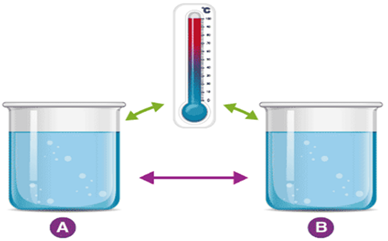
Consider two cups A and B, with boiling water. When a thermometer is placed in cup A, it gets warmed up by the water until it reads 100 °C. When it reads 100 °C, we say that the thermometer is in equilibrium with cup A. When we move the thermometer to cup B to read the temperature, it continues to read 100 °C. The thermometer is also in equilibrium with cup B. By keeping in mind the zeroth law of thermodynamics, we can conclude that cup A and cup B are in equilibrium with each other.
The zeroth law of thermodynamics enables us to use thermometers to compare the temperature of any two objects that we like.
Thermodynamics Examples in Daily Life
Whether we are sitting in an air-conditioned room or travelling in any vehicle, the application of thermodynamics is everywhere. We have listed a few of these applications below:
- Different types of vehicles such as planes, trucks and ships work on the basis of the 2nd law of thermodynamics.
- The three modes of heat transfer work on the basis of thermodynamics. The heat transfer concepts are widely used in radiators, heaters and coolers.
- Thermodynamics is involved in the study of different types of power plants such as nuclear power plants, thermal power plants.
Thermodynamics – Summary and Overview
In simple terms, thermodynamics deals with the transfer of energy from one form to another.
→ The laws of thermodynamics are:
- First law of thermodynamics: Energy can neither be created nor be destroyed, it can only be transferred from one form to another.
- Second law of thermodynamics: The entropy of any isolated system always increases.
- Third law of thermodynamics: The entropy of a system approaches a constant value as the temperature approaches absolute zero.
- Zeroth law of thermodynamics: If two thermodynamic systems are in thermal equilibrium with a third system separately, then they are in thermal equilibrium with each other.
→ Entropy is the measure of the number of possible arrangements the atoms in a system can have.
→ Enthalpy is the measurement of energy in a thermodynamic system.
Thermodynamic State Functions
• Thermodynamic State Functions: Thermodynamic properties that are dependent on the state of the system only regardless of the pathway. Examples: (Energy, pressure, volume, temperature)
∆E = Efinal – Einitial
∆P = Pfinal- Pinitial
∆V = Vfinal- Vinitial
∆T = Tfinal – Tinitial
• Other variables will be dependent on pathway (Examples: q and w). These are Path Functions. The pathway from one state to the other must be defined.
Thermochemistry is the study of heat change in chemical reactions.
Exothermic process is any process that gives off heat – transfers thermal energy from the system to the surroundings.
2H2 (g) + O2 (g) →2H2O (l) + energy
H2O (g)→ H2O (l) + energy
Endothermic process is any process in which heat has to be supplied to the system from the surroundings.
energy + 2HgO (s)→ 2Hg (l) + O2 (g)
energy + H2O (s)→ H2O (l)
Enthalpy of Chemical Reactions
Definition of Enthalpy
•Thermodynamic Definition of Enthalpy (H):
H = E + PV
E = energy of the system
P = pressure of the system
V = volume of the system
Changes in Enthalpy (ΔH)
• Consider the following expression for a chemical process:
ΔH = Hproducts - Hreactants
If ΔH >0, then qp >0. (+) The reaction is endothermic If ΔH <0, then qp <0. (-) The reaction is exothermic
ΔH=qp
qp: heat at constant pressure
Calorimetry: the measurement of heat change
Standard Enthalpy (Heat) of reaction (ΔHorxn)
Enthalpy change at standard conditions (25 oC, 1 atm)
N2 (g) + 3H2 (g) → 2NH3 (g) ΔHo = - 92.38 kJ
↓
Thermochemical reaction
Standard Heat of formation (ΔHf o)
The standard enthalpy of formation of any element in its most stable form is zero.
∆Ho (C, diamond) = 1.90 kJ/mol
What is ΔHf o→ of O2 (g), Hg(l), C(graphite)?
Thermochemical Equations
CH4 (g) + 2O2 (g)→CO2 (g) + 2H2O (l) ∆H = -890.4 kJ/mol
- It shows the physical states of all products and reactants
- Balanced
- It shows Heat of reaction kJ
H2O (s)→H2O (l) ∆H = 6.01 kJ/mol
• If you reverse a reaction, the sign of ∆H changes H2O (l) H2O (s) ∆H = -6.01 kJ/mol
• If you multiply both sides of the equation by a factor n, then H must change by the same factor n.
2H2O (s)→2H2O (l) ∆H = 2 x 6.01 = 12.0 kJ
How to calculate ΔHro
1- Direct method 2- indirect method
Direct method: by heat of formation
∆Ho = ∑n∆H0 (Product) - ∑n∆Ho (Reactant)
n = no. of moles in the balanced thermochemical equation
Example
Calculate the enthalpy of the following reaction:
2Al (s) + Fe2O3 (s)→ Al2O3 (s) + 2Fe(l)
ΔHfo of Fe2O3, Al2O3 and Fe(l) = - 822.2, - 1669.8 and 12.40 kJ/mol
ΔHo = ∑ n ∆Hfo (products) - ∑ n ΔHf o (reactants)
ΔHo = [(ΔHfo (Al2 O3))+ (2× ΔHfo (Fe))]-[(2×ΔHfo (Al))+(ΔHfo (Fe2O3 ))]
ΔHo= [ (-1669.8)+ (2×12.40)] – [2×(0)+(-822.2)] = -822.8 kJ
2- indirect method :(Hess’s Law)
∆H for a process involving the transformation of reactants into products is not dependent on pathway. Therefore, we can pick any pathway to calculate ∆H for a reaction.
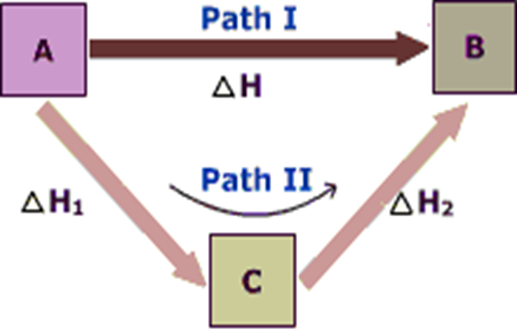
When reactants are converted to products, the change in enthalpy is the same whether the reaction takes place in one step or in a series of steps. H is a state function
Hess’ Law:
• Once can always reverse the direction of a reaction when making a combined reaction. When you do this, the sign of H changes.
N2(g) + 2O2(g)→2NO2(g) ∆H = 68 kJ
2NO2(g) →N2(g) + 2O2(g) ∆H = -68 kJ
• If the coefficients of a reaction are multiplied by a constant, the value of H is also multiplied by the same integer.
N2(g) + 2O2(g)→2NO2(g) ∆H = 68 kJ
N2(g) + 4O2(g)→4NO2(g) ∆H = 136 kJ
Calculate the enthalpy of the following reaction:
Fe2O3 (s) + 3CO (g) →2Fe (s) + 3CO2 (g)
1- CO (g) + ½O2 (g) →CO2 (g) ΔHo = - 283.0 kJ
2- 2Fe (s) + 3/2O2 (g) →Fe2O3 (s) ΔHo = - 822.2 kJ
3CO (g) + 3/2O2 (g) →3CO2 (g) ΔHo = 3× - 283.0 = - 849 kJ Fe2O3 (s)
2Fe (s) + 3/2O2 (g) →ΔHo = + 822.2 kJ
Fe2O3 (s) + 3CO (g) →2Fe (s) + 3CO2 (g) ΔHo =-26.7KJ
Question 3
The specific heat of aluminum is 0.214 cal/g.oC. Determine the energy, in calories, necessary to raise the temperature of a 55.5 g piece of aluminum from 23.0 to 48.6oC.
A. 109 cal
B. 273 cal
C. 577 cal
D. 347 cal
E. 304 cal
Question 4
Energy is the ability to do work and can be:
A. converted to one form to another
B. can be created and destroyed
C. used within a system without consequences
D. none of the above
Question 5
To which one of the following reactions, occurring
at 25oC, does the symbol ΔHo [H SO (l)] refer?
A. H2(g) + S(s) + 2 O2(g) ----> H2SO4(l)
B. H2SO4(l) ----> H2(g) + S(s) + 2 O2(g)
C. H2(g) + S(g) + 2 O2(g) ----> H2SO4(l)
D. H2SO4(l) ----> 2 H(g) + S(s) + 4 O(g)
E. 2 H(g) + S(g) + 4 O(g) ----> H2SO4(l)
Question 6
Given: SO2(g) + ½O2(g) ----> SO3(g) ΔHo = -99 kJ,
what is the enthalpy change for the following reaction? 2 SO3(g) ----> O2(g) + 2 SO2(g)
A. 99 kJ
B. -99 kJ
C. 49.5 kJ
D. -198 kJ
E. 198 kJ
RACK YOUR BRAIN
(1) What is the first law of thermodynamics?
(2) Give an example that can demonstrate the first law of thermodynamics?
(3) Explain the second law of thermodynamics with examples?
(4) Describe entropy in four different ways