
RATES OF CHEMICAL REACTIONS
Rates of Reaction
• Rates of reaction (ROR) is a measure of how fast a reaction will occur
• Reactions happen when molecules, elements or atoms collide with the proper orientation and sufficient energy
• But not all collisions result into a reaction.
• The Collision Theory
• The collision theory of Arrhenius suggests that
• The collision theory is based on the principle of kinetic theory: that particles of matter are in continuous random motion colliding with one another. Hence, the rate of reaction is directly proportional to the to the frequency of collision between the particles.
• Effective Collisions and Activation Energy effective
• It is not all collision between the particles that are effective i.e. form product. For a collision to be effective, the particles must be properly orientated (or aligned) and also, possess the minimum kinetic activation energy, EA.
• Activation energy can be likened to energy barrier, which must be overcome before a reaction can occur.
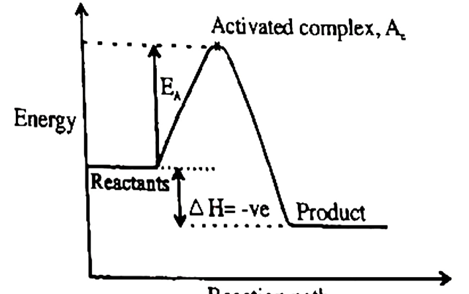
• Energy profile diagram for an exothermic reaction
• When the orientation of reactants are okay, there is still a need for enough energy to break the bonds between the atoms of each reactant for a reaction to occur
• Activation energy is the minimum amount of energy needed to break the bonds between atoms of reactants.
• AE is like going from one side of a hill to the other side. We need enough energy to get to the top of a hill and then can easily run down the hill to the other side.
• Hence condition for a reaction to occur includes: collision, proper orientation, concentration and sufficient energy
Factors Affecting the Rates of Reactions
Nature of the reactants;
Concentration of reactants;
Effect of temperature;
Surface areas of reactants;
· Presence of catalyst;
Pressure changes in gaseous reactants;
·Effect of light or radiation on the reaction.
1.The Nature of Reactants
The nature of the particles of reactants can affect the reaction rate. The particles are usually in the form of atoms, molecules, and ions:
a. Reactions involving ions in aqueous solutions-as in inorganic reactions,are usually immediate,due to the electrostatic force of attraction between opposite ions,e.g.
i. Neutralization reactions:
Reactions involving an acid and an alkali are fast and instantaneous.
H+(aq) + OH(ag)→H2O
2.Concentration of Reactants
The concentration of a solution is a measure of the number of reactant particles in the solution. When a solution is concentrated, there are more reactant per unit volume than when it is dilute.
Example: Action of an acid on a metal
When magnesium wire is dropped into a beaker of dilute HCl, the metal dissolves with effervescence; the colourless and odourless gas liberated is hydrogen.
Mg(s)+2HCl(aq) → MgCl2(aq) + H2(g)
3. Temperature- increase in temperature increases the rate of a reaction by increasing the rate of collision, kinetic energy and energy. For example, increasing the heat when we are cooking increases the rate of cooking also if body temperature increases, the pulse rate and breathing will also increase. If we decrease temperature, ROR will also decrease. For example, freezing food decreases the rate of spoilage
4. Surface Area of Reactants
The surface area represents the state of subdivision of a solid reactant in a reaction. It is a measure of the area of the particle exposed to physical or chemical attack.
Consider a cube of sugar and granulated sugar of the same mass. The surface area of the granulated sugar is larger than that of the cube of sugar.
5.Catalyst: increases or slows down the rate of a reaction by lowering AE or providing and alternative pathway with a lower AE. So, if AE is lowered, more collision will occur, hence sufficient energy will be provided to make the reaction occur. For example, Platinum and Palladium are catalytic converters that convert pollutants form combustion of petrol in an automobile engine into harmless products. Pollutants in combustion engine include: CO, C8H18 and NO
Pt
• 2COg + O2g → 2CO2g
Pt
• C8H18g + 25 O2g → 16CO2g + 18H2Ol
Pt
• 2NOg → N2g + O2g
6. Effect of Pressure
A change in pressure affects chemical systems in which one or more of the reactants or products are gases. An increase in pressure on a given mass of gas at constant temperature leads to a decrease in volume (Boyle's law), and hence, an increase in concentration.
An increase in pressure enables gaseous particles to be in close contact and collide more frequently with one another, thereby, increasing the rate of reaction. Conversely,a decrease in pressure on a gaseous system decreases the rate of reaction.
7.Effect of Light or Radiation
Some reactions occur only in the presence of sun-light; such reactions will not occur in the dark:
a. Hydrogen and chlorine form hydrogen chloride readily on exposure to sunlight, or when irradiated.
b. Photosynthesis in plants does not occur in the dark, except by the absorption of sunlight energy.
In these reactions, sunlight provides the required energy to promote the frequent collisions between the particles, leading to the expected reactions.
A reaction that occurs in the presence of light is called photochemical or photocatalytic reaction.
Measurement of Rates of Reaction
• We can measure the rates of a reaction by measuring the amount of reactants consumed or amount of product formed over a given amount of time
• R = [∆ in concentration]/∆ in time
• For example, we can buy a loaf of bread cut into 20 slices. We can measure how long it will take us to eat the whole 20 slices of bread. Then we can calculate how long it took us to eat each slice of bread, which indicates the rate of reaction
Rate Constants and Rate Laws
1.Consider a reaction involving only one reactant
A Products
The reaction rate, r is directly proportional to the initial concentration of A, [A]i.e.
Rate, r α [A]
When the proportionality constant k is included. the expression becomes: r=k[A]
k is the rate constant, while the expression is called the rate law or rate equation.
2.When a reaction involves two reactants having will be directly proportional to 1their initial concentrations i.e.
A+B Products
Rate, r α [A][B]
When the proportionality constant k is included, the rate Iaw is: r= k[A][B]
Order and Molecularity of a Reaction
The order of a reaction is the power, n, to which the concentration terms in the rate equation must be raised, while the molecularity is the number of molecules involved in the reaction. The order of a reaction, n is usually determined experimentally; it cannot be deduced from the balanced equation of reaction, since it may be different from the molecularity. For instance,
Solved Problem
15 The following data show the rates of reaction of nitrogen (II) oxide with chlorine at 25℃
|
Exp.No. |
Initial conc.of |
|
. Initial reation rate |
|
NO |
Initial conc.of Cl2 |
||
|
1 |
0.01 |
0.01 |
0.001 |
|
2 |
0.01 |
0.02 |
0.001 |
|
3 |
0.02,
|
0.02 |
0.004 |
a. Determine the order with respect to
i. NO and ii. Cl2.
b. Write the rate law expression for the reaction.
Solution
a i. To find the order of the reaction with respect to NO: In experiments 2 and 3: When [Cl2] is kept constant and [NO] is doubled, reaction rate increases four-fold [(0.004)/ (0.001) =4], i.e. doubled twice. Hence, the order of reaction with respect to NO is two.
i.e. rate, r =[NO]2.
ii. To find the order of the reaction with respect to Cl2: In experiments 1 and 2: When [NO] is kept constant and [Cl2] is doubled, reaction rate remains the same', i.e. constant. Hence, the order of reaction with respect to Cl2is zero. i.e. rate, r a [Cl2].
b. The overall rate equation is: Rate, r=k[NO]2[Cl2] =k[NO]2
Example 2:
• (a) Distinguish between reactions rate and reaction mechanism (b) The following data were obtained for the reaction: I- + OCI- → IO- + CI-
|
[I-] [OCI-] |
|
mol/dm3 mol/dm3 Initial Rate |
|
mol/dm2/s |
|
• I 1.8 x 10⁻³ 2.1 x 10⁻³ 5.4 x 10⁻⁵ |
|
• II 3.6 x 10⁻³ 2.1 x 10⁻³ 10.8 x 10⁻⁵ |
|
III 1.8 x 10⁻³ 6.3 x 10⁻² 4.9 x 10⁻⁴ |
• (i)What is the order of the reaction with respect to [I-] and [OCI-]
• (ii) Calculate the rate constant using the results of experiment II
• (iii) What is the rate law or rate equation for this reaction?
Answer
• (a) reaction rate is the velocity with which reactants are used up (disappearance) to form products or the velocity at which products are formed while reaction mechanism is the pathway by which reactants are converted into products
• (bi) Rate = k[I-] [OCI-] Using experiments I and II
• 5.4 x 10-5 = k[1.8 x 10-3]x[2.1x10—3]y (1)
• 10.8 x 10-5 = k[3.1 x 10-3]x[2.1x10—3]y (2) Divide equation (2) by (1)
• 10.8 x 10⁻⁵/(5.4x10-5) = k/k (3.1x10⁻³/1.8 x 10-3)x(2.1x10-3/2.1x10-3)y
• 2 = 2x hence x = 1 and therefore, the order wrt. I- is 1
• Using equation I and III
• 5.4 x 10-5 = k[1.8 x 10-3]x[2.1x10—3]y (1)
• 4.9 x 10-4 = k[1.8 x 10-3]x[6.3x10—2]y (2). Divide equation 2 by 1
• 4.9 x 10⁻⁴/5.4 x 10-55.4 x 10-5 = k(1.8 x10⁻³/1.8x103)x(6.3 x 10-2/2.1 x 10-3)y
• 32 = 3y and y = 2, therefore, the order wrt. [OCI-] is 2
Attempt this: The following data shows the rate of reaction of nitrogen (II) oxide with hydrogen at 600 K.
|
Exp. |
Initial [NO] (mol dm-3) |
Initial [H2] (mol dm-3) |
. Initial rate
|
|
·1 |
0.004 |
0.001 |
|
|
2 |
0.004 |
0.002 |
4.0 x 10⁻³ |
|
3 |
0.001 |
0.004 |
|
|
4 |
0.002 |
0.004 |
2.0x 10⁻³ |


a. What is the order of the reaction with respect to i. NO; ii. H2.
b. Write a rate equation for the reaction of NO and H2
c. Using the data from experiment 1, calculate the rate constant k.
CHEMICAL EQUILIBRIUM
A reaction is said to be reversible, if it can be A reaction is forward and backward, under a made to proceed forward and backward, under a given set of conditions. For instance,
1. Water evaporates from rivers, and seas, to form water vapour in the atmosphere, which on condensation form cloud, which eventually falls as rain.
2. Atmospheric oxygen is produce by photosynthesis in plants, while plants and animals consume oxygen during respiration.
Dynamic Equilibrium
When the rates of forward and backward reactions in a reversible reaction are equal, the reaction is said to be at equilibrium. At equilibrium, both the forward and backward reactions are still going on, but because their rates are the same, the concentration of the reactants and products no longer change with time.
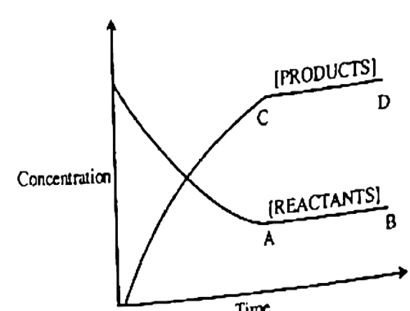
How to Identify a Reaction at Equilibrium
· At equilibrium, certain observable properties become constant depending on the type of reaction. Such properties include:
·Concentrations of the reactants and products;
·Pressure of gases; Density or intensity of colour of a solution;
·Temperature of the system.
Properties of systems at equilibrium
1.The equilibrium is dynamic; that is,
·The reactants and products are present at equilibrium, i.e. equilibrium can be achieved from either direction:
H2 +I2 →2HI(g)
2HI(g) → H2(g) +I2(g)
2. The concentrations of the reactants and pro-ducts, pressure, density or intensity of colour, and the temperature of the system are constant -depending on the type of the reaction.
3. The rates of forward and backward reactions are equal.
4. The equilibrium position is not affected by the presence of a catalyst; it only quickens the rate at which equilibrium is achieved.
5.At equilibrium, the free energy change, ΔG, of the reaction is zero.
6.A system at equilibrium will resist a change.
Information from an Equilibrium Equation The following information can be obtained from an equation of a typical reversible reaction:
N2(g)+3H2(g) → 2NH3(g) ΔH=-92.0kJ
1.The two opposing reactions are occurring at the same time-as indicated by the opposing arrows.
2. The two opposing reactions are at equilibrium.
3. The amounts, in moles, of the reactants and pro-ducts at equilibrium are proportional to the stoichiometry in the balanced equation.
4.The forward reaction is exothermic (ΔH is -ve); hence, the backward (or reverse) reaction will be endothermic (ΔH is +ve), i.e.
2NH3(g) → N2 (g)+3H2(g) ΔH=+92.0kJ
Limitations of an Equilibrium Equation
An equilibrium equation does not provide the following information in respect of the reaction:
1.The time taken for equilibrium to be achieved.
2. The concentrations of the reactants and products at equilibrium.
3.The mechanism of the reaction.
Equilibrium Constants
Equilibrium Constant, Kc
Equilibrium Law
Like the rate law, the equilibrium law is based the law of mass action, which states that:
The rate at which a reaction proceeds is directly pro-active species in the system.
Consider a reversible reaction:
 →
 D
The rate of forward reaction, rr is:

Similarly, th rate of backward reaction, rb is:

where kr and kp are the rate constants for the forward and reverse reactions respectively.
At equilibrium, the rates of forward and backward reactions are equal,
Hence, kr[A][B] = kb[C][D]
On rearranging, equation 3 becomes:
Kf/Kb = [A][B]/[C][D] = Kc
The ratio kf/kb is a constant; it is called equilibrium constant, Kc, when concentration terms are used. Hence, Kc is the ratio of the forward and reverse rate constants.
Generally, the equilibrium constant, Kc is the ratio of the concentrations of products and reactants at equilibrium, at a given temperature:
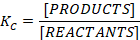
The expression above is called the equilibrium law.
• Reaction of reactants goes in forward and backward reaction at the same time and rate. At a certain time, the rate of the forward reaction and backward reaction will be the same. Then, the reaction is said to have reached equilibrium. Hence the [Reactants] and [Product] are constant
• If aA + bB ↔ cC + dD
• Keq = [C]c[D]d/[A]a[B]b
• For example, H2g + I2g ↔ 2HIg
• Keq = [HI]2 /[H2][I2]
• Some reactions are heterogeneous, i.e. the reactants and products are in more than one states in a reaction. The Keq for the reaction is called heterogeneous Keq
• The concentration of solids and liquids reactant or product are not included in the equation for equilibrium constant. For example, in the reaction shown below,
• CaCO3(s) CaO(s) + CO2(g) the Keq = [CO2(g)]
• In the reaction of CO2g + 2H2g CH3OHl the
• Keq = 1/[CO2][H2]2
• If we know the concentrations of the reactants and the products, we can calculate the Keq for any reaction
• For example, in the reaction of H2g + I2g ↔ 2HIg with the following concentrations:
• 0.1M 0.2M 1.0M
• Keq = [HI]2 /[H2][I2]
• = [1.0]2/[0.1][0.2] = 0.4
Using Keq to Predict Direction of Reaction
• If Ag ↔ Bg, Keq = [B]/[A]
• If Keq is large, then [B] >>>> [A], the more product will be formed by the time equilibrium is reached. Hence the direction of reaction is towards the right. The converse is also true
• Le Chatellier's Principle
• Changes in conditions of reactions such as P, C, T, when a reaction is already in equilibrium, changes the position of equilibrium
• Le Chatellier's says that when a stress (change) is placed on a system already at equilibrium, the equilibrium will change (shift) in the direction that relieves the stress
• If a system is in equilibrium and a factor of equilibrium such as concentration is changed while others remain constant, Keq will not change but the concentration of the other components and the direction of equilibrium will change so as to keep Keq constant
• Effect of Change in Concentration: For example: PCl5g ↔ PCl3g + Cl2g
• Keq = [PCl3][Cl2]/[PCl5]= 0.42
• If [PCl5] is changed by adding mor PCl5, while P, T are constant, the concentrations of PCl3 and Cl2 will change, but Keq will not change but moves in the direction of the product.
• If [PCl3] and [Cl2] are increased, equilibrium will not change but shift towards the PCl5 while its value remains constant
• Effect of a Catalyst: Addition of a catalyst to a reaction either fastens or slows down the rate of a reaction
• Changes in Volume and Pressure: Volume and pressure are inversely related to each other. But changes in their value will only change the direction of equilibrium and not its value
• Changes in Temperature: When Temperature is increased, the KE increase in
• the forward direction
• If the reaction is endothermic and the temperature is increased, the Keq will increase and more products will be formed, hence the direction of equilibrium will be towards the right. If the temperature is lowered, equilibrium will shift to the left and the reaction will become exothermic.
Equilibrium Constant in a Saturated Solution
In a saturated solution, some undissolved reactants are in contact with the
maximum number of dissolved solutes. At equilibrium, the rate of dissolution will be equal to the rate of crystallization at a fixed temperature.
RACK YOUR BRAIN
Define (i) Rates of a reaction (ii) activation energy
• How does equilibrium constant responds to the change in concentration of Chlorine in the reaction shown below:
• PCl5g ↔ PCl3g + Cl2g
• If the equilibrium constant of a reaction is written as shown below, write the equation for the reaction:
• Keq = [HI]2 /[H2][I2]
• Write the equilibrium equation for the reactions shown below
• CaCO3s → CaOs + CO2g
• CO2g + 2H2g → CH3OHl
• State Le Chatellier's principle?
• A loaf of bread consists of 20 slices. It took Nwachukwu 15 minutes to eat the 20 slices. What is the rate at which Nwachukwu ate the bread
• State 4 parameters that affects the rate of a reaction. Briefly describe how each one of them affects the rate of a reaction
• If a reaction is expressed as shown below, write an equation for its equilibrium constant
If aA + bB ↔ cC + dD