RADIOACTIVITY
BRIEF HISTORY OF RADIOACTIVITY
Radioactivity was discovered in 1896 by scientists Henri Becquerel and Marie Skłodowska-Curie, while working with phosphorescent materials. These materials glow in the dark after exposure to light, and Becquerel suspected that the glow produced in cathode ray tubes by X-rays might be associated with phosphorescence. He wrapped a photographic plate in black paper and placed various phosphorescent salts on it. All results were negative until he used uranium salts. The uranium salts caused a blackening of the plate in spite of the plate being wrapped in black paper. These radiations were given the name "Becquerel Rays"
The emission of ionizing radiation or particles caused by the spontaneous disintegration of atomic nuclei (the breaking down of something into small particles or into its constituent elements). This is done by an atomic nucleus that, for some reason, is unstable; it "wants" to give up some energy in order to shift to a more stable configuration.
March 1, 1896: Henri Becquerel Discovers Radioactivity.
In one of the most well-known accidental discoveries in the history of physics, on an overcast day in March 1896, French physicist Henri Becquerel opened a drawer and discovered spontaneous radioactivity.
What is Radioactivity?
Radioactivity is the spontaneous decay or disintegration of the nucleus of an atom with the emission of radiations and a large quantity of heat.
Radioactivity is due to energy changes occurring within the nucleus of the atom. Any substance capable of undergoing radioactivity is radioactive e.g. Uranium, radium, radon and carbon-14.
Cause of Radioactivity
There are two classes of naturally occurring isotopes of elements: stable and unstable isotopes.
a. Atoms of stable isotopes consist of nuclei with approximately equal numbers of protons and neutrons. For instance: The two isotopes of chlorine have proton-to-neutron ratios of 17:18 and 17:20, while those of oxygen are 8:8, 8 :9 and 8:10. Such isotopes are stable.
b. Atoms of unstable isotopes consist of nuclei with much more neutrons than protons. For instance: Uranium-238 with atomic number 92 has a nucleus of 92 protons and 146 neutrons. The nuclei of atoms of elements with atomic numbers greater than 83 are unstable.
The basis of radioactivity is the instability in isotopic atoms. An unstable isotope tends to become stable by emitting nuclear particles and radiations. Hence, an unstable isotope is radioactive; so also, artificial isotopes.
Laws of Radioactivity
- Radioactivity is the result of the decay of the nucleus.
- The nucleus’s decay rate is independent of temperature and pressure.
- Radioactivity is dependent on the law of conservation of charge.
- The emission of energy from radioactivity is always accompanied by alpha, beta, and gamma particles.
- The rate of decay of radioactive substances is dependent on the number of atoms that are present at the time.
Examples of Radiations in Everyday Life
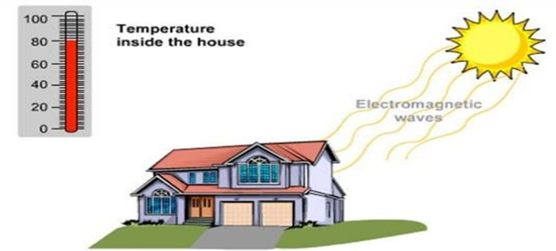
One of the most important sources of energy is the Sun. The cosmic radiation emitted from the Sun is a mixture of electromagnetic waves; which range from infrared (IR) to ultraviolet rays (UV). In addition, it also emits visible light. Most of the radiation emitted by the Sun is absorbed by the atmosphere. However, the part which is not absorbed by the atmosphere reaches the earth. Humans are exposed to this part of the radiation almost all times
BURNER
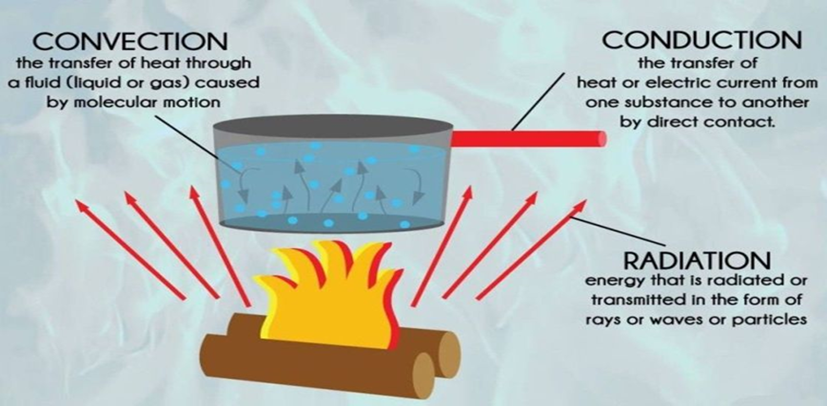
While boiling water or cooking food, you are yet again exposed to radiation. The visible sign of radiation is when you heat up a substance as much as you can, say, for example, heating a stove for a long time will make it glow red. This is a visible sign of radiation. However, even if it is visibly not glowing, then also it radiates heat. Moreover, if the stove and the bottom of the pan are not in contact physically, radiation is responsible for transferring heat from the stove to the pan.
3. Stereo
Radio waves are most commonly used in communication. Television, cell phones, and radios utilise radio waves and, in turn, convert them into vibrations so that sound waves can be created. The artificial sources of radio waves include electrical generators, power lines, appliances and radio transmitters.
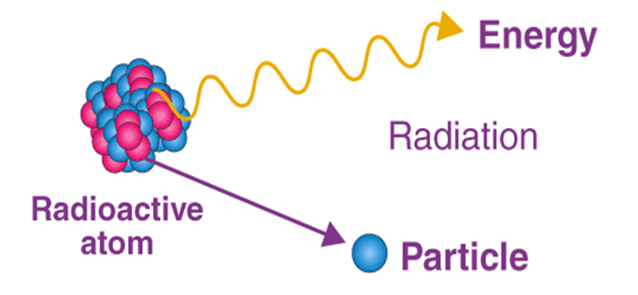
During radioactivity, particles like alpha, beta & gamma rays are emitted by an atom, due to unstable atom trying to gain stability. Hence, the atoms eventually decay by emitting a particle that transforms when they are unstable and transforms the nucleus into a lower energy state. This process of decaying continues till the nucleus attains a stable stage.
Types of Radiations
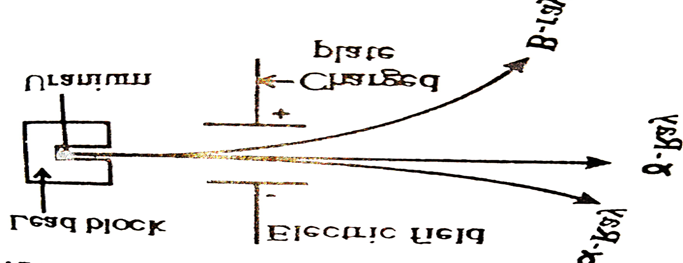
Ernest Rutherford (1904), a physicist, studied the nature of radiations emitted during radioactivity; by subjecting the radiations from a small piece of uranium salt to a strong electromagnetic field. Three types of radiations were identified: alpha (α)rays, beta (β) rays and gamma (γ) rays.
• Alpha (Helium nucleus is emitted)
• Beta (Electrons are emitted)
• Gamma (High energy photons are emitted)
He discovered that the alpha and beta rays were deflected in opposite directions by the magnetic field, while the gamma rays were not deflected at all
Properties of the Radioactive Radiations
1. Alpha (a) Rays
a. Alpha rays consist of positively charged particles; hence, they are deflected towards the negative pole of the electromagnetic field.
b. They are massive; hence, only slightly deflected.
c. They have the longest wavelength; hence, the least energetic. They move with a velocity of about one tenth that of light, and have the least penetrating power: a sheet of paper or thin aluminium foil can stop them.
d. Being massive, they cause ionization on collision with particles on their path; they cause substances, such as zinc blend, ZnS, to fluorescence, i.e. glow brightly.
Naturally, a -particles have mass units of 4, and are regarded as the nuclei of helium atoms.
Beta (β) Rays
a. Beta rays consist of negatively charged particles; hence, they are deflected towards the positive pole of the electromagnetic field.
b. They are less massive than the α-particles; hence, more deflected towards the positive pole.
c. They have a shorter wavelength than the α-particles; hence, more energetic, move faster, and have a higher penetrating power than the α-particles. They will pass through a sheet of paper or a aluminium foil; only a 5 mm thick foil or a sheet of aluminium can stop them.
d. They have less ionizing effect than the α-particles.
A beta particle is called an electron. It has neither proton nor neutron. Its nuclear symbol is °-1β or °-1e.
Gamma (γ) Rays
a. They are electromagnetic radiations that have no mass or charge, i.e. they are neutral; hence, they are not deflected at all by the magnetic field.
b. They have the shortest wavelength; hence, the most energetic. They move at the velocity of light and have the highest penetrating power. They can only be stopped by 15 cm thick steel or lead block.
c. Gamma rays have the least ionizing power.
Relative Energy of Radiations
When compared with X-rays, the order of increasing energy of the radioactive radiations is:
X-rays < α-rays < β-rays < γ-rays
Increasing Energy→
Increasing Penetrating Power →
Detection of Radioactive radiations
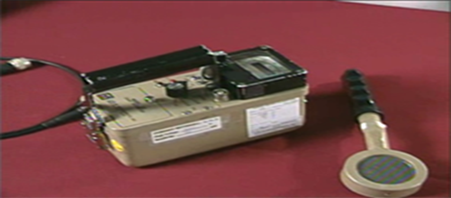
Radioactive radiations are not only harmful; they are dangerous - being invisible. The following devices or instruments can be used to detect the radiations:
1.Geiger-Muller counters.
2. Wilson diffusion cloud chamber.
3.Scintillation counter.
4. Photographic plate.
5.Fluorescent screen coated with zinc sulphide, ZnS.
Nuclear Reactions
Nuclear reactions occur in the nucleus of the atom of a radioactive element, due to energy changes. A nuclear reaction can be represented by a balanced nuclear equation. The atoms of different isotopes of an element are called nuclides.
A nuclear equation is balanced if the sum of the mass numbers of the nuclides on the left is equal to those on the right; and the sum of the atomic numbers on the left is equal to those on the right.
Example1. Balance the following nuclear equation and hence, identify X:
147N + X → 189F
Solution:
Let the nuclear symbol of X be AZX
147N + AZX → 189F
Considering the mass number on both sides:
14 +A =18
A=18-14
A=4
Considering the atomic number on both sides:
7 +Z = 9
Z = 9-7
Z=2
The nuclear symbol of X is 42X, therefore, it is an alpha particle.
Example 2: Balance the following nuclear equation
208O + 10n → 10Ne + 0-1e
Solution:
Let A represent the mass number of Ne, in the equation
Sum of mass numbers on both sides
20 + 1 = A + 0
A = 21
The sum of atomic numbers on the left is 8 + 0 =8. For the sum of the atomic numbers on the right to be equal to 8, there must be 2 of 0-1e; so that 10 + 2 (-1) = 10 – 2 =8. Hence, the balanced equation of reaction is:
208O + 10n → 218Ne + 2 0-1e
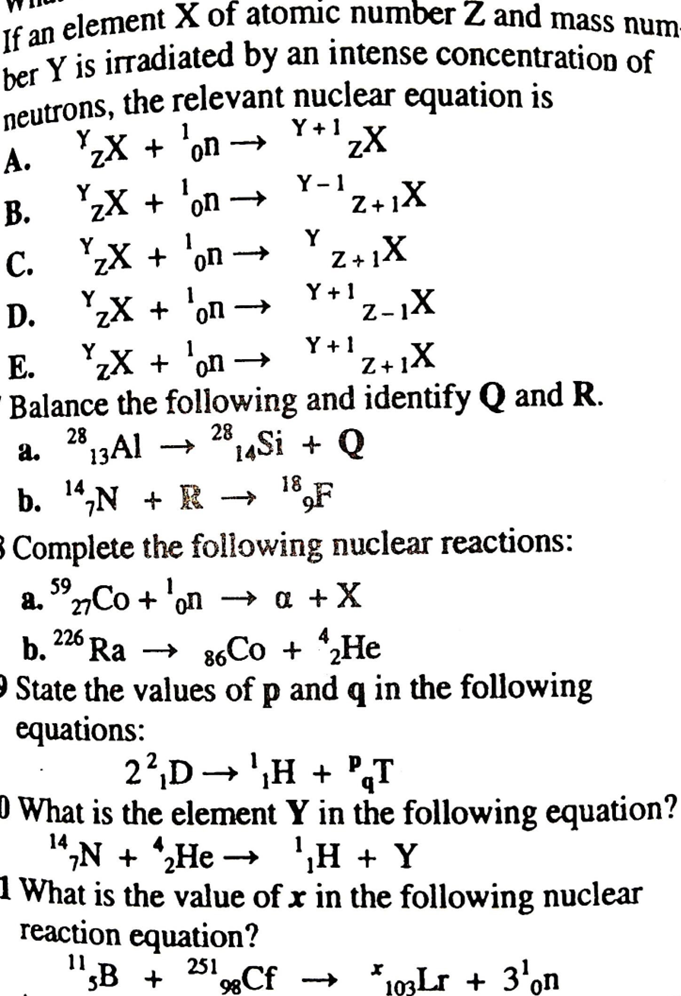
RACK YOUR BRAIN
Types of Nuclear Reactions
There are four types of nuclear reactions:
·Radioactive decay;
. Nuclear disintegration;
·Nuclear (atomic) fission;
·Nuclear (atomic) fusion.
Nuclear fission and nuclear fusion are the two nuclear reactions that provide the so-called nuclear energy.
What is Alpha Decay?
Alpha decay or α-decay is a type of radioactive decay in which the atomic nucleus emits an alpha particle thereby transforming or decaying into a new atomic nucleus. Here the atomic mass number of the newly formed atom will be reduced by four and the atomic number will be reduced by two. The emitted alpha particle is also known as a helium nucleus. The mass of the alpha particles is relatively large and has a positive charge.
Ernest Rutherford distinguished alpha decay from other forms of radiation by studying the deflection of the radiation through a magnetic field. The deflection of alpha decay would be a positive charge as the particles have a +2e charge.
Alpha Decay Equation
In α-decay, the mass number of the product nucleus (daughter nucleus) is four less than that of the decaying nucleus (parent nucleus), while the atomic number decreases by two. In general, the alpha decay equation is represented as follows:

Where,

A is the total no.of nucleons
Z is the total no.of protons


Alpha Decay Example
A well-known example of alpha decay is the decay of uranium.





What is Gamma Decay?
Gamma decay is the emission of electromagnetic radiation of an extremely high frequency i.e. very high energy, giving out excess energy in order to stabilize the unstable nucleus. You must be quite familiar with the various energy levels in an atom. The Nucleus has its own energy levels. Gamma decay is the nucleus’s way of dropping from a higher energy level to a lower energy level through the emission of high energy photons. The gamma rays emitted can be differentiated from x-rays only by the fact that gamma rays come from the nucleus. Due to their high energy, they are extremely penetrating and thereby dangerous to biological life forms.
SOURCES OF GAMMA RAYS
They are produced by the hottest and most energetic objects in the universe, such as neutron stars and pulsars, supernova explosions, and regions around black holes. On Earth, gamma waves are generated by nuclear explosions, lightning, and the less dramatic activity of radioactive decay.
Examples
1.Theγ-decayofbarium-137.
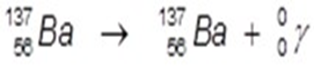
In this example, the parent atom is lowered in energy.
2. The γ-decay of plutonium-240.
In this example, the parent atom is lowered in energy.
What is Beta Decay?
Beta Decay is a type of radioactive decay in which a proton is transformed into a neutron or vice versa inside the nucleus of the radioactive sample. Processes like beta decay and alpha decay allow the nucleus of the radioactive sample to get as close as possible to the optimum neutron/ proton ratio. While doing so, the nucleus emits a beta particle which can either be an electron or positron. Remember that there either a proton can turn into a neutron or a neutron into a proton. Electron and the positron are generated to obey the law of conservation of charge. Beta-decay occurs via weak interaction.
What happens in Beta Decay
Beta decay is a radioactive decay in which a beta ray is emitted from an atomic nucleus. During beta decay, the proton in the nucleus is transformed into a neutron and vice versa. If a proton is converted to a neutron, it is known as β+ decay. Similarly, if a neutron is converted to a proton, it is known as β– decay. Due to the change in the nucleus, a beta particle is emitted. The beta particle is a high-speed electron when it is a β– decay and a positron when it is a β+ decay. Beta particles are used to treat health conditions such as eye and bone cancer and are also used as tracers.
Types of Beta Decay
There are two beta decay types: beta minus (β–) and beta plus (β+).
Beta-Minus Decay
- In beta minus, a neutron is transformed to yield a proton, causing an increase in the atom’s atomic number. The neutron is neutral, but the proton is positive.
- To maintain the conservation of charge, the nucleus in the process also produces an electron and an antineutrino.
- Antineutrino is the antimatter counterpart of neutrino. Both of these are neutral particles with negligible mass. They interact with matter very weakly and can even pass through the entire earth without being disturbed.
Beta-Plus Decay
- In beta plus decay, the proton disintegrates to yield a neutron causing a decrease in the atomic number of the radioactive sample. The nucleus experiences a loss of proton but gains a neutron.
- Again, conservation of charge is important. The beta plus decay in order to obey the conservation law also yields a positron and a neutrino.
- A positron is the antimatter equivalent of an electron; the same in all aspects except that a positron has a positive charge.
Beta plus decay can happen only if the daughter nucleus is more stable than the mother nucleus. This difference goes into the conversion of a proton into a neutron, a positron and a neutrino. There is no increase in mass number because a proton and a neutron have the same mass.
Examples
If the proton and neutron are part of an atomic nucleus, the above described decay processes transmute one chemical element into another. For example:
|
|
|
→ |
+ |
+ |
(beta minus decay) |
||||
|
|
|
→ |
+ |
+ |
(beta plus decay) |
||||
|
+ |
→ |
+ |
|
|
(electron capture) |
Nuclear Disintegration
Nuclear disintegration is an artificial radioactivity in which the nucleus of a non-radioactive atom, a is stable isotope, is bombarded with nuclear particles, to produce an artificial radioisotope or cause atomic transmutation.
a. Formation of Artificial Radioisotopes An artificial radioisotope is obtained when a neutron or a γ-ray bombards a stable isotope:
i. Neutron Bombardment
· When a neutron bombards the atom of the stable non-radioactive uranium-238, radioactive uranium-239 is produced:
23892U +1 0n → 23992U
(non-radioactive) (radioactive)
· When the stable cobalt-59 captures a neutron bullet, radioactive cobalt-60 is obtained:
5927Co + 10n → 6027Co
(non-radioactive) (radioactive)
ii. γ-ray Bombardment
·The stable beryllium-9 undergoes γ-ray bombardment to produce radioactive beryllium-8 with ejec-tion of a neutron:
94B
b. Atomic Transmutations
Atomic transmutation occurs when charged particles or fast-moving neutrons are used to bombard stable nuclei:
i. α-particle Bombardment
·When an α-particle bombards the atom of a stable non-radioactive nitrogen-14, radioactive oxygen-17 and a proton are produced:
147N + 42He → 178O + 11H + heat
ii. Proton Bombardment
168O+ 11H → 179F + γ-rays +heat
73Li + 11H → 2 42α + heat
iii. Fast-moving Neutron Bombardment
147N+10n→126C+11H
3.Nuclear Fission- A Chain Reaction
In a nuclear fission, the nucleus of an atom of a heavy radioisotope breaks into two nearly equal nuclei, with a release of large quantity of heat and radiation, which can cause a temperature rise of over one million degrees centigrade. It is usually a chain reaction, e.g.
When radioactive uranium-235 captures a fast-moving neutron, nuclear fission occurs; it leads to the formation of nuclei of strontium and xenon, three new neutrons and a large quantity of heat.
 →

The uniqueness of this nuclear reaction is that three new neutrons are ejected during the process. Each of them goes to initiate the fission of another nucleus of uranium atom; leading to a chain nucl-ear reaction:
leading to a chain nucl-ear reaction:
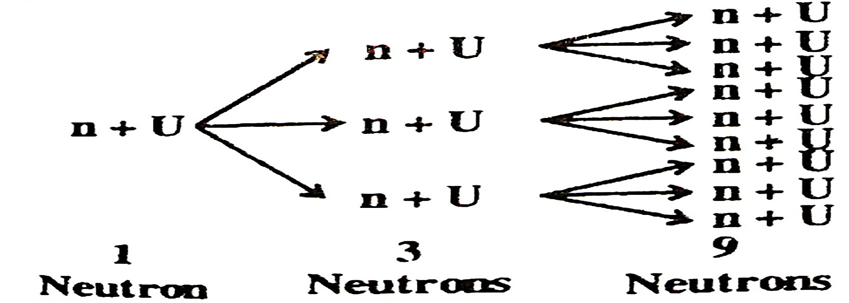
Uses of Nuclear fission: The process is used to generate electricity, and to produce new elements, radioisotopes, and nuclear bombs.
4. Nuclear Fusion: Nuclear fusion is the opposite of nuclear fission. In a nuclear fusion, two or more light nuclei combine to produce a single heavier nucleus.
Such a reaction occurs at extremely high temperatures, i.e., nuclear fusion requires extremely high activation energy. The reaction can only take place in the sun, or where there is nuclear fission, e.g.
· When the nuclei of hydrogen atoms undergo atomic fusion in the sun, a-particles together with positrons are emitted; the heat liberated is responsible for the sunlight energy we are enjoying on earth!
· 41 1H →4 2α +2 01e + heat
· In the man-made (artificial) hydrogen bomb, the nuclei of deuterium and tritium (both are isotopes of hydrogen) undergo nuclear fusion to produce α-particles, neutrons and a large quantity of heat:
21D + 31T → 42α +1 0n + heat
Usually, the heat energy released during nuclear fusion is greater than that of nuclear fission.
Uses of Nuclear fusion: The process is used to produce new elements, radioisotopes, and atomic bombs.
Heat Liberated During Nuclear Reactions
In a chemical reaction, there is conservation of mass; there is no conservation of mass in a nuclear reaction. Reason: Nuclear processes are usually accompanied by mass loss, i.e. total mass of product is less than total mass of reactants. The large quantity of heat liberated is as a result of the conversion of the mass loss to heat e.g.
In the nuclear fission of uranium-235, there is a mass loss of 0.20g per mole. The quantity of heat associated with the mass loss can be calculated from the Einstein equation: ; where
E =energy in Joules,
 ass ios
 kg

Substituting:
 1010kJ
Half-life in Nuclear Processes
What is Half-life?
The half-life, t1/2 of a radioactive isotope is the time taken for a half of the original quantity to change or decay. The quantity can be in terms of number of atoms, its mass, in grams, etc.
Every radioactive element has its own half-life; it is constant for every decay process, and unaffected by temperature or pressure change. For instance:
The half-life of thorium-234 is 24 days. Suppose the original mass of pure thorium-234m=100g.
· In 24 days, 100 g of thorium decay to 1/2 of 100g,
· i.e. mass left, ... 1st half-life
· ·In another 24 days, the mass left, decay to 1/2 of 50 g, or 1/2 of 1/2 of 100 g.
· i.e. mass left, …2nd half-life
· ·In another 24 days, the mass left,
 decay to 1/2 of 25 g, or 1/2 of 1/2 of 1/2 of 100 g.
· i.e. mass left, 3rd half-life
· It will be noticed that:
· In the 1st half-life, mass left, x1 1=1/2 of m.
· In the 2nd half-life,
· mass left, x2 = (1/2)2 of m or (m/22)
And so on;
Generally, expression for a decay process is:
X = m/2n
(Where m= initial quantity; x= the quantity left after a given number of half-lives, n)
x/m = fraction that is left.
2. I n the 3rd half-life,
mass left, 

d. In the nth half-life,
mass left,
The general expression for a decay process is:

(where; m =initial quantity, x=quantity left
after a given number of half-lives, n).
 fraction that is left.
 hatt has decayed.
 raction that has decayed.
Number of half-lives, n= (Period of decay)/(Half-life)
2. The half-life of a radioactive element is 10 days. If you start with 100 g, how much will remain after 10 days?
Solution:
After one half-life (10 days), half of the substance remains.
100 g ÷ 2 = 50 g
Answer: 50 g remains after 10 days.
3. The half-life of a substance is 5 hours. If you have 80 g, how much will be left after 10 hours?
Solution:
10 hours = 2 half-lives (because 10 ÷ 5 = 2)
After first half-life (5 hours):
80 g ÷ 2 = 40 g
After second half-life (10 hours):
40 g ÷ 2 = 20 g
Answer: 20 g remains after 10 hours.
4. A sample decreases from 160 g to 20 g. How many half-lives have passed?
Solution:
160 → 80 → 40 → 20
That’s 3 half-lives.
Answer: 3 half-lives.
5. A radioactive substance has a half-life of 2 days. If you start with 32 g, how much will remain after 6 days?
Solution:
6 ÷ 2 = 3 half-lives
32 → 16 → 8 → 4
Answer: 4 g remains after 6 days.
6. After 2 half-lives, 25 g of a substance remains. What was the original amount?
Solution:
After 1st half-life → 25 g × 2 = 50 g
After 2nd half-life → 50 g × 2 = 100 g
Answer: The original amount was 100 g.
7. A radioactive substance has a half-life of 4 days. If the starting amount is 200 g, how much remains after 4 days?
Solution:
One half-life = 4 days → the substance reduces to half.
200 g ÷ 2 = 100 g
Answer: 100 g remains after 4 days.
8. A substance has a half-life of 3 hours. If you begin with 64 g, how much is left after 6 hours?
Solution:
6 ÷ 3 = 2 half-lives
1st half-life: 64 g → 32 g
2nd half-life: 32 g → 16 g
Answer: 16 g remains after 6 hours.
9. A substance starts at 48 g. After some time, only 6 g is left. How many half-lives have passed?
Solution:
48 → 24 → 12 → 6
That’s 3 half-lives.
Answer: 3 half-lives passed.
10. A substance has a half-life of 5 minutes. After 20 minutes, only 6.25 g remains from an original 100 g. How many half-lives passed?
Solution:
20 ÷ 5 = 4 half-lives
Let’s confirm:
100 → 50 → 25 → 12.5 → 6.25
Answer: 4 half-lives, or 20 minutes passed.
11. After 2 half-lives, a sample has 12.5 g remaining. What was the original amount?
Solution:
After 1st half-life: 12.5 × 2 = 25 g
After 2nd half-life: 25 × 2 = 50 g
Answer: The original amount was 50 g.
N=N0(1/2)t/T
Where:
- N = remaining quantity
- N0 = original quantity
- t = time elapsed
- T = half-life
- (1/2)t/T = fraction remaining
RACK YOUR BRAIN
1. A substance has a half-life of 10 days. If 25 g remains from an original 200 g, how many days have passed?
2. A 200 g sample of a substance has a half-life of 5 years. How much remains after 15 years?
3. A 100 g substance decays to 12.5 g in 18 hours. What is its half-life?
4. A 50 g sample decays to 10 g in time ttt. If the half-life is 3 hours, find t.
5. A radioactive isotope has a half-life of 24 minutes. If you start with 500 g and only 62.5 g remains, how much time has passed?
6. A 200 g sample decays to 20 g in 30 hours. What is the half-life?
7. A substance with a half-life of 5 years starts at 240 g. How much remains after 12 years?
8. A sample decreases from 160 g to 10 g. How many half-lives have passed?
9. Write an equation for the decay of a 100 g substance with a half-life of 6 hours, and use it to find the amount remaining after 9 hours.
Decay Constant
Radioactive isotopes decay according to first-order kinetics. It can be shown that the quantity, 0.6931/k, is known as half-life; where k is the decay (rate) constant, i.e. t1/2=0.6391/k.
The half-life period of a radioactive element is a measure of the degree of radioactivity, and the relative stability of its atoms. The longer the half-life, the slower the rate of decay and the more stable the atoms of the element. Conversely, the shorter the half-life, the faster the rate of decay and the less stable the atoms of the element.
The decay process of a radioactive element is unaffected by physical and chemical changes.
Nuclear Reactor
A nuclear reactor is a device in which the large quantity of heat produced during fission reaction of a radioactive element is controlled to generate electricity.
In a nuclear reactor, an atomic pile made of rods of uranium-235 serves as the nuclear fuel and the source of energy. The rods of graphite, which surrounds the rods of uranium acts as moderators: to slow down the fast-moving neutrons - without absorbing them and make them available for the chain reactions.
Moveable rods of boron or cadmium are inserted between the rods of uranium-235, in order to absorb the neutrons and control the chain reactions, and hence, obtain a steady and continuous product-ion of heat.
The nuclear reactor is made of a thick concrete structure, which acts as a shield, and provides protection against radioactive radiation fallouts.
The large quantity of heat produced in the reactor is used in heating water in the boiler, and the steam generated is used in driving turbines, which generate electricity.
In order to sustain a chain reaction, the quantity of uranium-235 must be large enough. The quantity of a radioactive substance required to sustain a chain reaction is called the critical size. Above the critical size, explosion is possible.
Uses of Radioactivity
- Radiation is used in a number of different ways:
- Medical procedures including diagnosis and treatment of cancer
- Sterilising food (irradiating food)
- Sterilising medical equipment
- Determining the age of ancient artefacts
- Checking the thickness of materials
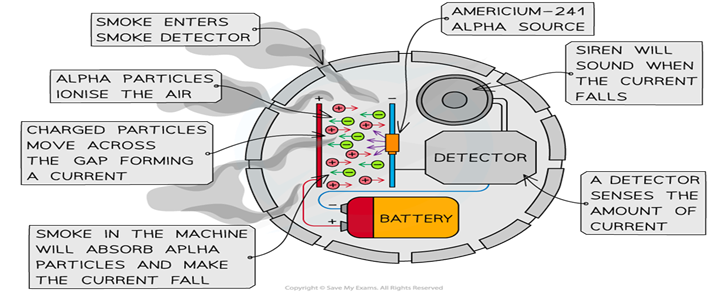
- Smoke detectors (alarms)
Smoke Detectors
- Alpha particles are used in smoke detectors
- The alpha radiation will normally ionise the air within the detector, creating a current
- The alpha emitter is blocked when smoke enters the detector
- The alarm is triggered by a microchip when the sensor no longer detects alpha
Diagnosis and Treatment of Cancer
- Radiotherapy is the name given to the treatment of cancer using radiation
(Chemotherapy is treatment using chemicals)
- Although radiation can cause cancer, it is also highly effective at treating it
- Radiation can kill living cells. Some cells, such as bacteria and cancer cells, are more susceptible to radiation than others
- Beams of gamma rays are directed at the cancerous tumour
- Gamma rays are used because they are able to penetrate the body, reaching the tumour
- The beams are moved around to minimise harm to healthy tissue whilst still being aimed at the tumour
- A tracer is a radioactive isotope that can be used to track the movement of substances, like blood, around the body
- A PET scan can detect the emissions from a tracer to diagnose cancer and determine the location of a tumour
Sterilising Food and Medical Equipment
- Gamma radiation is widely used to sterilise medical equipment
- Gamma is most suited to this because:
- It is the most penetrating out of all the types of radiation
- It is penetrating enough to irradiate all sides of the instruments
- Instruments can be sterilised without removing the packaging
- Food can be irradiated in order to kill any microorganisms that are present on it
This makes the food last longer, and reduces the risk of food-borne infections
HARMFUL EFFECT OF RADIATION
Radiation can be categorized into non-ionizing or ionizing depending on the radiated particle’s energy. Radioactive materials that emit α, β, or γ radiation are the common sources of ionizing radiation. Visible light, microwaves, infrared light, are the common sources of non-ionizing radiation. Both types of radiation are harmful to health even though they have few advantages.
1. Hair
Loss of hair fall occurs when exposure to radiation is higher than 200 rems.
2. Heart and Brain
Intense exposure to radiation from 1000 to 5000 rems will affect the functioning of the heart. Radiation kills nerve cells and small blood vessels of heart which may cause immediate death. Brain cells are affected if the radiation exposure is greater than 5000 rems.
3. Thyroid
Certain body parts are affected specifically when exposed to different types of radiation sources. The thyroid gland may be affected when exposed to radioactive iodine. If exposed to a considerable amount of radioactive iodine, whole or part of the thyroid can be affected.
4. Blood System
A number of lymphocytic cells present in the blood will be reduced if a person is exposed to 100 rems. This may cause several immune problems. This is termed as mild radiation sickness. As per the reports from Nagasaki and Hiroshima, symptoms may be present more than ten years from that exposure.
5. Reproductive Tract
As the cells of the reproductive tract divide fastly, these are more prone to be affected even if the exposure is not more than 200 rems