SPACE AND TIME/UNIT AND DIMENSION
| Site: | Newgate University Minna - Elearning Platform |
| Course: | General Physics I |
| Book: | SPACE AND TIME/UNIT AND DIMENSION |
| Printed by: | Guest user |
| Date: | Monday, 28 September 2026, 1:13 AM |
Description
This course introduces students to the fundamental principles of physics, focusing on physical quantities, units of measurement, and the concept of dimensions. It provides a strong foundation for understanding the quantitative aspects of physical laws and their practical applications.
1. SPACE AND TIME
SPACE AND TIME
1.0 Introduction:
In physics, space is where things happen, and time tells us when they happen. They are basic ideas we use to understand how everything in the universe moves and changes.
1.1 Space and Time
Space
space refers to the region in which objects exist and events occur. It provides the position or location of object.
Time
Time is the continuous progression of events from the past through the present into the future.
Importance of space and time in Physics
1. They can describe motion
2. They are used in measurements
3. They allow Physics to study events and changes.
The unit of space(length) is in meters (m) and Time in seconds (s).
DEFINITION OF PHYSICS AND PHYSICAL QUANTITIES
Physics: Physics is the branch of science, which deals with the study of nature and properties of matter and energy. The subject matter of physics includes heat, light, sound, electricity, magnetism and the structure of atoms.
For designing a law of physics, a scientific method is followed which includes the verifications with experiments. The physics, attempts are made to measure the quantities with the best accuracy. Thus, Physics can also be defined as science of measurement.
Applied Physics is the application of the Physics to help human beings and solving their problem, it is usually considered as a bridge or a connection between Physics & Engineering.
Physical Quantities: All quantities in terms of which laws of physics can be expressed, and which can be measured are called Physical Quantities.
For example; Distance, Speed, Mass, Force etc.
2. UNIT
1.2 UNITS: FUNDAMENTAL AND DERIVED UNITS
Measurement: In our daily life, we need to express and compare the magnitude of different quantities; this can be done only by measuring them.
Measurement is the comparison of an unknown physical quantity with a known fixed physical quantity.
Unit: The known fixed physical quantity is called unit. OR
The quantity used as standard for measurement is called unit.
For example, when we say that length of the class room is 8 metre. We compare the length of class room with standard quantity of length called metre.
Length of class room = 8 metre
Q = UN
Physical Quantity = Numerical value × unit Q = Physical Quantity
n = Numerical value u = Standard unit
e.g. Mass of stool = 15 kg Mass = Physical quantity 15 = Numerical value Kg = Standard unit
Means mass of stool is 15 times of known quantity i.e. Kg.
Characteristics of Standard Unit: A unit selected for measuring a physical quantity should have the following properties
(i) It should be well defined i.e. its concept should be clear.
(ii) It should not change with change in physical conditions like temperature, pressure, stress etc..
(iii) It should be suitable in size; neither too large nor too small.
(iv) It should not change with place or time.
(v) It should be reproducible.
(vi) It should be internationally accepted.
Classification of Units: Units can be classified into two categories.
1. Fundamental
2. Derived
Fundamental Quantity: The quantity which is independent of other physical quantities. In mechanics, mass, length and time are called fundamental quantities. Units of these fundamental physical quantities are called Fundamental units.
e.g. Fundamental Physical Quantity Fundamental unit
Mass Kg, Gram, Pound
Length Metre, Centimetre, Foot
Time Second
Derived Quantity: The quantity which is derived from the fundamental quantities e.g. area is a derived quantity.
Area = Length x Breadth
= Length x Length
= (Length)2
Speed =Distance /Time
=Length / Time
The units for derived quantities are called Derived Units.
1.2.1 Table of Fundamental Units
|
Sr. No. |
Name of Physical Quantity |
Unit |
Symbol |
|
1 2 3 4 5 6 7 |
Length Mass Time Temperature Electric Current Luminous Intensity Quantity of Matter |
Metre Kilogram Second Kelvin Ampere Candela Mole |
m Kg s K A Cd mol |
1.2.2Table of Supplementary unit
|
Sr. No |
Name of Physical Quantity |
Unit |
Symbol |
|
1 2 |
Plane angle Solid angle |
Radian Steradian |
rad sr |
3. SYSTEMS OF UNITS:
1.3 SYSTEMS OF UNITS: CGS, FPS, MKS, SI
For measurement of physical quantities, the following systems are commonly used:-
(i) F.P.S system: In this system, the unit of length is foot, the unit of mass is pound and the unit of time is second.
(ii) C.G.S system: In this system, the unit of length is centimeter, the unit of mass is gram and the unit of time is second.
(iii) M.K.S: In this system, the unit of length is metre, unit of mass is kg and the unit of time is second.
(iv) S.I System: This system is an improved and extended version of M.K.S system of units. It is called international system of unit.
With the development of science & technology, the three fundamental quantities like mass, length & time were not sufficient as many other quantities like electric current, heat etc. were introduced.
Therefore, more fundamental units in addition to the units of mass, length and time are required.
Thus, MKS system was modified with addition of four other fundamental quantities and two supplementary quantities.
Advantage of S.I. system:
(i) It is coherent system of unit i.e. the derived units of a physical quantities are easily obtained by multiplication or division of fundamental units.
(ii) It is a rational system of units i.e. it uses only one unit for one physical quantity. e.g. It uses Joule (J) as unit for all types of energies (heat, light, mechanical).
(iii) It is a metric system of units i.e. it’s multiples & submultiples can be expressed in power of 10.
4. DIMENSION
1.4 DIMENSIONS
Dimensions: The powers, to which the fundamental units of mass, length and time written as M, L and T are raised, which include their nature and not their magnitude.
For example, Area = Length x Breadth
= [ L1] × [L1] = [L2] = [M0L2T0]
Power (0,2,0) of fundamental units are called dimensions of area in mass, length and time respectively.
e.g. Density = mass/volume
= [M]/[L3]
= [ M1L-3T0]
5. DIMENSIONAL FORMULAR
1.5 DIMENSIONAL FORMULAE
Dimensional Formula: An expression along with the power of mass, length & time which indicates how physical quantity depends upon fundamental physical quantity.
e.g. Speed = Distance/Time
= [L1]/[T1] =[M0L1T-1]
It tells us that speed depends upon L & T. It does not depend upon M.
1.5.1 Dimensional Equation: An equation obtained by equating the physical quantity with its dimensional formula is called a dimensional equation.
The dimensional equation of area, density & velocity are given as under- Area = [M0L2T0]
Density = [M1L-3T0] Velocity = [M0L1T-1]
Dimensional formula SI& CGS unit of Physical Quantities
|
Sr. No. |
Physical Quantity |
Formula |
Dimensions |
Name of S.I unit |
|
1 |
Force |
Mass × acceleration |
[M1L1T-2] |
Newton (N) |
|
2 |
Work |
Force × distance |
[M1L2T-2] |
Joule (J) |
|
3 |
Power |
Work / time |
[M1L2T-3] |
Watt (W) |
|
4 |
Energy ( all form ) |
Stored work |
[M1L2T-2] |
Joule (J) |
|
5 |
Pressure, Stress |
Force/area |
[M1L-1T-2] |
Nm-2 |
|
6 |
Momentum |
Mass × velocity |
[M1L1T-1] |
Kgms-1 |
|
7 |
Moment of force |
Force × distance |
[M1L2T-2] |
Nm |
|
8 |
Impulse |
Force × time |
[M1L1T-1] |
Ns |
|
9 |
Strain |
Change in dimension / Original dimension |
[M0L0T0] |
No unit |
|
10 |
Modulus of Elasticity |
Stress / Strain |
[M1L-1T-2] |
Nm-2 |
|
11 |
Surface energy |
Energy / Area |
[M1L0T-2] |
Joule/m2 |
|
12 |
Surface Tension |
Force / Length |
[M1L0T-2] |
N/m |
|
13 |
Co-efficient of Viscosity |
Force × Distance/ Area × Velocity |
[M1L-1T-1] |
N/m2 |
|
14 |
Moment of inertia |
Mass × (radius of gyration)2 |
[M1L2T0] |
Kg-m2 |
|
15 |
Angular Velocity |
Angle / time |
[M0L0T-1] |
Rad.per sec |
|
16 |
Frequency |
1/Time period |
[M0L0T-1] |
Hertz |
|
17 |
Area |
Length × Breadth |
[M0L2T0] |
Metre2 |
|
18 |
Volume |
Length × breadth × height |
[M0L3T0] |
Metre3 |
|
19 |
Density |
Mass/ volume |
[M1L-3T0] |
Kg/m3 |
|
20 |
Speed or velocity |
Distance/ time |
[M0L1T-1] |
m/s |
|
21 |
Acceleration |
Velocity/time |
[M0L1T-2] |
m/s2 |
|
22 |
Pressure |
Force/area |
[M1L-1T-2] |
N/m2 |
6. VECTORS AND SCALARS
2.0 Scalar and Vector Quantities
Scalar Quantities: Scalar quantities are those quantities which has only magnitude but no direction. Examples: Mass, length, density, volume, energy, temperature, electric charge, current, electric potential etc.
Vector Quantities: Vector quantities are those quantities which has both magnitude as well as direction.
Examples: Displacement, velocity, acceleration, force, electric intensity, magnetic intensity etc.
Vector Addition
While scalars can be added or subtracted easily (e.g. 30cm+ 50cm = 90cm and 3m-2m = lm), vector addition takes into consideration not only the magnitude but the direction of the vectors. The method of calculation also depends on whether the vectors are acting in a straight line or at an angle to each other, illustrated by the following typical cases. In addition, vectors can be added using; triangle law and parallelogram law. These vectors can be resolved into horizontal and vertical components.
a. i Two parallel forces acting in same direction

The result force R = 70+90 = 160N
ii. Two forces acting in opposite direction in a straight line

the resultant force R = 90N-70N = 20N
a. Two forces acting perpendicularly (At right Angle or 900) to each other
The resultant R is the diagonal of the rectangle (If F1 and F2) are not equal to each other or the square of (If F1 = F2)
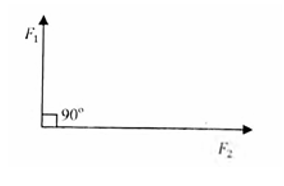
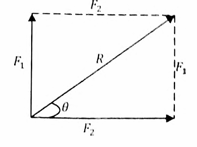
The resultant R is found using Pythagoras theorem;
R2 =  or R =
2.1 DISPLACEMENT, VELOCITY AND ACCELERATION
Speed
Speed is defined as distance moved by an object per unit time. It is a scalar quantity and is measured in metre per second (m/s or ms-1).
Velocity
Velocity is defined as distance travelled in a specified direction per unit time.
OR
Velocity is defined as displacement over time. It is a vector quantity and is also measured in metre per second (m/s or ms-1).
Both speed and velocity have the same unit, formula and dimension.
v = s/t
where v = velocity(speed) in m/s
s = displacement (distance) in m
t = time in seconds.
Examples on speed and velocity
1. An air force jet flying with a speed of 335m/s went past an anti-aircraft gun. How far is the aircraft 5s later when the gun was fired.
2. A student walks a distance of 3km in 20 minutes. Calculate his average speed.
3. A man cycles non-stop through a distance of 1.0km in 5minutes. Calculate his average speed.
4. 4. A car travels with a constant velocity of 45 km/hr for 20s. What distance does it cover in this time?
5. A marble rolls 5.2 m in 1.8 s. What was the marble's average speed
Rectilinear Acceleration
The term rectilinear acceleration means the rate of increase of velocity along a straight-line path in a unit time. When the velocity of an object changes it could be said to accelerate or decelerate. Acceleration is defined as the increasing rate of change of velocity with time. Deceleration on the other hand is defined as the decreasing rate of change of velocity with time.
Deceleration is also called retardation or negative acceleration.
Acceleration (Deceleration) = Change in velocity
Time taken for change
= F inal velocity - Initial velocity
Final time - Initial time
Equations of Uniformly Accelerated Motion
Equations of motion for a body traveling along a straight line with uniform acceleration are as follows:
v = u + at --------------------(1)
s = ut + ½ at2 --------------------(2)
v2 = u2 + 2as ---------------(3)
Always Remember:
1. When an object moves or accelerates from rest, its initial velocity, u = 0.
2. When a body comes to rest or stops, its final velocity, v = 0.
3. When a body’s velocity is constant or not changing, its acceleration, a = 0.
Examples:
1. A cyclist is travelling at 15 ms−1 at a distance of 18m, brakes so that she doesn’t collide with the wall. Calculate the magnitude of her deceleration.
2. Leaving a bus stop, a bus reaches a velocity of 8.0ms−1 after 10s. Calculate the acceleration of the bus.
3. A sprinter starting from rest has an acceleration of 5.0ms−2 during the first 2.0s of a race. Calculate her velocity after 2.0s.
4. A train slows down from 60ms−1 to 20 ms−1 in 50s. Calculate the magnitude of the deceleration of the train.
5. If a car starts from rest and moves with a uniform acceleration of 12m/s2 for 8s. What is the distance it's covers in the last 3sec of the motion?
6. A car moving with a speed of 90km/hr was brought to rest by the application of brakes in 10s. How far did the car travel after the brakes were applied?
Exercise
1. A body uniformly accelerates from rest at 8m/s2. In how much time will the body travel a distance of 2.5km?
2. A particle starts from rest and moves with a uniform acceleration of 4m/s2. What is its velocity after covering a distance of 8m?
3. A particle accelerates uniformly from rest at 6.0m/s2 for 8s and then decelerates uniformly to rest in the next 5s. Determine the magnitude of the deceleration.
4. A body accelerates uniformly from rest at the rate of 3ms-2 for 8s. Calculate the distance covered by the body during acceleration.
5. A bus driver moving at a velocity of 100km/hr suddenly sees a Goat Crossing the Highway 49m ahead. He hit hand on his brakes to get a maximum retardation of 8.0ms-2
a. How far does he go before stopping?
b. Can he avoid hitting the Goat?
6. A rocket lifts off from rest with an acceleration of 20ms−2. Calculate its velocity after 50s.
7. A car is travelling along a straight road at 8.0 ms−1. It accelerates at 1.0 ms−2 for a distance of 18 m. How fast is it then travelling?
8. A train travelling at 20ms−1 accelerates at 0.50ms−2 for 30s. Calculate the distance travelled by the train in this time.