
WORK, ENERGY AND MOMENTUM
The Properties of Matter course explores the fundamental characteristics that define and distinguish materials, focusing on both physical and mechanical attributes. Key concepts include density, which explains why oil floats on water; pressure, as seen in how sharp knives cut more effectively due to higher pressure over smaller areas; and elasticity, which is crucial in designing springs and shock absorbers. The course also covers floatation using Archimedes’ Principle, which helps explain how ships float despite their massive weight. Additionally, it examines surface tension, observable when insects like mosquitoes walk on water, and viscosity, which influences the flow of engine oils in automobiles.
1. Work and Kinetic Energy
Work and Kinetic Energy
Work and kinetic energy are connected by the work-energy theorem: the net work done on an object equals the change in its kinetic energy.
Work is done when a force moves an object through a distance in the direction of the force. If the work done on an object is positive, its kinetic energy increases; if the work is negative, its kinetic energy decreases.
The relationship is written as: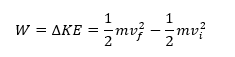
where is mass, is initial velocity, and is final velocity.
This means work transfers energy to or from an object. For example, when you push a cart and it speeds up, the work you do increases its kinetic energy.
Example
If a stationary ball is kicked and begins moving, the kick does work on the ball, and that work becomes kinetic energy. The greater the force or the distance moved, the more work is done and the more the kinetic energy changes.
Definition: work is defined as the product of Force and distance in the direction of the applied force. It's is simply the application of Force to move an object over a distance d, in the direction of the applied force. In addition, it's described by the equation: W = f.d
Example.
1. Doing homework. It's not work because objects are not moved from one place to another over a distance
2. Lifting a rock upwards off the ground. It work-done because the rock is moving toward the applied force.
3. Carrying a rock in a straight line or path across a lawn at a constant speed. It's not working. Recall from the laws of motion that force is not required to move an object at constant velocity.
Work done W = fxs
Or
W = mgxs
Resolving work in terms of magnitude and direction.
Let's assume force is applied at an angle to the horizontal or vertical. The work done will depend on the direction the object moves in.
Assume the box moves in the horizontal direction
W = Fcosxs or W = mgcosxs
Again, assume the box moves in the vertical direction, W = Fsinxs or mgsinxs
Where F = force in Newtons
M = mass in kg
S = distance in meters
g = acceleration due to gravity in ms^-2
w = work in Joules
Kinetic Energy: It is the energy an object has because of its motion. The faster an object moves, or the more mass it has, the greater its kinetic energy. Any moving object has kinetic energy, whether it is a rolling ball, a moving car, or flowing water. If the object stops moving, its kinetic energy becomes zero. It depends on the mass of an object and its velocity
Energy is defined ability or capacity to do work. Energy can take a variety of forms, and one form of energy can transform into another.
Potential energy: Also called stored energy, comes in several forms. Potential energy is the energy stored in an object because of its position, condition, or arrangement. In simple terms, it is energy that has the potential to be converted into motion or other forms of energy later. For instance, if a force is applied to lift a rock off the ground, it increases the rock's potential energy, PE. However, if we drop the rock, the force of gravity increases the rock's KE as the rock moves downward until it hits the ground. The force exerted to lift the rock is equal to its weight, which is equal to its mass, multiplied by acceleration due to gravity g and the distance to which the rock was lifted F = W = mg. Hence PE = mgh (Energy possessed by a body at rest or height)
Examples:
1. A constant force of 80N acting on a body initially at rest gives an acceleration of 0.3 m/s2 for 8s. Calculate the work done by the force.
2. A boy drags a bag of Rice along a smooth horizontal floor surface with a force of 2N applied at a. Angle 60° to the floor. Determine the work done at distance of 3m.
3. A pulley of efficiency lifts 54kg of water through a height of 33m in 12s. Calculate the power of the pulley?
Gravitational Potential Energy
Gravitational potential energy (GPE) is the energy stored in an object due to its position in a gravitational field, usually because it is raised above some reference level (such as the ground). This energy can be converted into kinetic energy when the object falls under gravity, obeying the law of conservation of energy.
Gravitational potential energy is a type of potential energy associated with the gravitational force between masses. For an object near Earth’s surface, GPE is the work done to lift the object against gravity from a chosen zero‑level (often the ground) to its present height, without changing its speed. Example:
· When you lift a book and hold it above the desk, the chemical energy in your muscles is partly stored as gravitational potential energy in the book–Earth system.
For most introductory physics problems, where the gravitational field is approximately constant (magnitude), the gravitational potential energy of a mass at height above a reference level is U=mgh
Note:
- The value of depends on the choice of the reference level (you can set at the ground, floor, tabletop, etc.), but changes in GPE are what matter for energy calculations.
- GPE increases with mass, height, and the strength of the gravitational field.