
WEB BASIC OVERVIEW
Working process of the internet
The internet works with the help of clients and servers. A device such as a laptop, which is
connected to the internet is called a client, not a server as it is not directly connected to the
internet. However, it is indirectly connected to the internet through an Internet Service Provider
(ISP) and is identified by an IP address, which is a string of numbers. Just like you have an
address for your home that uniquely identifies your home, an IP address acts as the shipping
address of your device. The IP address is provided by your ISP, and you can see what IP address
your ISP has given to your system.
A server is a large computer that stores websites. It also has an IP address. A place where a
large number of servers are stored is called a data center. The server accepts requests send by
the client through a browser over a network (internet) and responds accordingly.
To access the internet we need a domain name, which represents an IP address number, i.e.,
each IP address has been assigned a domain name. For example, youtube.com, facebook.com,
paypal.com are used to represent the IP addresses. Domain names are created as it is difficult
for a person to remember a long string of numbers. However, internet does not understand the
domain name, it understands the IP address, so when you enter the domain name in the browser
search bar, the internet has to get the IP addresses of this domain name from a huge phone
book, which is known as DNS (Domain Name Server). For example, if you have a person's
name, you can find his phone number in a phone book by searching his name. The internet uses
the DNS server in the same way to find the IP address of the domain name. DNS servers are
managed by ISPs or similar organizations.
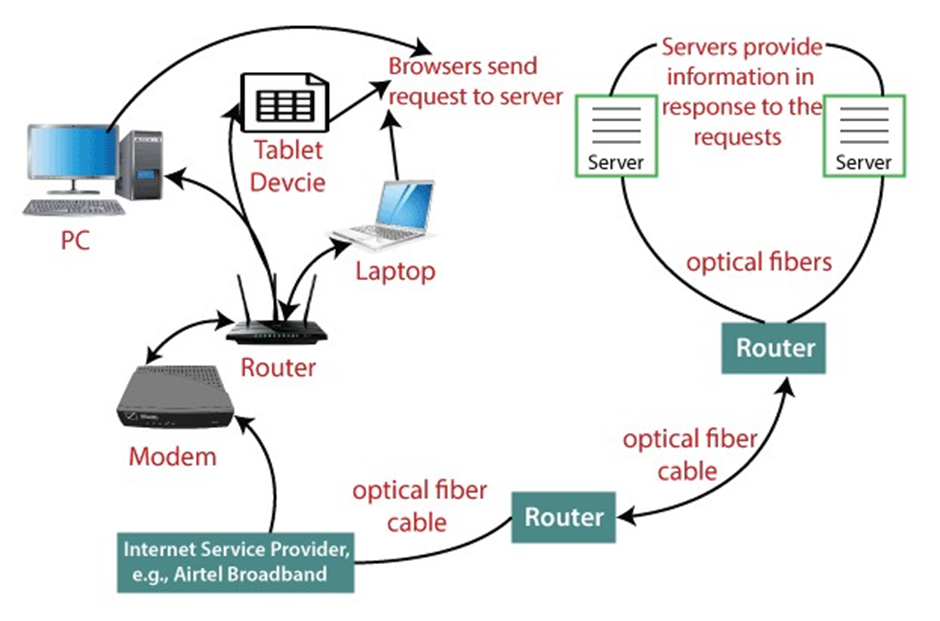
When you turn on your computer and type a domain name in the browser search bar, your
browser sends a request to the DNS server to get the corresponding IP address. After getting
the IP address, the browser forwards the request to the respective server.
Once the server gets the request to provide information about a particular website, the data
starts flowing. The data is transferred through the optical fiber cables in digital format or in the
form of light pulses. As the servers are placed at distant places, the data may have to travel
thousands of miles through optical fiber cable to reach your computer.
The optical fiber is connected to a router, which converts the light signals into electrical signals.
These electrical signals are transmitted to your laptop using an Ethernet cable. Thus, you
receive the desired information through the internet, which is actually a cable that connects you
with the server.
Furthermore, if you are using wireless internet using wifi or mobile data, the signals from the
optical cable are first sent to a cell tower and from where it reaches to your cell phone in the
form of electromagnetic waves.
The internet is managed by ICANN (Internet Corporation for Assigned Names and Numbers)
located in the USA. It manages IP addresses assignment, domain name registration, etc.
The data transfer is very fast on the internet. The moment you press enter you get the
information from a server located thousands of miles away from you. The reason for this speed
is that the data is sent in the binary form (0, 1), and these zeros and ones are divided into small
pieces called packets, which can be sent at high speed.