
1. Definition of Sound
9. SPEECH ORGANS AND THEIR FUNCTIONS
Speech organs are part of mouth content and other organs used in producing sounds of any given language. The sound system makes use of different organs for different sounds. In consonant sounds, two organs must come in contact to block the flow of air but there is always a free flow of air in the production of vowel sounds.
DIAGRAMME OF SPEECH ORGAN
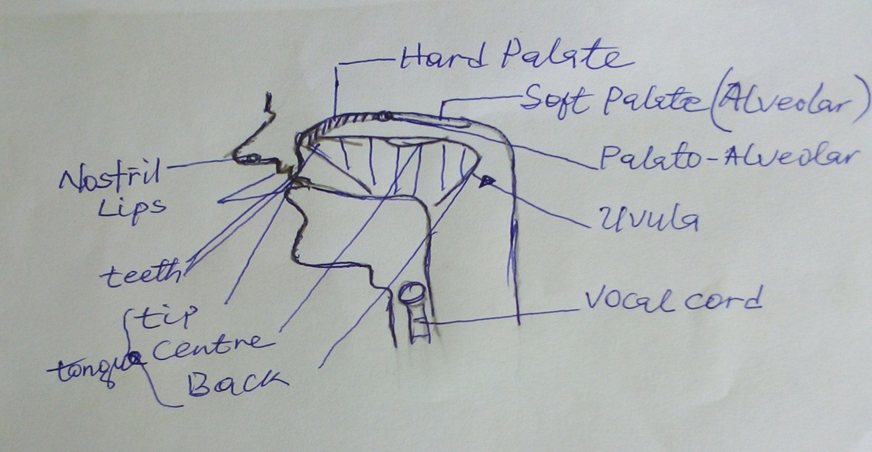
FUNCTIONS OF THE ORGANS ACCORDING TO THEIR NUMBER
1. Nostril - when the mouth is closed by upper and lower lips, thus blocking the free flow of air, the only way for air to escape is through the nose. So, nostril is used in producing nasal sounds /n,m, /.
2. Lips - the upper and the lower lips are important in sounds production. When the two come in contact, Plosive or Stop sounds are produced /p,b,m,w/. The shape of lips is also important in production of vowel sounds. It could be: rounded, spread, neutral and protruded, depending on vowel sound involved. When the upper teeth come in contact with the lower lip, the sounds produced are labio-dental sounds /f/ and /v/.
3. Teeth – that is, the upper and the lower teeth are used for production of Dental sounds when the two come in contact, i.e. / , 0/.
4. Tongue à tongue is divided into three parts and each part in used for the production of different type of sounds. Tongue is more used in the production of vowel sounds. The height of tongue also conditions the type of vowel sounds produced.
5. Alveolar - The tip of the tongue touches the Alveolar regions to produce the Alveolar sounds /t,d,s,z,l,n/. When the tip of the tongue touches the junction between the Alveolar and hard Palate, the sounds produced are called Palato-alveolar /3,d3/. Alveolar is directly behind the upper teeth.
Back of tongue produces /u, u;/ vowel sounds.
6. Hard Palate or Palate: this follows the Alveolar region. The central part of the tongue touches there to produce central vowel sound. There is no actual contact there but there is an approximation of it in vowel sound production. Example of vowel sounds /,3:,^/. Palate is also used in producing a semi vowel sound /j/ called palatal.
7. Uvula—this is used in production of velar sound when the back of tongue touches there /k, g, j/.
Vocal track- this houses the vocal cord which states the type of sounds produced i.e whether the sound is voiced or voiceless. When the vocal cord vibrates when any sound is produced, the sound is called Voiced. When it does not vibrate, it is Voiceless. All the vowel sounds are Voiced.