
Thyroid and Adrenal Glands
The thyroid and adrenal glands are two essential endocrine organs that regulate a wide range of physiological processes crucial for survival, growth, metabolism, and adaptation to stress.
While the thyroid gland primarily controls the rate of energy metabolism and protein synthesis, the adrenal glands coordinate the body’s stress response, electrolyte balance, and metabolic adjustments through hormonal secretion.
Together, they exemplify how the endocrine system maintains homeostasis through finely tuned hormonal interactions and feedback control mechanisms
1. The Thyroid Gland
1.4. Regulation of Hormonal Secretion
- The endocrine system maintains physiological stability by precisely controlling hormone secretion.
- Hormone release is rarely constant; rather, it fluctuates in response to feedback signals, neural input, and metabolic demands.
- Regulation occurs through several mechanisms, including hypothalamic–pituitary control, feedback loops, and local autoregulatory processes.
1.Hypothalamic–Pituitary–Thyroid (HPT) axis
The HPT axis is a classic example of endocrine regulation through a hierarchical control system involving three major structures:
Hypothalamus
Anterior Pituitary Gland
Thyroid Gland
Mechanism of Regulation
- The hypothalamus secretes thyrotropin-releasing hormone (TRH) into the hypophyseal portal circulation.
TRH stimulates the anterior pituitary to release thyroid-stimulating hormone (TSH).
TSH acts on the thyroid gland, promoting synthesis and secretion of thyroxine (T₄) and triiodothyronine (T₃).
The circulating T₃ and T₄ then act on target tissues to increase metabolic activity and energy production.
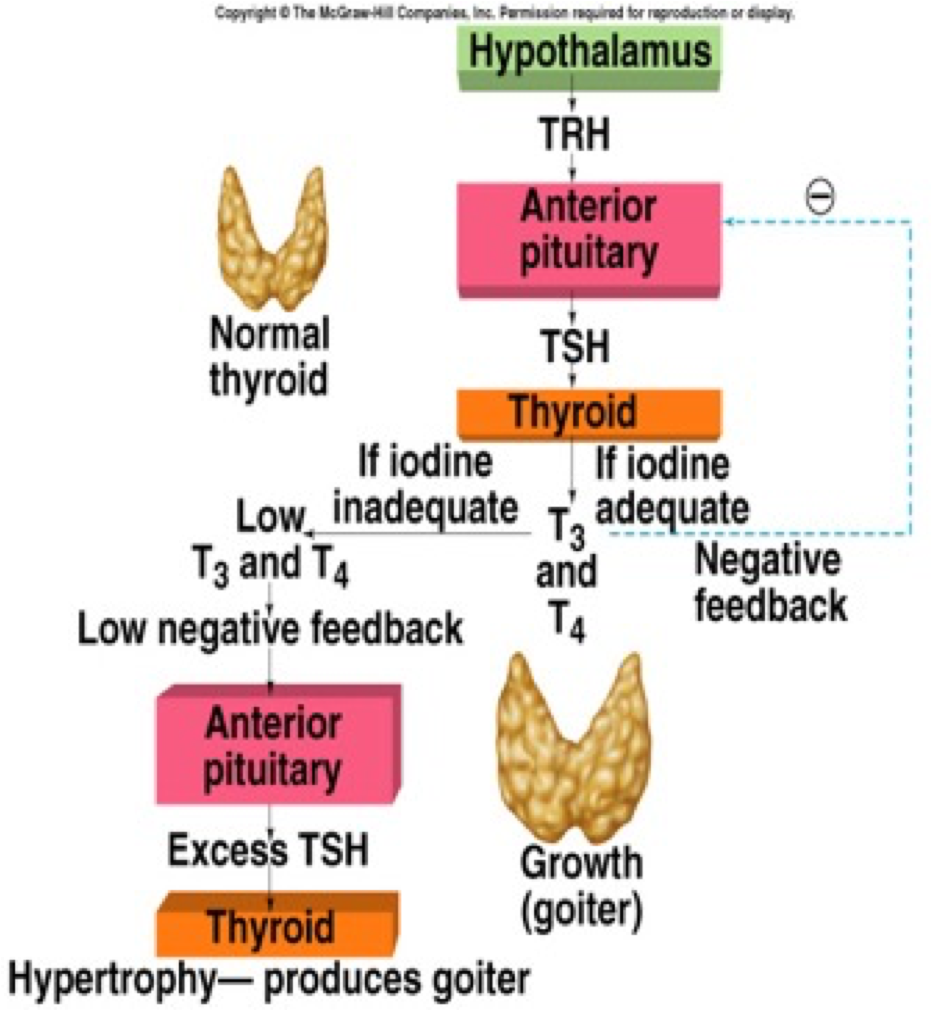
- TRH → TSH → Thyroid hormones → Negative feedback on TRH and TSH
This axis allows for integrated control of thyroid function based on the body’s metabolic needs, temperature regulation, and growth status.
It also exemplifies how the brain communicates with peripheral endocrine organs through a hormone cascade.
2. Feedback Mechanisms
- Feedback control is the core principle of endocrine regulation. It ensures hormone levels remain within a narrow physiological range.
This is the most common mechanism. Increased levels of a target hormone inhibit the release of its stimulating hormones at higher regulatory levels.
Example: Elevated plasma T₃ and T₄ inhibit TRH secretion from the hypothalamus and TSH release from the anterior pituitary.
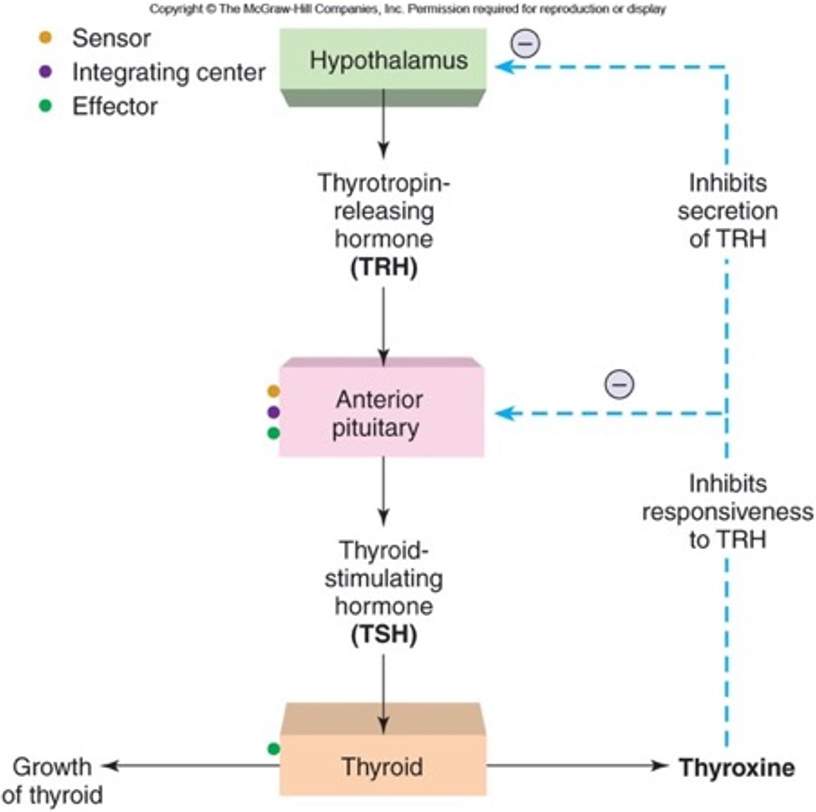
Effect: Stabilizes circulating thyroid hormone levels and prevents overproduction.
3. Autoregulation
- Autoregulation refers to local control mechanisms within the endocrine gland itself—independent of hypothalamic or pituitary influence.
- It allows fine-tuning of hormone synthesis and release according to local conditions.
- When iodine intake is excessively high, the thyroid gland temporarily reduces hormone synthesis (the Wolff–Chaikoff effect) to prevent hyperthyroidism.
- When iodine is insufficient, the thyroid gland increases formation of hormones.
Physiological Importance:
Autoregulation acts as a safety mechanism, preventing excessive hormone output when substrate levels or glandular stimulation are high. It also helps maintain consistent hormonal output during fluctuations in systemic signals.
Summary Table
|
Mechanism |
Level of Control |
Key Hormones/Structures |
Type of Regulation |
Physiological Role |
|
HPT Axis |
Central (Hypothalamus → Pituitary → Thyroid) |
TRH, TSH, T₃/T₄ |
Hierarchical |
Controls metabolic rate and growth |
|
Feedback Mechanisms |
Central and Peripheral |
Multiple endocrine axes |
Negative or Positive |
Maintains hormonal balance |
|
Autoregulation |
Local (within gland) |
Thyroid, Adrenal, Pancreas |
Intrinsic |
Fine-tunes hormone synthesis and prevents overactivity |