
Thyroid and Adrenal Glands
The thyroid and adrenal glands are two essential endocrine organs that regulate a wide range of physiological processes crucial for survival, growth, metabolism, and adaptation to stress.
While the thyroid gland primarily controls the rate of energy metabolism and protein synthesis, the adrenal glands coordinate the body’s stress response, electrolyte balance, and metabolic adjustments through hormonal secretion.
Together, they exemplify how the endocrine system maintains homeostasis through finely tuned hormonal interactions and feedback control mechanisms
2. Adrenal Glands
2.2. Synthesis of Adrenal Cortex Hormones
- The adrenal cortex is the outer region of the adrenal gland and is responsible for the production of steroid hormones, collectively known as corticosteroids.
- All adrenal cortical hormones are steroid-based and derived from cholesterol, but each cortical zone expresses distinct enzymes that determine which specific hormone is produced.
- Together, these hormones enable the body to maintain metabolic stability, electrolyte balance, and adaptive responses to stress.
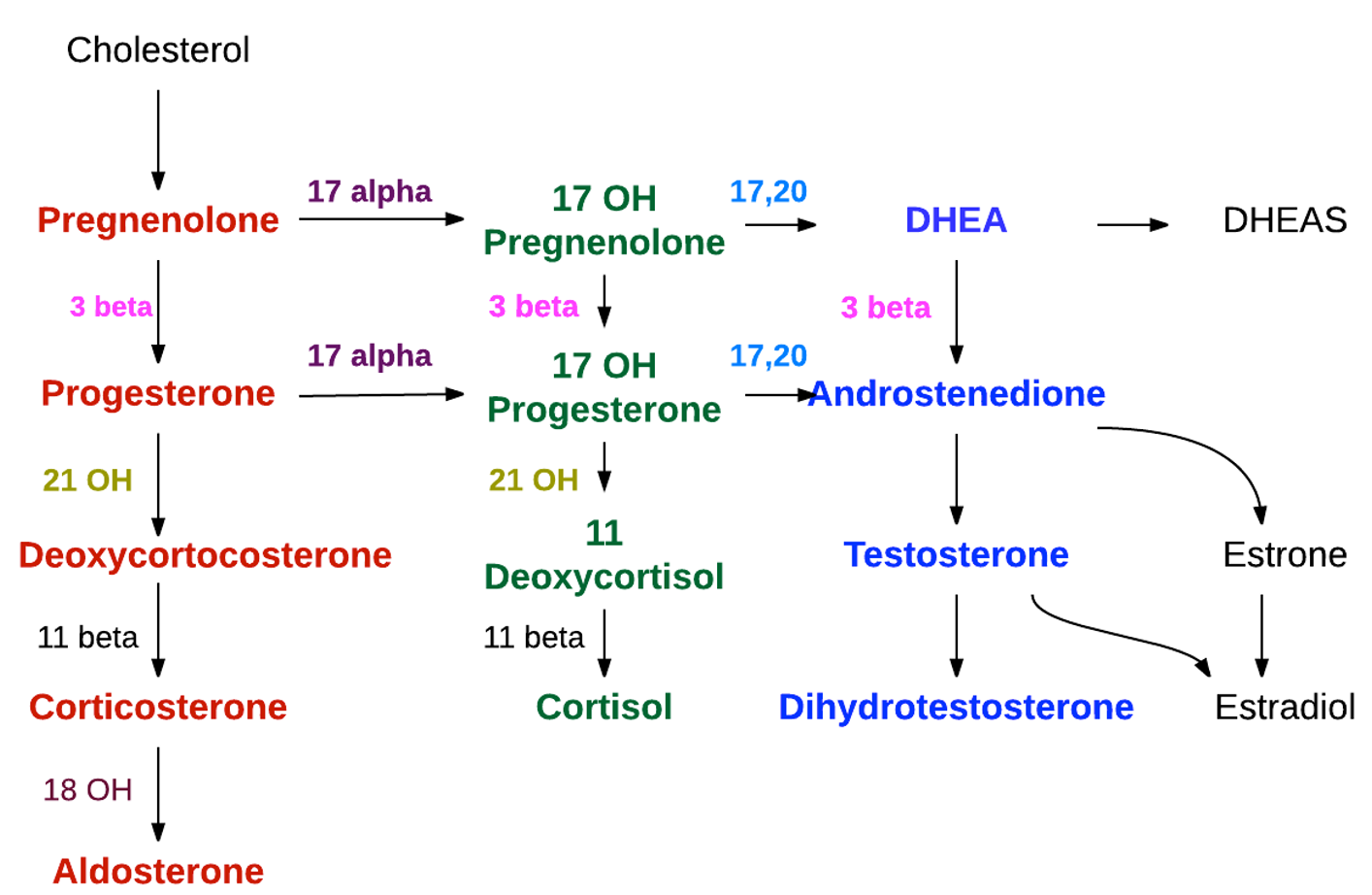
1. Zona Glomerulosa – Mineralocorticoids (Aldosterone)
-
Main Hormone: Aldosterone
-
Primary Function: Regulates sodium (Na⁺) and potassium (K⁺) balance and maintains blood pressure.
-
Synthesis Pathway:
Cholesterol → Pregnenolone → Progesterone → 11-Deoxycorticosterone → Corticosterone → Aldosterone -
Regulation:
-
Controlled mainly by the renin–angiotensin–aldosterone system (RAAS) and plasma K⁺ levels.
-
ACTH (from the pituitary) has a minor stimulatory role
-
2. Zona Fasciculata – Glucocorticoids (Cortisol)
-
Main Hormone: Cortisol
-
Primary Function: Influences glucose metabolism, stress response, immune modulation, and protein catabolism.
-
Synthesis Pathway:
Cholesterol → Pregnenolone → 17-Hydroxypregnenolone → 17-Hydroxyprogesterone → 11-Deoxycortisol → Cortisol -
Regulation:
-
Controlled by the hypothalamic–pituitary–adrenal (HPA) axis.
-
CRH from the hypothalamus stimulates ACTH release from the pituitary, which in turn stimulates cortisol synthesis and secretion.
-
Cortisol exerts negative feedback on both the hypothalamus and pituitary.
-
3. Zona Reticularis – Androgens (DHEA and Androstenedione)
-
Main Hormones: Dehydroepiandrosterone (DHEA) and Androstenedione
-
Primary Function: Serve as precursors for sex hormones (testosterone and estrogen) and contribute to secondary sexual characteristics.
-
Synthesis Pathway:
Cholesterol → Pregnenolone → 17-Hydroxypregnenolone → DHEA → Androstenedione -
Regulation:
-
Stimulated by ACTH, similar to cortisol.
-
No strong negative feedback system, so androgen levels depend largely on ACTH activity.
-