
Thyroid and Adrenal Glands
The thyroid and adrenal glands are two essential endocrine organs that regulate a wide range of physiological processes crucial for survival, growth, metabolism, and adaptation to stress.
While the thyroid gland primarily controls the rate of energy metabolism and protein synthesis, the adrenal glands coordinate the body’s stress response, electrolyte balance, and metabolic adjustments through hormonal secretion.
Together, they exemplify how the endocrine system maintains homeostasis through finely tuned hormonal interactions and feedback control mechanisms
2. Adrenal Glands
2.3. Regulation of Adrenal Cortex Hormones
- The adrenal cortex maintains homeostasis through the secretion of mineralocorticoids, glucocorticoids, and androgens.
- Each hormone class is regulated by distinct mechanisms that respond to systemic needs such as stress, electrolyte balance, and metabolic demand.
1. Regulation of Mineralocorticoids (Aldosterone) – Zona Glomerulosa
Main
Hormone: Aldosterone
Primary Role: Controls sodium and
potassium balance and maintains extracellular fluid volume and blood pressure.
Regulatory Mechanisms
1. Renin–Angiotensin–Aldosterone System (RAAS):
- The most important regulatory pathway.
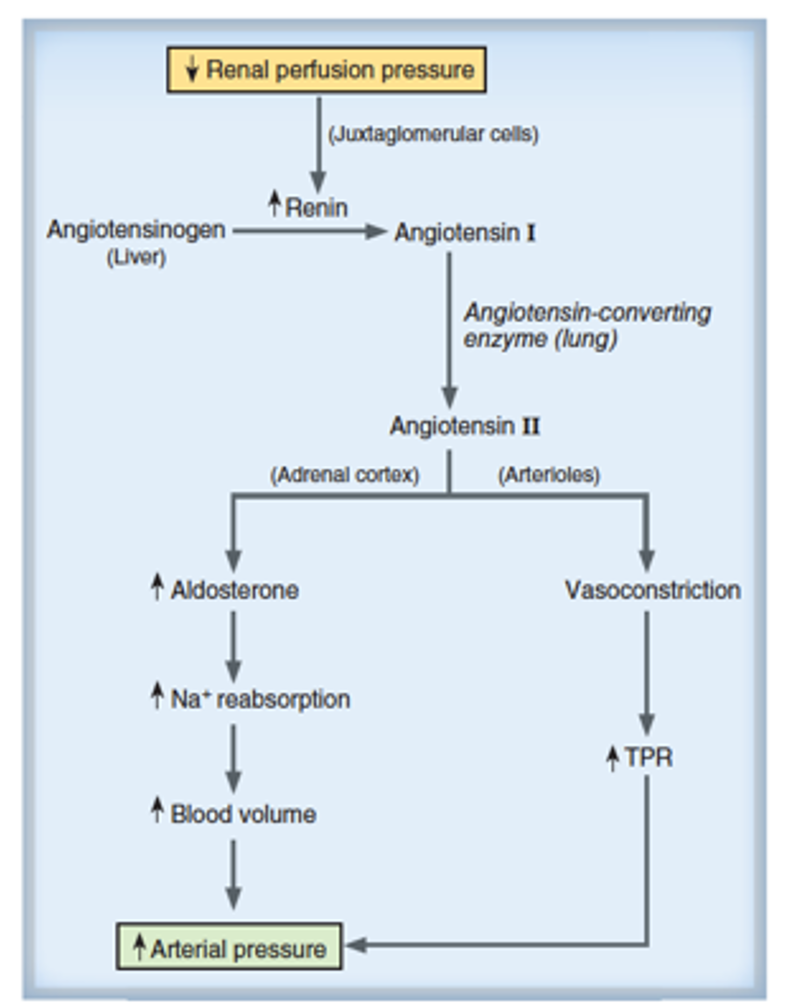
- Low blood pressure, low blood volume, or low sodium concentration stimulates the kidney’s juxtaglomerular cells to release renin.
- Renin converts angiotensinogen (from the liver) → angiotensin I, which is then converted by angiotensin-converting enzyme (ACE) → angiotensin II.
- Angiotensin II directly stimulates the zona glomerulosa to secrete aldosterone.
- Aldosterone increases Na⁺ reabsorption and K⁺ excretion in the kidneys, restoring blood pressure and fluid balance.
2. Plasma Potassium Concentration:
- Elevated K⁺ levels directly stimulate aldosterone secretion.
- Decreased K⁺ inhibits it.
3. ACTH (Adrenocorticotropic Hormone):
- Plays a minor role by transiently enhancing aldosterone secretion.
2. Regulation of Glucocorticoids (Cortisol) – Zona Fasciculata
Main
Hormone: Cortisol
Primary Role: Regulates glucose
metabolism, immune response, and adaptation to stress.
Regulatory Mechanisms
1. Hypothalamic–Pituitary–Adrenal (HPA) Axis:
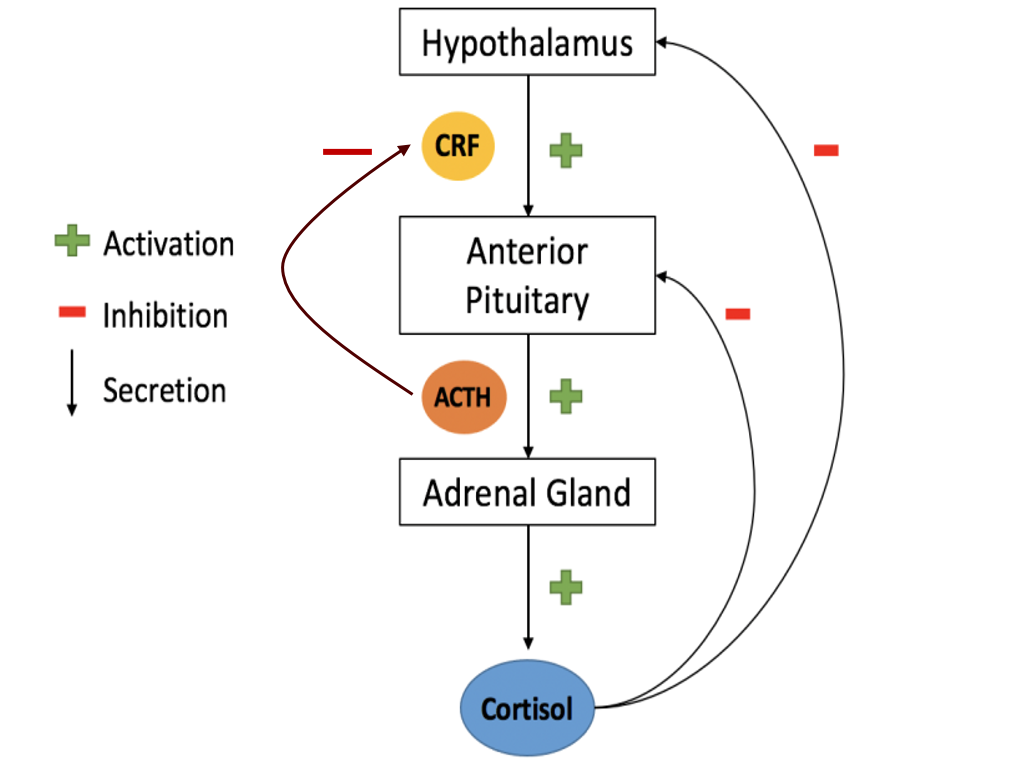
- Stress or circadian rhythms stimulate the hypothalamus to release corticotropin-releasing hormone (CRH).
- CRH acts on the anterior pituitary, triggering release of ACTH.
- ACTH stimulates the zona fasciculata to synthesize and secrete cortisol.
2. Negative Feedback Control:
- Elevated cortisol levels inhibit CRH release from the hypothalamus and ACTH release from the pituitary.
- This feedback loop maintains cortisol within normal physiological limits.
3. Circadian Rhythm:
- Cortisol secretion follows a diurnal pattern, peaking in the early morning and reaching its lowest level at midnight.
- This rhythm aligns metabolic activity with daily energy demands.
3. Regulation of Adrenal Androgens – Zona Reticularis
Main
Hormones: Dehydroepiandrosterone
(DHEA) and Androstenedione
Primary Role: Act as precursors
for sex steroids and influence secondary sexual characteristics.
Regulatory Mechanisms
1. ACTH-Dependent Secretion:
- The zona reticularis responds to ACTH, similar to the zona fasciculata.
- Increased ACTH enhances androgen synthesis, while low ACTH reduces it.
2. Lack of Strong Feedback Control:
- Unlike cortisol, adrenal androgens do not exert significant negative feedback on CRH or ACTH.
- Their levels depend largely on the activity of the HPA axis.
Key Takeaway
-
Cortisol regulation is mainly under the HPA axis with strong feedback control.
-
Aldosterone secretion is governed by the RAAS and plasma K⁺ concentration.
-
Adrenal androgens follow ACTH influence but lack tight feedback regulation.
-
Disruptions in these regulatory pathways lead to clinically significant adrenal disorders with characteristic hormonal and systemic effects.