
Organization & Structure of a Computer System.
13. Software Architecture
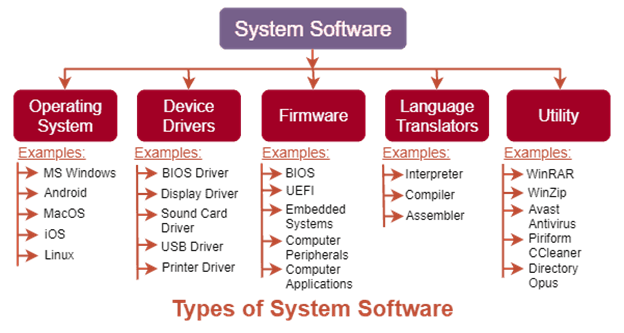
OPERATING SYSTEM (O S) –can be define as an organized collection of software extensions for hardware control routines for operating a computer and for providing an environment for execution of programs.
An operating system (OS) is system software that manages computer hardware and software and provides common services for computer programs.
An operating system (OS) is a program that manages the computer's resources --- its CPU, primary storage, its input/output devices --- so that the resources can be correctly and fairly used by one or more persons and/or computer programs
It can also be defined as a collection of programs that facilities the effective management of all these resources (hardware and software).
EXAMPLES OF OPERATING SYSTEM
1. LINUX
2. MS-DOS (MICROSOFT DISK OPERATING SYSTEM)
3. UNIX
4. XENIX
5. NOVELL NETWARE
6. macOS
7. IOS
8. ANDROID
9. MICROSOFT WINDOWS (MS WINDOWS : VERSION OF MS WINDOWS)
ü WINDOW VISTA
ü WINDOWS 95
ü WINDOWS 98
ü WINDOWS 2000
ü WINDOWS ME (M4ILLENNIUM EDITION)
ü WINDOWS 7
ü WINDOWS 8
ü WINDOWS 8.1
ü WINDOWS 10
ü WINDOWS 11
ü WINDOWS X P EXPERIENCE
ü WINDOWS N T, (NEW TECHNOLOGY)
ü WINDOWS SERVER 2003
|
List of Operating Systems |
|
|
Name of the OS |
Release Date |
|
UNIX |
1969 |
|
MS-DOS |
1981 |
|
Windows |
1985 |
|
Blackberry OS |
1999 |
|
Mac OS |
2001 |
|
Ios |
2007 |
|
Android |
2008 |
|
Windows Phone |
2010 |
|
Chrome OS |
2011 |
|
Firefox OS |
2013 |