
Introduction to Networking
Computer networking is the practice of connecting multiple computing devices—such as PCs, servers, routers, and IoT gadgets—to facilitate communication and resource sharing over wired or wireless links Think of networks as digital road systems where nodes (devices) exchange data via links, following agreed-upon rules called protocols
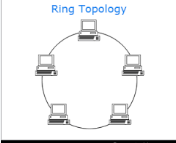
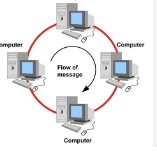
4. Ring Topology
In a ring topology, each device is connected to exactly two other devices, forming a circular path. Data flows in a single direction (unidirectional) or both directions (bidirectional). Data packets travel from device to device until they reach their destination. Each device connects to exactly two others, forming a closed loop (ring). Data travels in one direction (or both in dual-ring setups).
Characteristics:
1. Common in older networks like Token Ring.
2. Each device acts as a repeater to boost the signal.
Advantages: There are no data collisions because a single token (or similar mechanism) control who can send data at any given time. It offers predictable performance, even with heavy network traffic.
Disadvantages: A single device or cable failure can break the entire ring, disrupting the network. Adding or removing devices requires temporarily shutting down the network