MODULE1: ELECTROSTATIC
These Course will help students understand the fundamental principles of electric current and apply them in real-life situations, including electronics, and how to go about them.
3. CAPACITANCE AND ENERGY STORED IN ELECTRIC FIELDS
2.0 Capacitance
Capacitance is a measure of the ability of a capacitor to store electric charge. It is defined as the ratio of the charge stored on either plate to the potential difference across the plates.
C = Q / V
Unit: Farad. Furthermore, Farad is large, so in practice capacitance is usually in Microfarads, nano farads and picofarads.
2.1 Capacitor Geometry:
A parallel plate capacitor in air or vacuum it is expressed as: 
Where: A = area of one plate
D = distance between plates
permittivity of free space (8.85x )
If an insulating material (Dielectric) with dielectric constant K fills the space between the plates; 
This means that the capacitor stores more charge at the same voltage.
Energy store in a capacitor
2.3 Capacitors
A capacitor is an electrical component used to store electrical energy in an electric field.
It consists of two conducting plates separated by an insulating material called a dielectric (e.g. air, paper, mica, ceramic).

2.3.1 Working Principle
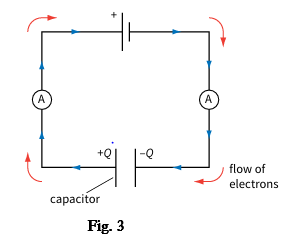
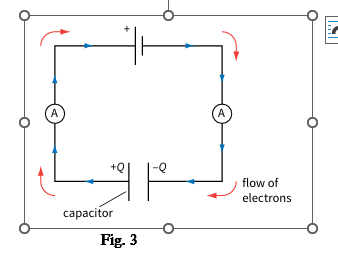
i. When a voltage is applied across the plates, an electric field is set up between them.
ii. Equal and opposite charges accumulate on the plates, and energy is stored in the electric field.
2.4 Arrangement of Capacitors
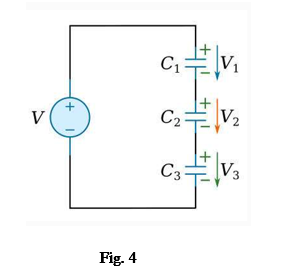
Capacitors in circuits are primarily arranged in series and parallel configurations, each altering total capacitance, voltage and charge differently.
1. Capacitors in series
i. Have same charges (Q) on all capacitor i.e Q = Q1 = Q2 = Q3
ii. The total voltage is shared i.e. V = v1+v2 +v3
iii. The equivalent capacitance decreases 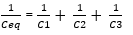
iv. Total capacitance is less than the smallest capacitance
v. Use when higher working voltage is needed.
2.4 Arrangement of Capacitors
Capacitors in circuits are primarily arranged in series and parallel configurations, each altering total capacitance, voltage and charge differently.
1. Capacitors in series
i. Have same charges (Q) on all capacitor i.e Q = Q1 = Q2 = Q3
ii. The total voltage is shared i.e. V = v1+v2 +v3
iii. The equivalent capacitance decreases 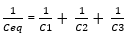
iv. Total capacitance is less than the smallest capacitance
v. Use when higher working voltage is needed.
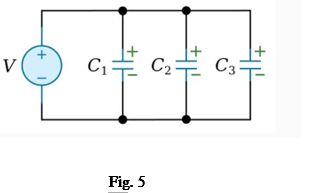
2.Capacitors in Parallel
i. The voltage across each capacitor is the same i.e. V = V1 = V2 = V3
ii. The equivalent capacitance increases Ceq = C1+C2+C3
iii. The total charge is the sum of the individual charge Q = Q1+Q2+Q3
iv. Parallel combinations are used to increase energy and charge storage
v. Parallel capacitance stores more charge hence total capacitance increases