
CURRENT ELECTRICITY
2. RESISTANCE AND RESISTIVITY
2.0 Resistance (R) Resistance is the opposition to the flow of electric current in an electric circuit. It is a measure of the difficulty to pass an electric current through a circuit. From Ohm’s law,
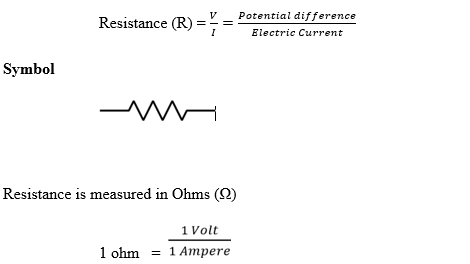
Therefore, one ohm is the resistance of a conductor in which a current of one ampere flows through it when a potential difference of one volt is maintained between its two ends. Examples:
1. If the resistance of a circuit is 12Ω and the current of 4A passes through it calculate the potential difference.
2. The electric fan takes a current of 0.5A when operated on a 200V supply. Find the resistance.
2.1 Factors Affecting the Resistance
The resistance of a conductor depends on the following factors:
(i) Length: The resistance of a conductor of uniform cross-sectional area is directly proportional to its length. R µ l
(ii) Area: The resistance of a conducting wire is inversely proportional to its area. 
(iii) Temperature: The resistance of a conductor varies directly with its temperature.
For Ohmic conductors, R µ T
(iv) Type of material: The resistance of a conductor depends upon the material of which it is made.
Experiments show that the resistance R of an ohmic conductor maintained at a constant temperature is related to its length (l) and its cross-sectional area (A) by the expression:
 where ρ is a constant of proportionality known as resistivity.
2.2 Resistivity
Resistivity is a measure of how much a material resists the flow of electrical charge through it. It is defined as the ratio of the electric field strength to the current density in a material.
Resistivity is an intrinsic property of a material and depends on the material’s temperature and other factors.
SI unit of resistivity is Ohm-meter (Ωm).

where ρ is the resistivity of the conductor in ohm-meter
R is the resistance in ohms
A is the surface area of the conductor
l is the length of the conducting wire
Examples
1. What is the resistivity of a cylindrical material wire whose 1m length has a resistance of 2Ω? (diameter of wire is 0.5mm).
2. Find the resistance of a wire of length 0.65m, radius 0.2mm and resistivity 3 x 10⁻⁶ ohm-meter.
3. If a current of 0.75A is generated when a battery of 1.5 V is connected to a 5m wire having cross sectional area 2.5 × 10⁻⁷ m², what will be the resistivity?