
CURRENT ELECTRICITY
1. Introduction
Current electricity is the branch of physics that deals with the flow of electric charges (usually electrons) through a conductor such as a wire. It occurs when there is a continuous path, called an electric circuit, and a source of electrical energy, such as a battery or generator, that provides a potential difference (voltage) to drive the charges.
Electric current is responsible for the operation of electrical devices such as bulbs, fans, televisions, computers, and many other appliances used in everyday life. The study of current electricity includes concepts such as electric current, voltage, resistance, electrical power, and electric circuits, which are essential for understanding how electrical systems work.
Definition: Electric current is rate of flow of electric charge through a conductor. It occurs when there is a continuous movement of charges (usually electrons) in a material. The conventional direction of current is taken as the direction in which positive charges would flow, from the positive terminal to the negative terminal of a power source.
Mathematical Expression I = Q / t
Where:
I = current (A)
Q = quantity of charge (C)
t = time (s)
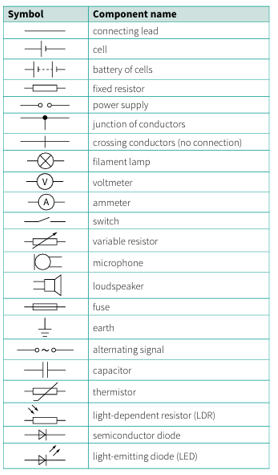
1.1 Components of Electric Current
1.2 Electric Charge
Electric charge is a fundamental property of matter responsible for all electrical phenomena.
Types of Electric Charge
There are two types of electric charge:
1. Positive charge: Carried by protons
2. Negative charge: Carried by electrons
Like charges repel each other, while unlike charges attract each other. The SI unit of electric charge is the coulomb (C). The charge of a single electron is approximately: [ e = 1.6 ^-19C]
1.3 Ohm’s Law
It states that the current flowing through a conductor is directly proportional to the potential difference across it, provided temperature and other physical conditions remain constant. V = IR Where: -
I = current (A)
V= potential difference (V)
R = resistance (Ω)