
KINEMATICS AND NEWTONIAN MECHANICS
The course motion helps students understand how things move and the forces that affect them. It covers important ideas like speed, acceleration, and Newton’s laws of motion, using simple math and real-life examples. Students learn about different types of motion, such as objects falling, cars driving, and planets orbiting. Through theory experiments, simulations, they develop problem-solving skills and see how motion is part of everyday life. This course also prepares them for more advanced studies in science, engineering, and technology.
2. NEWTON'S LAW OF MOTION
Introduction
Isaac Newton was a brilliant scientist who helped explain how things move on Earth and in space. His three laws of motion changed the way people understood the physical world. By building on the ideas of earlier scientists like Galileo and Kepler, Newton demonstrated that motion can be predicted using mathematical principles. His discoveries marked a major shift from old ways of thinking to modern science.
Forces are what cause objects to move. A force can be a push or a pull, like when you push a door open or when gravity pulls an object down. Some forces are strong, like a cannon firing a cannonball, while others are weak, like a mosquito landing on your arm. When multiple forces act on an object, they combine to create a net force, which determines how the object moves. If forces push in opposite directions, the more potent force will win out. Scientists use a system of positive and negative signs to keep track of forces and movement, making calculations easier and more accurate.
Newton’s laws help explain motion everywhere, from a ball rolling on the ground to a satellite orbiting Earth. Forces can come from inside a system (internal forces) or from outside (external forces). For example, when an object hangs from a rope, the force of gravity pulls it down while the rope pulls it up, keeping it in place. Understanding these forces helps us predict how objects will move, making Newton’s laws essential to physics and engineering.
Sir Isaac Newton gave three fundamental laws. These laws are called Newton's laws of motion.
Newton’s First Law:
a. A body at rest tends to remain at rest.
b. A body in motion tends to remain in motion at a constant velocity unless acted on by a net external force.
Inertia: is the tendency of an objects to resist changes in its state of motion.
Newton’s Second Law:
The rate of change of momentum of a body is directly proportional to the applied force, and the change takes place in the direction of the applied force.
Or
Acceleration produced in a body is directly proportional to the force applied.
Let a body of mass m moving with a velocity u. Let a force F be applied so that its velocity changes from u to v in t seconds.
Initial momentum = mu
Final momentum after time t second = mv
Total change in momentum = mv-mu.
Thus, the rate of change of momentum will be
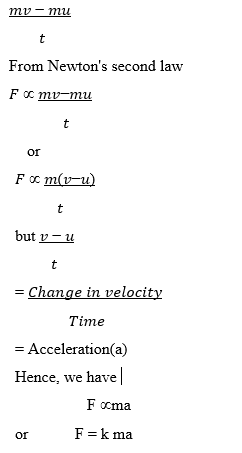
Where k is constant of proportionality, for convenience let k = 1.
Then F = ma
Unit for Force is Newton (N)
Newton’s Third law:
To every action there is an equal and opposite reaction or action and reaction are equal and opposite.
When a body exerts a force on another body, the other body also exerts an equal force on the first, in opposite direction.
From Newton's third law these forces always occur in pairs.
FAB (force on A by B) = -FBA (force on B by A).
Common forces in Newtonian Mechanics
1. Weight (w): Gravitational force on a mass, W = mg directed downward
2. Normal force(N): perpendicular contact force exerted by surface
3. Friction: opposes motion. There are two main types
a. Static friction: acts when objects are not moving
b. Kinetic friction: acts when objects are sliding
4. Tension(T): pulling force in a rope, string, or cable
Examples:
1. A block of mass 5kg rest on a horizontal frictionless surface. A horizontal force of 20N is applied. Find
a. The acceleration of the block
b. Its speed after 4s if it starts from rest.