
MAGNETISM
2. MAGNETIC FIELD LINES
1.2 Magnetic field lines
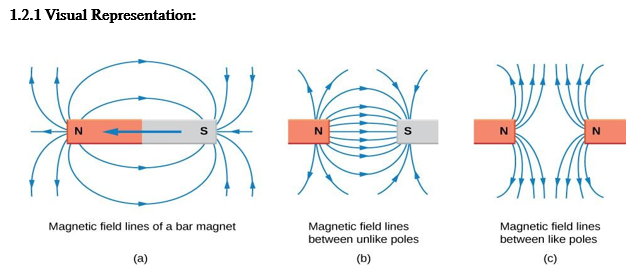
By convention, magnetic field lines point away from the north pole of a magnet and toward the south pole. Importantly, these field lines form closed loops they don’t start or stop in empty space but continue inside the magnet itself. To see these field lines, you can move a small compass around a magnet and mark the direction it points, or sprinkle iron filings around the magnet; the filings naturally arrange themselves along the field lines, revealing the invisible magnetic pattern.
1.2.2 Properties of magnetic lines of force
I. The magnetic field lines of a magnet form continuous closed loops.
II. The tangent to the field line at a given point represents the direction of the net magnetic field B at that point.
III. The larger the number of field lines crossing per unit area, the stronger is the magnitude of the magnetic field B.
IV. Their density decreases with increasing distance from the poles.
V. The magnetic field lines do not intersect with each other.
VI. They flow from the South Pole to the North Pole within a material and North Pole to the South Pole in air.
1.3 Magnetic flux: refers to the total number of magnetic field lines crossing through given surface area S held perpendicular to the direction of the magnetic field B.
1.4 Magnetic Properties of Materials: Magnetic Dipoles
Magnetic Dipole: Consists of two opposite magnetic poles separated by a distance, or practically, a current loop or spinning electron. Magnetic Dipole Moment (m):
m = I × A
- I: current; A: area vector perpendicular to loop.
- Unit: A·m²
1.4.1 Types of Magnetic Materials:
Based on the behaviour of magnetic material in a magnetic field, the materials are divided into three (3) categories:
1. Diamagnetic materials: These materials, when placed in a magnetic field, acquire magnetism opposite to the direction of the magnetic field. The magnetic dipoles in these substances tend to align opposite to the applied field and tend to repel the external field around them.
i. Diamagnetic substances tend to move from a stronger to a weaker magnetic field.
ii. When a rod of diamagnetic material is placed in a magnetic field, it aligns perpendicular to the magnetic field
iii. Permeability of the diamagnetic material is < 1. Examples; gold, Bismuth, copper, mercury, graphite, lead etc
2. Paramagnetic materials: Paramagnetic substances are those which get weakly magnetized when placed in an external magnetic field. These materials show weak attraction in magnetic field. The magnetic dipoles in the magnetic materials tend to align along the applied magnetic field. Such materials show weak feeble magnetization, and the magnetization disappears as soon as the external field is removed.
i. Permeability of paramagnetic material is > 1.
ii. The magnetization (I) of such materials dependent on the external magnetic field (B) and temperature (T) as:
Where C is the Curie constant.
Examples: sodium, liquid oxygen, salts of iron and nickel, Aluminum, platinum.
3. Ferromagnetic materials: Ferromagnetic substances are those which get strongly magnetized when placed in an external magnetic field. They exhibit the strongest attraction in magnetic field. Magnetic dipoles in these materials are arranged into domains.
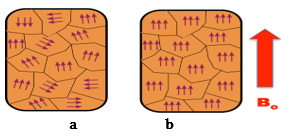
These domains are usually randomly oriented as shown in Fig. 11.1 (a) and net magnetism is zero in the absence of magnetic field. When an external field is applied, the domains reorient themselves to reinforce the external field as shown in Fig. 11.1 (b) and produce a strong internal magnetic field that is along the external field. These materials show magnetism on removal of magnetic field. Examples are iron, cobalt, nickel, neodymium and their alloys. These are usually highly ferromagnetic and are used to make permanent magnets.