
The Homologous Series
The Homologous Series
A family of organic compounds with the same functional group is called homologous series. Members in a series are called homologs. The study of organic chemistry becomes simplified when examined according to their functional groups.
Homologous series serves as a useful tool for the study of organic compounds. The term is used to describe a family of organic compounds with the following characteristics:
1.Members of the same family (homologues) can be represented by a general molecular formula.
2.Successive members in a series differ in molecular formula by -CH2(or in molecular mass, by 14 atomic mass units). It is an arithmetic progression.
3.Laboratory methods for the preparation of members in a series are similar.
4. There is gradation of physical properties, ie. Gradual change from one physical to another, such as melting point, boiling point, density and viscosity as the relative the relative molecular mass increase.
5.Members undergo similar chemical reactions.
6. Members contain an identical functional group. Their properties depend on the type of the functional group.
Characteristics of Organic Compounds
1.Type of Bonds: The type of bonds in organic compounds is the covalent bond, formed by sharing of electrons between atoms. Most organic compounds exist as molecules.
2.Nature of Bonds: The forces of attraction holding covalent molecules are the weak van der Waal's forces. Hence, organic compounds are generally gases, volatile liquids, and solids with low melting points.
3.Shapes of Molecules: Covalent bonds are rigid and highly directional; hence, organic molecules have definite shapes.
4.Isomerism
Organic compounds exhibits a phenomenon in which two or more compounds have the same molecular formula but with different structural formulae. The different forms are isomers.
5.Solubility
Organic compounds are generally insoluble in water - except alkanols, alkanoic acids and amines with low molecular masses. They are readily soluble in organic solvents like propanone (acetone).
6.Conductivity
Organic compounds do not form ions in water; hence, they are non-electrolytes. Those that form ions in water are weak electrolytes, e.g. alkanoic acids and amines.
|
7. Reactivity-Fission of Covalent Bonds
Organic reactions are generally slow. Reason: Organic compounds exist as covalent molecules; they do not form ions in solution. Hence, most organic reactions take place at high temperatures, under high pressures and, or in the presence of catalysts
FORMULAE OF REPRESENTING ORGANIC COMPOUNDS
Organic compounds can be represented in various forms depending on the level of detail required about their composition and structure. The three primary ways to represent organic compounds are:
1. Empirical Formula
The empirical formula represents the simplest whole-number ratio of the elements in a compound. It does not provide information about the exact number of atoms or how they are arranged in the molecule.
Characteristics:
- Shows only the relative proportions of the elements.
- Does not indicate the actual number of atoms in a molecule or its structure.
Examples:
- For glucose (C₆H₁₂O₆), the empirical formula is CH₂O.
- For ethene (C₂H₄), the empirical formula is CH₂.
- How to Determine:
- Determine the mass or percentage composition of each element in the compound.
- Convert the masses or percentages to moles.
- Divide each mole value by the smallest mole value to obtain the simplest whole-number ratio.
WORKED EXAMPLES
Example 1: Using Percentage Composition
A compound contains:
Carbon = 40.0%
Hydrogen = 6.7%
Oxygen = 53.3%
Step 1: Assume 100 g of the compound
(This converts percentages directly to grams)
- C = 40.0 g
- H = 6.7 g
- O = 53.3 g
Step 2: Convert grams to moles
Use:
Moles=Mass/Atomic mass
- Carbon: 40.0/12 = 3.33 mol
- Hydrogen: 6.7/1 = 6.7 mol
- Oxygen: 53.3/16 = 3.33 mol
Step 3: Divide by the smallest number of moles
Smallest = 3.33
- C: 3.3/33.33=1
- H: 6.7/3.33≈2
- O: 3.33/3.33=1
· Step 4: Write the empirical formula
CH2O
Example 2: Using Mass Data
A compound contains:
- 2.4 g of Carbon
- 0.4 g of Hydrogen
- 3.2 g of Oxygen
Step 1: Convert masses to moles
- Carbon: 2.4/12=0.20 mol
- Hydrogen: 0.4/1=0.40
- Oxygen: 3.2/16=0.20 mol
Step 2: Divide by the smallest mole value
Smallest = 0.20
- C: 0.20/0.20=1
- H: 0.40/0.20=2
- O: 0.20/0.20=1
Step 3: Empirical formula
CH2O
2. Molecular Formula
The molecular formula provides the actual number of atoms of each element in a molecule. It is a multiple of the empirical formula.
Characteristics:
- Indicates the exact number of each type of atom in a molecule.
- Does not provide information about the arrangement or bonding of atoms.
Examples:
- Glucose: Molecular formula is C₆H₁₂O₆.
- Ethene: Molecular formula is C₂H₄.
How to Determine:
- Find the empirical formula.
- Determine the molar mass of the compound.
- Divide the molar mass by the molar mass of the empirical formula to find the multiplier.
- Multiply the subscripts in the empirical formula by the multiplier.
WORKED EXAMPLES
Example 1: Simple Molecular Formula Calculation
Question:
A compound has an empirical formula CH₂O and a molar mass of 180 g mol⁻¹.
Determine its molecular formula.
Step 1: Write the empirical formula
Empirical formula = CH₂O
Step 2: Calculate the molar mass of the empirical formula
C=12, H=1, O=16
(1×12) + (2×1) + (1×16) =30 g/mol
Step 3: Find the multiplier
Multiplier=Molar mass of compound / Empirical formula mass
=180/30 = 6
Step 4: Multiply the subscripts
(CH2O)6=C6H12O6
Answer:
C6H12O6
3. Structural Formula
The structural formula provides detailed information about the arrangement of atoms and the bonds between them in a molecule. There are three types of structural formulas:
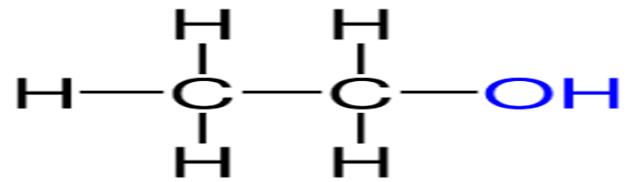
a) Displayed Formula (Full Structural Formula):
- Shows all the bonds between atoms in the molecule.
- Provides a clear view of how atoms are connected.
Example: For ethanol (C₂H₅OH)
b) Condensed Structural Formula:
- Shows the arrangement of atoms but omits the individual bonds for brevity.
- Atoms bonded to the same carbon are grouped together.
Example:
- Ethanol: CH₃CH₂OH
c) Skeletal Formula:
- Uses lines to represent bonds between carbon atoms.
- Each vertex represents a carbon atom, and hydrogens are implied.
Example:
- For butane: Skeletal formula: A zigzag line with 4 vertices represents butane (C₄H₁₀).
See the differences below for better understanding
|
Type of Formula |
Example |
|
Empirical Formula |
CH₂O (for glucose) |
|
Molecular Formula |
C₆H₁₂O₆ (for glucose) |
|
Structural Formula |
CH₃CH₂OH (for ethanol) |
Note: The Structural formula shall be used mostly in our subsequent classes