
QUALITATIVE ANALYSIS OF ORGANIC COMPOUNDS
QUALITATIVE ANALYSIS OF ORGANIC COMPOUNDS
What Is Qualitative Analysis?
Quantitative analysis is an analysis method used to determine the number of elements or molecules produced during a chemical reaction. Organic compounds comprise carbon, hydrogen, oxygen, nitrogen, phosphorus, sulphur and halogens. The various methods used for the measurement of the percentage composition of elements in an organic compound are explained here.
Qualitative analysis is the analysis of the species present in a given compound. For example, if a compound is taken, the qualitative analysis would be more focused on finding the elements and the ions present in the compound rather than study as to how much they are present.
C and H are detected by heating the compound with CuO in a dry test tube. They are oxidised to CO2 and H2O, respectively. If the CO2 turns lime water milky, and H2O turns anhydrous CuSO4 blue, then the presence of C and H is confirmed.
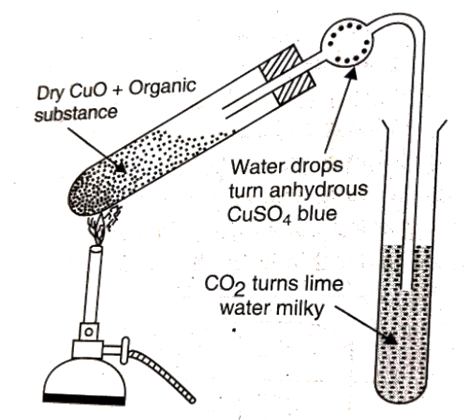
Detection of Carbon and Hydrogen
The organic compound is heated with an oxidising agent to oxidise phosphorous to phosphate. The solution is then boiled with concentrated HNO3 and treated with ammonium molybdate. Yellow precipitate confirms the presence of phosphorous.
The reaction is given below:
Na3PO4 + 3HNO3 → H3PO4 + 3NaNO3
H3PO4 + 12(NH4)2MoO4 + 21HNO3 → (NH4)3PO4.12MoO3 + 21NH4NO3 + 12H2O
Quantitative analysis is more towards finding out how much of the elements are present, that is, their amounts.
Estimation of C and Hl
A known mass of the compound is heated with CuO. The carbon present is oxidised to CO2 and hydrogen to H2O. The CO2 is absorbed in the KOH solution, while H2O is absorbed by anhydrous CaCl2, and they are weighed.
Percentage of Carbon=RAM of C / Molar Mass of CO2X((Mass of CO2)/(Mass of compound)) x 100
Percentage of C = 12/44 x ((Mass of CO2)/(Mass of compound)) x 100
Percentage of H = 2/18 x ((Mass of H2O)/(Mass of compound)) x 100
A 0.50 g sample of an organic compound was completely oxidized. The CO₂ produced was absorbed in KOH and found to weigh 1.10 g, while the H₂O produced was absorbed by anhydrous CaCl₂ and found to weigh 0.45 g.
Calculate the percentage of carbon and hydrogen in the compound.
Solution:
Given:
- Mass of compound = 0.50 g
- Mass of CO₂ = 1.10 g
- Mass of H₂O = 0.45 g
Step 1: Calculate percentage of carbon
Percentage of C=12/44 × 1.10/0.50×100 ×100
Percentage of C=0.2727×2.2×100=60.0%
Step 2: Calculate percentage of hydrogen
Percentage of H=2/18×0.45/0.50×100
Percentage of H=0.1111×0.9×100=10.0%
Final Answer:
- % C = 60.0%
- % H = 10.0%
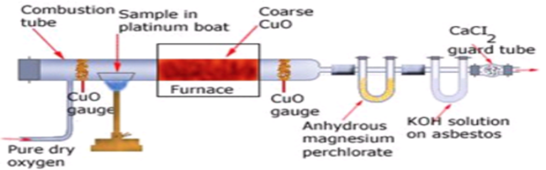
-
Liebig’s combustion method Estimation of Halogens
A known mass of the compound is heated with Conc. HNO3 in the presence of AgNO3 in a hard glass tube called the Carius tube. C and H are oxidised to CO2 and H2O. The halogen forms the corresponding AgX. Then, it is filtered, dried and weighed.
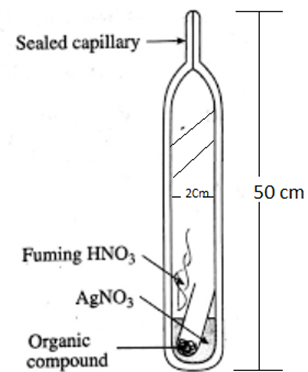
-
Estimation of Halogens by Carius method
Percentage of X =
((Atomic mass of X) / (Molecular mass of AgX)) x ((Mass of AgX) / (Mass of the compound)) x 100
Calculations:
Let the mass of the given organic compound be m g.
Suppose the mass of AgX formed = m1 g.
We know that 1 mol of AgX consists of 1 mol of X.
So, in m1 g of AgX, mass of halogen
= (atomic mass of X × m1 g) (molecular mass of AgX)
Percentage of halogen
= (atomic mass of X × m1 × 100) (molecular mass of AgX × m)
Example: Estimation of Chlorine by Carius Method
A 0.30 g sample of an organic compound was heated with fuming nitric acid and silver nitrate. The AgCl precipitate formed weighed 0.435 g.
Calculate the percentage of chlorine in the compound.Solution:
Given:
- Mass of compound (m) = 0.30 g
- Mass of AgCl formed (m₁) = 0.435 g
- Atomic mass of Cl = 35.5 g/mol
- Molecular mass of AgCl = 143.5 g/mol
Apply the formula:
Percentage of Cl=35.5/143.5 × 0.435/0.30×100
Step-by-step Calculation:
- 35.5/143.5≈0.2474
- 0.435/0.30=1.45
- Multiply all:
0.2474 × 1.45 × 100 ≈ 35.87%
Estimation of Bromine
A 0.40 g sample of an organic compound gave 0.574 g of AgBr after treatment with fuming nitric acid and silver nitrate.
Calculate the percentage of bromine in the compound.Solution:
Given:
- Mass of compound (m) = 0.40 g
- Mass of AgBr (m₁) = 0.574 g
- Atomic mass of Br = 80 g/mol
- Molar mass of AgBr = 188 g/mol
Apply the formula:
Percentage of Br=80/188×0.574/0.40×100
- 80/188≈0.4255
- 0.5740.40=1.435
- Multiply:
0.4255×1.435×100≈61.04%
Final Answer:
- % Bromine = 61.04%
Example 2: Estimation of Iodine
A 0.25 g sample of an organic compound produced 0.635 g of AgI after the Carius reaction.
Calculate the percentage of iodine in the compound.Solution:
Given:
- Mass of compound (m) = 0.25 g
- Mass of AgI (m₁) = 0.635 g
- Atomic mass of I = 127 g/mol
- Molar mass of AgI = 235 g/mol
Apply the formula:
Percentage of I=127/235×0.635/0.25×100
- 127235≈0.5404
- 0.6350.25=2.54
- Multiply:
0.5404×2.54×100≈137.3%
Note: The calculated %I seems too high (above 100%), which implies an error in experimental data (too much AgI) or incorrect sample weight. In practice, the % of any element in a compound cannot exceed 100%.
A known mass of the compound is heated with conc. HNO3 in the presence of BaCl2 solution in the Carius tube. Sulphur is oxidised to H2SO4 and precipitated as BaSO4. It is then dried and weighed.
Percentage of S = ((Atomic mass of S)/(Molecular mass of BaSO4)) x (( Mass of BaSO4)/(Mass of the compound)) x 100
Calculations:
Suppose the mass of organic compound = mg
Let the mass of barium sulphate formed = m1 g
We know that 32 g sulphur is present in 1 mol of BaSO4
Therefore, 233 g BaSO4 contains 32 g sulphur:
⇒M1 g of BaSO4 contains 32 × m1233g of sulphur
Percentage of sulphur
=32 × m1 × 100233 × m
Example: Estimation of SulphurA 0.250 g sample of an organic compound was heated with concentrated HNO₃ and BaCl₂ solution. The BaSO₄ precipitate formed was dried and found to weigh 0.466 g.
Calculate the percentage of sulphur in the compound.Solution:
Given:
- Mass of compound (m) = 0.250 g
- Mass of BaSO₄ (m₁) = 0.466 g
- Atomic mass of S = 32 g/mol
- Molecular mass of BaSO₄ = 233 g/mol
Use the formula:
Percentage of S=32/233×0.466/0.250×100
- 32233≈0.1373
- 0.4660.250=1.864
- Multiply:
0.1373×1.864×100≈25.59%
Final Answer:
- % Sulphur = 25.59%
Estimation of Phosphorus
A known mass of the compound is heated with HNO3 in a Carius tube, which oxidises phosphorous to phosphoric acid. It is then precipitated as ammonium phosphomolybdate ((NH4)3PO4.12MoO3) by adding NH3 and ammonium molybdate ((NH4)2MoO4). Then, it is filtered, dried and weighed.
Percentage of P=
((Atomic mass of P)/(Molecular mass of (NH4)3PO4.12MoO3)) x ((Mass of (NH4)3PO4.12MoO3)/(Mass of compound)) x 100
Example: Estimation of Phosphorus
A 0.300 g sample of an organic compound was heated with concentrated HNO₃ in a Carius tube to oxidize phosphorus to phosphoric acid. On adding ammonia and ammonium molybdate, a yellow precipitate of ammonium phosphomolybdate, (NH₄)₃PO₄·12MoO₃, was obtained and weighed 1.20 g.
Calculate the percentage of phosphorus in the compound.Given:
- Mass of compound = 0.300 g
- Mass of precipitate = 1.20 g
- Atomic mass of P = 31 g/mol
- Molar mass of (NH₄)₃ PO₄·12MoO₃ = 1877 g/mol
Apply the formula:
Percentage of P=31/1877×1.20/0.300×100
Step-by-step Calculation:
- 31/1877≈0.01652
- 1.20/0.300=4.0
- Multiply:
0.01652×4.0×100≈6.61%
Final Answer:
- % Phosphorus = 6.61%
Estimation of Nitrogen
Estimation of Nitrogen by Dumas Method
A known mass of the compound is heated with CuO in an atmosphere of CO2, which yields free nitrogen along with CO2 and H2O.
CxHyNz + (2x+ 0.5y) CuO → xCO2 + 0.5y H2O + 0.5z (N2) + (2x+ 0.5y)Cu
The gases are passed over a hot copper gauze to convert trace amounts of nitrogen oxides to N2. The gaseous mixture is collected over a solution of KOH, which absorbs CO2, and nitrogen is collected in the upper part of the graduated tube.
Principle Recap:
In the Dumas method, a known mass of an organic compound containing nitrogen is heated with excess copper(II) oxide (CuO) in a CO₂ atmosphere. The nitrogen in the compound is released as N₂ gas, while carbon and hydrogen are oxidized to CO₂ and H₂O respectively. Any nitrogen oxides formed are reduced back to N₂ by passing the gases over hot copper gauze. The CO₂ is absorbed by KOH, and the volume of nitrogen gas is measured.
Formula Used:
Percentage of Nitrogen=Volume of N2 at STP (in litres)×28/Mass of compound (g)×22.4×100
Where:
- 28 g = molar mass of N₂
- 22.4 L = molar volume of gas at STP
Example:
A 0.20 g sample of an organic compound gave 25.0 mL (0.025 L) of nitrogen gas collected over KOH at STP.
Calculate the percentage of nitrogen in the compound.Solution:
Given:
- Mass of organic compound = 0.20 g
- Volume of nitrogen gas collected at STP = 25.0 mL = 0.025 L
- Molar mass of nitrogen gas (N₂) = 28 g/mol
- Molar volume at STP = 22.4 L/mol
Formula:
Percentage of Nitrogen=Volume of N2×28/Mass of compound×22.4×100
Plug in values:
Percentage of Nitrogen=0.025×28/0.20×22.4×100
Final Answer:
- % Nitrogen = 15.63%
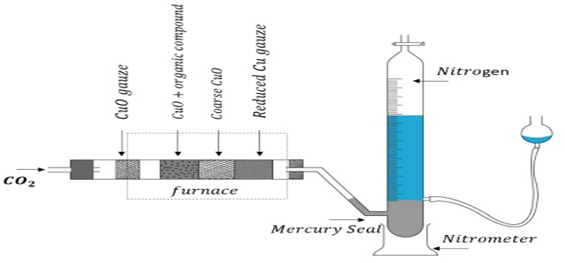
-
Estimation of Nitrogen by Dumas Method
Let the volume of N2 collected be V1 mL.
Then, volume of N2 at STP = (P1V1 x 273) / (760 x T1) = V mL
Where P1 and V1 are the pressure and volume of N2.
P1= Atmospheric pressure – aqueous tension
22.4 L of N2 weighs 28 g,
Therefore, V ml of N2 weighs
=(28 x V)/22400 grams
The percentage of N would be,
= (28/22400) x (V/ Mass of compound) x 100.
Estimation of Nitrogen by Kjeldahl Method
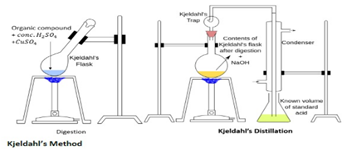
A known mass of an organic compound (0.5 g) is mixed with K2SO4 (10 g), CuSO4 (1.0 g) and conc.H2SO4 (25 mL), and heated in a Kjeldahl’s flask.
CuSO4 acts as a catalyst, while K2SO4 raises the boiling point of sulphuric acid. The nitrogen in the compound is quantitatively converted to (NH4)2SO4. The resulting mixture is reacted with excess of NaOH solution, and the NH3, so evolved, is passed into a known but excess volume of standard acid.
The acid left unreacted is estimated by titration with some standard alkali. Thus, the percentage of nitrogen can be calculated.
-
The reactions are given below:
- C + H + S → CO2 + H2O + SO2
- N → (NH4)2SO4
- (NH4)2SO4 + 2NaOH → Na2SO4 + 2NH3 + 2H2O
- 2NH3 + H2SO4 → (NH4)2SO4
Calculation of the percentage of N
Let the mass of the organic compound be mg.
Volume of H2SO4 (Molarity M) = V mL
The volume of NaOH of molarity M used for titration excess of H2SO4 = V1 mL
mEq of excess H2SO4 = mEq of NaOH
= MV1 mEq
Total mEq of H2SO4 taken = 2MV
mEq of H2SO4 used for neutralisation of NH3 = (2MV – MV1)
Therefore,
mEq of NH3 = (2MV-MV1)
1000 mEq or 1000 mL of NH3 solution contains = 17 g of NH3 (or) 14 g of N
Therefore,
(2MV-MV1) mEq of NH3 contains
=(14 x (2MV-MV1)) / 1000 g of N
Percentage of N= ((14x(2MV-MV1)) x (100/(1000xm)))
Estimation of Oxygen by Aluise’s Method
A known mass of the compound is decomposed by heating it in the presence of N2 gas. The mixture of gases so produced is passed over red-hot coke. This is done so that all the O2 is converted to CO. This mixture is heated with I2O5, in which CO is oxidised to CO2, liberating I2.
The reactions are given below:
Organic compound → Other gaseous products + O2
2C + O2 → 2CO
I2O5 + 5CO → 5CO2 + I2
Percentage of O = ((Molecular mass of O2/Molecular mass of CO2) x (Mass of CO2/Mass of the compound) x 100
Calculating Percentage of Oxygen
From your formula:
Where:
- M(O2)M(O_2)M(O2) = Molecular mass of oxygen = 32 g/mol
- M(CO2)M(CO_2)M(CO2) = Molecular mass of carbon dioxide = 44 g/mol
- Mass of CO₂ = Mass of CO₂ collected/generated
- Mass of compound = Mass of organic sample
Step 5: Step-by-Step Example Calculation
Given:
- Mass of compound = 0.500 g
- Mass of CO₂ produced = 0.687 g
Step 1: Apply formula
%O=32/44×0.687/0.500×100
Step 2: Calculate ratio of masses
32/44=0.727
0.687/0.500=1.374
0.500/0.687=1.374
Step 3: Multiply
0.727×1.374=0.998≈1.00
Step 4: Multiply by 100
%O=1.00×100=99.8%≈100%
✅ Answer: 100% oxygen (hypothetical, for example only).
Example 1: Oxygen in a Sample of Organic Compound
Given:
- Mass of organic compound = 0.500 g
- Mass of CO₂ produced after the reactions = 0.687 g
Step 1: Recall formula
%O=M(O2)/M(CO2)×Mass of CO2/Mass of compound×100
Where:
- M(O2)=32 g/mol
- M(CO2)=44 g/mol
Step 2: Plug in numbers
%O=32/44×0.687/0.500×100
Step 3: Calculate
0.727×1.374=0.998
=99.8%
✅ Answer: 99.8% oxygen
Oxygen in Another Organic Sample
Given:
- Mass of organic compound = 0.350 g
- Mass of CO₂ produced after the reaction = 0.400 g
Step 1: Apply formula
%O=M(O2)/M(CO2)×Mass of CO2/Mass of compound×100
%O=32/44×0.400/0.350×100
Step 2: Calculate ratios
32/44=0.727
0.400/0.350=1.143
Step 3: Multiply
0.727×1.143=0.830
0% = 0.830 × 100 = 83.0%
✅ Answer: 83.0% oxygen