
The Internet
The purpose of the Internet, of course, is to interconnect end systems, called hosts; these include PCs, workstations, servers, mainframes, and so on. Most hosts that use the Internet are connected to a network, such as a local area network (LAN) or a wide area network (WAN). These networks are in turn connected by routers. Each router attaches to two or more networks. Some hosts, such as mainframes or servers, connect directly to a router rather than through a network.
In essence, the Internet operates as follows. A host may send data to another host anywhere on the Internet. The source host breaks the data to be sent into a sequence of packets, called IP datagrams or IP packets. Each packet includes a unique numeric address of the destination host. This address is referred to as an IP address, because the address is carried in an IP packet. Based on this destination address, each packet travels through a series of routers and networks from source to destination. Each router, as it receives a packet, makes a routing decision and forwards the packet along its way to the destination.
A key element of the Internet is the set of hosts attached to it. Simply put, a host is a computer. Today, computers come in many forms, including mobile phones and even cars. All of these forms can be hosts on the Internet. Hosts are sometimes grouped together in a LAN. This is the typical configuration in a corporate environment. Individual hosts and LANs are connected to an Internet service provider (ISP) through a point of presence (POP).The connection is made in a series of steps starting with the customer premises equipment (CPE).The CPE is the communications equipment located onsite with the host.
For many home users, the CPE is a 56-kbps modem. This is perfectly adequate for e-mail and related services but marginal for graphics-intensive Web surfing. Newer CPE offerings provide greater capacity and guaranteed service in some cases. A sample of these new access technologies includes DSL, cable modem, and satellite. Users who connect to the Internet through their work often use workstations or PCs connected to their employer-owned LANs, which in turn connect through shared organizational trunks to an ISP. In these cases the shared circuit is often a T-1 connection (1.544 Mbps), while for very large organizations T-3 connections (44.736 Mbps) are sometimes found. Alternatively, an organization’s LAN may be hooked to a wide area network (WAN), such as a frame relay network, which in turn connects to an ISP.
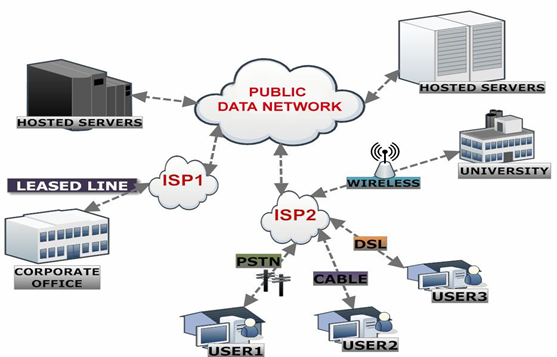
The CPE is physically attached to the “local loop” or “last mile.” This is the infrastructure between a provider’s installation and the site where the host is located. For example, a home user with a 56K modem attaches the modem to the telephone line. The telephone line is typically a pair of copper wires that runs from the house to a central office (CO) owned and operated by the telephone company. In this instance the local loop is the pair of copper wires running between the home and the CO. If the home user has a cable modem, the local loop is the coaxial cable that runs from the home to the cable company facilities. The preceding examples are a bit of an oversimplification, but they suffice for this discussion. In many cases the wires that leave a home are aggregated with wires from other homes and then converted to a different media such as fiber. In these cases, the term local loop still refers to the path from the home to the CO or cable facility. The local loop provider is not necessarily the ISP. In many cases the local loop provider is the telephone company and the ISP is a large, national service organization. Often, however, the local loop provider is also the ISP.
The ISP provides access to its larger network through a POP. A POP is simply
a facility where customers can connect to the ISP network. The facility is sometimes owned by the ISP, but often the ISP leases space from the local loop carrier. A POP can be as simple as a bank of modems and an access server installed in a rack at the CO. The POPs are usually spread out over the geographic area where the provider.
Central Office (CO)
The place where telephone companies terminate customer lines and locate switching equipment to interconnect those lines with other networks.
Customer Premises Equipment (CPE)
Telecommunications equipment that is located on the customer’s premises (physical location) rather than on the provider’s premises or in between. Telephone handsets, modems, cable TV set-top boxes, and digital subscriber line routers are examples. Historically, this term referred to equipment placed at the customer’s end of the telephone line and usually owned by the telephone company. Today, almost any end-user equipment can be called customer premises equipment and it can be owned by the customer or by the provider.
Internet Service Provider (ISP)
A company that provides other companies or individuals with access to, or presence on, the Internet. An ISP has the equipment and the telecommunication line access required to have a POP on the Internet for the geographic area served. The larger ISPs have their own high-speed leased lines so that they are less dependent on the telecommunication providers and can provide better service to their customers.
Network Access Point (NAP)
In the United States, a network access point (NAP) is one of several major Internet interconnection points that serve to tie all the ISPs together. Originally, four NAPs—in New York, Washington,D.C., Chicago, and San Francisco—were created and supported by the National Science Foundation as part of the transition from the original U.S. government—financed Internet to a commercially operated Internet. Since that time, several new NAPs have arrived, including WorldCom’s “MAE West” site in San Jose, California and ICS Network Systems’ “Big East.”
The NAPs provide major switching facilities that serve the public in general. Companies apply to use the NAP facilities. Much Internet traffic is handled without involving NAPs, using peering arrangements and interconnections within geographic regions.
Network Service Provider (NSP)
A company that provides backbone services to an Internet service provider (ISP). Typically, an ISP connects at a point called an Internet exchange (IX) to a regional ISP that in turn connects to an NSP backbone.
Point of Presence (POP)
A site that has a collection of telecommunications equipment, usually refers to ISP or telephone company sites. An ISP POP is the edge of the ISP’s network; connections from users are accepted and authenticated here. An Internet access provider may operate several POPs distributed throughout its area of operation to increase the chance that their subscribers will be able to reach one with a local telephone call. The largest national ISPs have POPs all over the country.