
Transmission Terminology
Data transmission occurs between transmitter and receiver over some transmission medium. Transmission media may be classified as guided or unguided. In both cases, communication is in the form of electromagnetic waves. With guided media, the waves are guided along a physical path; examples of guided media are twisted pair, coaxial cable, and optical fiber. Unguided media, also called wireless, provide a means for transmitting electromagnetic waves but do not guide them; examples are propagation through air, vacuum, and seawater.
The term direct link is used to refer to the transmission path between two devices in which signals propagate directly from transmitter to receiver with no intermediate devices, other than amplifiers or repeaters used to increase signal strength. Note that this term can apply to both guided and unguided media. A guided transmission medium is point to point if it provides a direct link between two devices and those are the only two devices sharing the medium. In a multipoint guided configuration, more than two devices share the same medium.
A transmission may be simplex, half duplex, or full duplex. In simplex transmission, signals are transmitted in only one direction; one station is transmitter and the other is receiver. In half-duplex operation, both stations may transmit, but only one at a time. In full-duplex operation, both stations may transmit simultaneously. In the latter case, the medium is carrying signals in both directions at the same time. How this can be is explained in due course.We should note that the definitions just given are the ones in common use in the United States (ANSI definitions). Elsewhere (ITU-T definitions), the term simplex is used to correspond to half duplex as defined previously, and duplex is used to correspond to full duplex as just defined.
Frequency, Spectrum, and Bandwidth
In this book, we are concerned with electromagnetic signals used as a means to
transmit data. At point 3 in Figure 1.3, a signal is generated by the transmitter and
transmitted over a medium. The signal is a function of time, but it can also be expressed as a function of frequency; that is, the signal consists of components of different frequencies. It turns out that the frequency domain view of a signal is more important to an understanding of data transmission than a time domain view. Both views are introduced here.
Time Domain Concepts Viewed as a function of time, an electromagnetic signal
can be either analog or digital. An analog signal is one in which the signal intensity
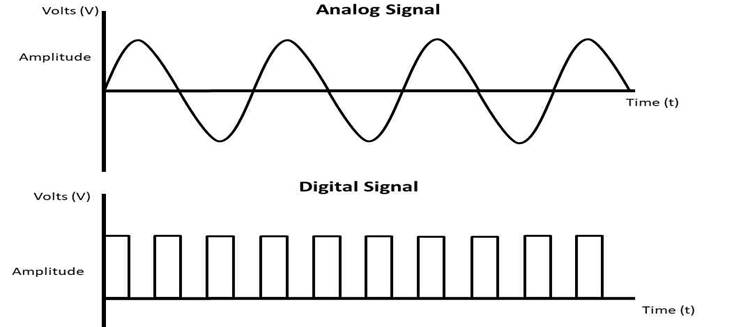
Analog and Digital Waveforms
varies in a smooth fashion over time. In other words, there are no breaks or discontinuities in the signal.1 A digital signal is one in which the signal intensity maintains a constant level for some period of time and then abruptly changes to another constant level. The figure above shows an example of each kind of signal. The continuous signal might represent speech, and the discrete signal might represent binary 1s and 0s.
The simplest sort of signal is a periodic signal, in which the same signal pattern
repeats over time. Figure 3.2 shows an example of a periodic continuous signal (sine wave) and a periodic discrete signal (square wave). Mathematically, a signal s(t) is defined to be periodic if and only if
s(t + T) = s(t) - ჶ < t < +ჶ
where the constant T is the period of the signal (T is the smallest value that satisfies the equation). Otherwise, a signal is aperiodic.