PROPERTIES OF MATTER
The Properties of Matter course explores the fundamental characteristics that define and distinguish materials, focusing on both physical and mechanical attributes. Key concepts include density, which explains why oil floats on water; pressure, as seen in how sharp knives cut more effectively due to higher pressure over smaller areas; and elasticity, which is crucial in designing springs and shock absorbers. The course also covers floatation using Archimedes’ Principle, which helps explain how ships float despite their massive weight. Additionally, it examines surface tension, observable when insects like mosquitoes walk on water, and viscosity, which influences the flow of engine oils in automobiles.
4. ELASTICITY AND RELATED CONCEPT
1.3 Elasticity and Related Concepts
1. Elasticity:
Is the
ability of a solid material to return to its original shape and size after the
removal of external forces that caused its deformation. This property allows
materials to resist permanent shape changes and recover their initial form when
the applied stress is removed.
2. Deforming
Forces: These
forces alter a body's shape, size, or configuration by causing deformation.
3. Restoring Force: A restoring force
is an internal force exerted by a deformed body that acts in the opposite
direction of deformation, striving to return the body to its equilibrium state.
4. Elastic
Body: An
elastic body is one that regains its original shape and dimensions after the
removal of deforming forces. Common examples include a soccer ball, rubber
band, and spring.
1.4.1 Stress
When a deforming force acts perpendicular (normal) to the surface of a body, it
generates normal stress. This type of stress can be further classified
into:
When a deforming force acts parallel (tangentially) to the surface of a body,
it produces tangential stress, also known as shear stress. This
type of stress leads to a change in the shape of the body without altering its
volume.
1.4.3 Strain
Longitudinal Strain:
If the deforming force produces a change in length only, the strain produced
is called longitudinal or tensile strain.
It is defined as the ratio of change
in length to the original length.
Stress is defined as the restoring force per unit area of a material.
Stress = F/A
Unit of stress is N/m2 or Pascal Stress is of two types:
1.4.2 Types of Stress
1. Normal Stress:
a. Tensile Stress (when the force pulls the body apart, increasing its length)
·b. Compressive Stress (when the force pushes the body inward, reducing its length)
2. Tangential Stress (Shear Stress):
Strain is defined as the ratio of change in configuration to the original configuration, when a deforming force is applied to a body.
Strain is of three types:
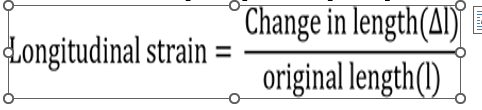
i. Longitudinal Strain: If the deforming force produces a change in length only, the strain produced is called longitudinal or tensile strain. It is defined as the ratio of change in length to the original length.
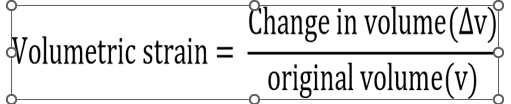
ii. Volumetric
strain: It is defined as the ratio of the change in
volume to the original volume
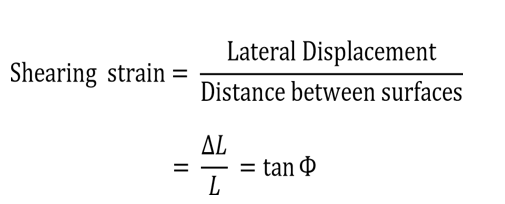
iii. Shearing strain: It is defined as the ratio of lateral displacement of a surface under the tangential force to the perpendicular distance between surfaces.
Strain is a ratio of two similar physical quantities, it has no units and dimensions.