
Introduction to Transition Metal Chemistry:
1. What are Transition Elements?
Transition elements (also known as transition metals) are elements that have partially filled d orbitals. IUPAC defines transition elements as an element having a d subshell that is partially filled with electrons, or an element that has the ability to form stable cations with an incompletely filled d orbital.
In general, any element which corresponds to the d-block of the modern periodic table (which consists of groups 3-12) is considered to be a transition element. Even the f-block elements comprising the lanthanides and the actinides can be considered as transition metals.
However, since the f-block elements have incompletely filled f-orbitals, they are often referred to as inner transition elements or inner transition metals. An illustration detailing the position of transition metals on the periodic table along with their general electronic configurations is provided below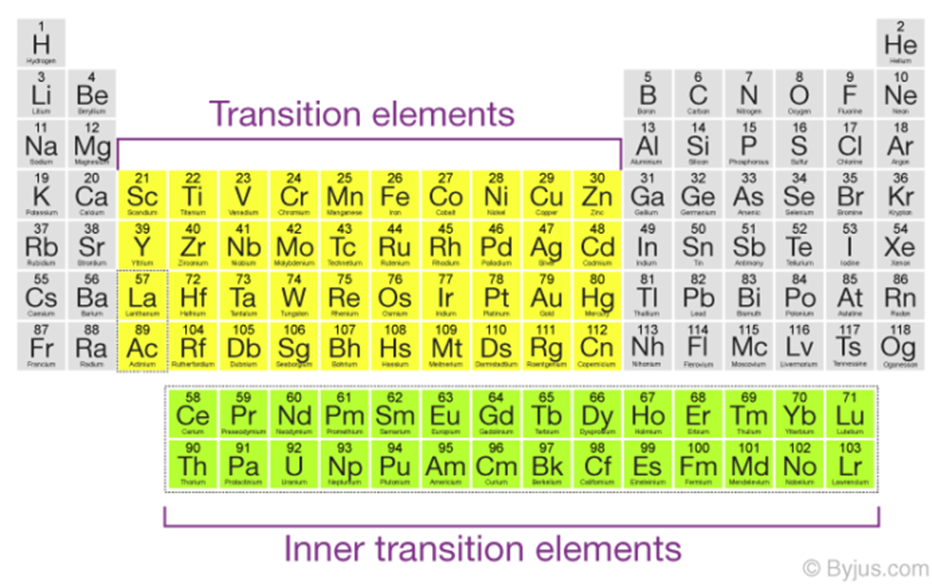
It is important to note that the element’s mercury, cadmium, and zinc are not considered transition elements because of their electronic configurations, which corresponds to (n-1)d10 ns2.
These elements have completely filled d orbitals in their ground states and even in some of their oxidation states. One such example is the +2 oxidation state of mercury, which corresponds to an electronic configuration of (n-1)d10.