
Lecture Notes: Sexual Differentiation, Sex Determination, and Gametogenesis
3. Sexual Differentiation
3.1 Overview
· Sex differentiation: the process by which a developing embryo or fetus develops into a male or female sexual phenotype.
· It's a complex process involving genetic, hormonal, and anatomical changes that lead to the development of distinct male and female characteristics
- Early embryo has indifferent gonads capable of developing into either testes or ovaries.
- The gonadal ridge can develop into either testes or ovaries.
- Supporting structures include the mesonephric (Wolffian) and paramesonephric (Müllerian) ducts
- Presence or absence of SRY gene and testicular hormones determines the direction of development.
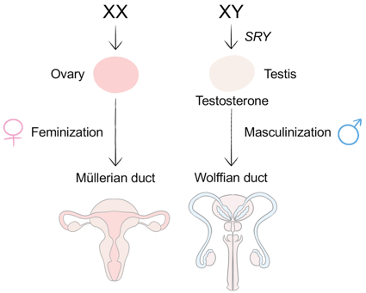
- Key Stages of Sexual Differentiation
- Chromosomal sex (XX or XY)
- Gonadal sex (ovaries or testes)
- Phenotypic sex (internal & external genitalia)
- Secondary sexual characteristics
3.2 Differentiation of Internal Genitalia (Gonadal sex)
· Development depends on presence or absence of testes and their hormones.
· Male Differentiation
o Triggered by SRY gene → TDF → Sertoli cell development.
o Sertoli cells secrete Anti-Müllerian Hormone (AMH) → regression of Müllerian ducts.
o Leydig cells produce testosterone, promoting the development of:
§ Wolffian ducts → epididymis, vas deferens, seminal vesicle.
§ Dihydrotestosterone (DHT) forms external genitalia (penis, scrotum, prostate).
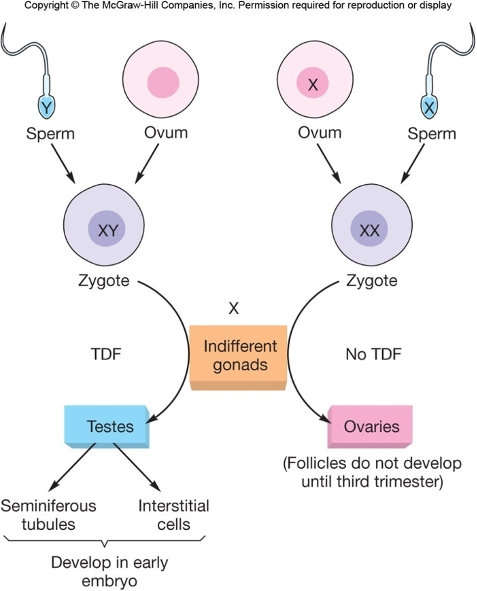
· Female Pathway (No Testes)
o In absence of SRY and AMH → Müllerian ducts form:
§ Fallopian tubes
§ Uterus
§ Upper vagina
o No testosterone → Wolffian ducts regress.
· Role of the SRY Gene
o Located on the Y chromosome.
o Codes for Testis-Determining Factor (TDF).
o Initiates differentiation of Sertoli cells → triggers testis formation.
o Absence of SRY allows ovarian development to occur by default
3.3 Differentiation of External Genitalia (Phenotypic sex)
· Driven by androgen exposure from weeks 8–12.
· Male
o DHT (from testosterone) causes formation of:
§ Penis
§ Scrotum
§ Prostate
· Female
o In absence of DHT:
§ Clitoris
§ Labia majora/minora
§ Lower vagina
3.4 Regulation of Sexual Differentiation
Regulation in Males
· Sertoli Cells
o Produce Anti-Müllerian Hormone (AMH)
o Causes regression of Müllerian ducts, preventing female internal organ formation.
· Leydig Cells
o Produce testosterone
o Testosterone converts Wolffian ducts into:
§ Epididymis
§ Vas deferens
§ Seminal vesicles
o Testosterone is converted by 5α-reductase to Dihydrotestosterone (DHT)
· DHT and External Genitalia
o DHT is responsible for:
§ Development of penis
§ Formation of scrotum
§ Growth of the prostate
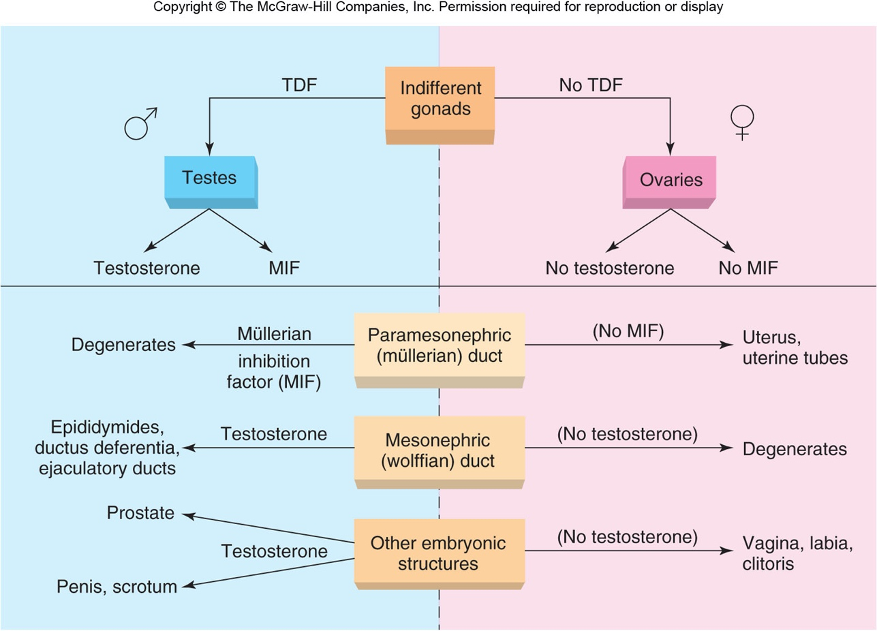
Regulation in Females
· Absence of SRY
o Gonad → ovary.
· Absence of AMH
o Müllerian ducts develop into:
§ Fallopian tubes
§ Uterus
§ Upper vagina
· Absence of Testosterone
o Wolffian ducts regress.
· In the absence of DHT, the external phenotype becomes:
o Clitoris
o Labia majora/minora
o Lower vagina