Lecture Notes: Sexual Differentiation, Sex Determination, and Gametogenesis
5. Gametogenesis
5.2. Oogenesis
6.1 Location
· ogenesis is the process by which female gametes (ova or eggs) develop from oogonia (germ cells) within the ovaries.
· Occurs in ovaries within ovarian follicles.
· It involves multiplication, growth, and maturation, resulting in the formation of a single functional ovum capable of being fertilized.
6.2 Stages of Oocyte Development
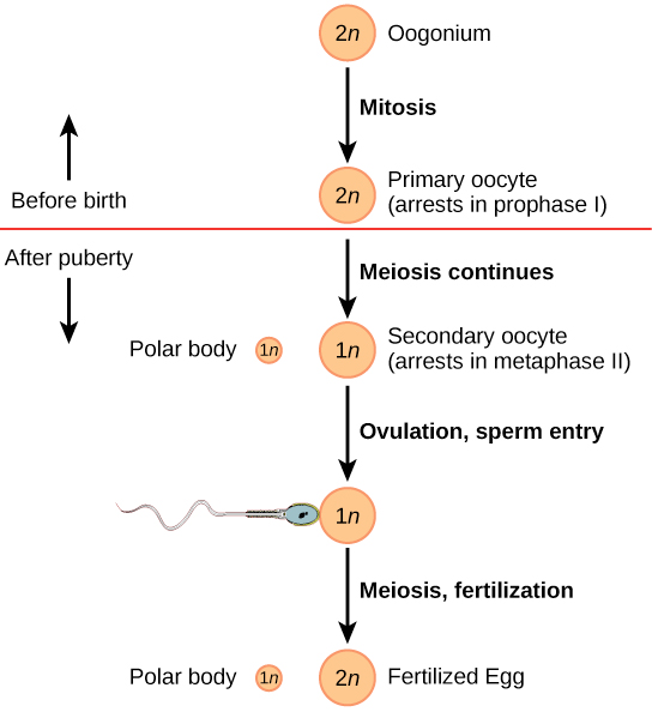
Unlike spermatogenesis, oogenesis begins before birth (oogonia → primary oocytes), pauses for many years, and resumes at puberty, continuing cyclically until menopause.
- Fetal (Pre-natal) Phase
- The primordial germ cells (PGCs) migrate into the developing ovaries and differentiate into oogonia (immature egg cells)
- Oogonia (diploid) proliferate (until 5th month of gestation by mitosis → to produce 6 to 7 million germ cells
- These germ cells develop into primary oocytes (most most of these degenerates before birth - atresia)
- Primary oocytes begin Meiosis I but are arrested in prophase I until puberty.
- This arrested state may last 10–50 years, depending on when ovulation occurs.
- At birth, about 1–2 million primary oocytes are present; by puberty, only about 300,000–400,000 remain.
- Puberty to menopause
- Monthly cohorts resume meiosis
- One primary oocyte completes Meiosis I → forms a secondary oocyte and a small polar body.
- The polar body allows for the oocyte to get rid of chromosomes while at the same time taking the least amount of resources (cytoplasm) from the oocyte
- The secondary oocyte begins Meiosis II but arrests at metaphase II until fertilization.
3. Ovulation
o Secondary oocyte arrests in meiosis II.
4. Fertilization
-
- Completion of meiosis II only if fertilized.
6.3 Folliculogenesis
· Primordial follicle
· Primary follicle
· Secondary follicle
· Graafian follicle
· Corpus luteum formation post-ovulation
6.4 Hormonal Regulation
-
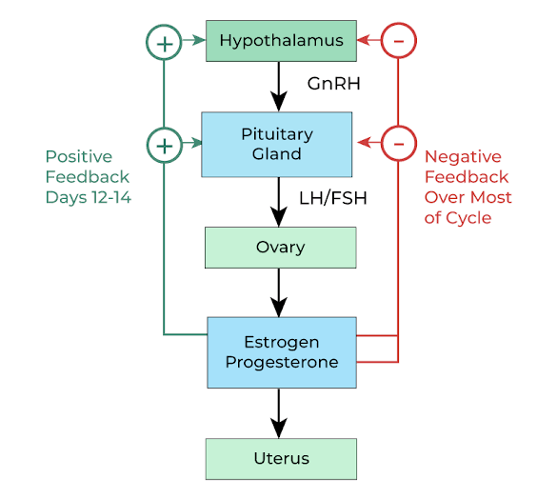
- FSH
- Stimulates follicular growth
- LH
- Triggers ovulation
- Supports corpus luteum formation
- Estrogen and progesterone
- Regulate endometrium
- Provide feedback to hypothalamus/pituitary
- FSH