
MODULE1: ELECTROSTATIC
These Course will help students understand the fundamental principles of electric current and apply them in real-life situations, including electronics, and how to go about them.
1. INTRODUCTION
1.0 Introduction to Electricity
Electricity is a form of energy associated with the presence and motion of electric charge. It is used for powering homes and industries, Lighting and heating, Communication systems, Transportation and for medical equipment. The scientific study of electricity and its applications is known as electrical engineering and electromagnetism. Understanding electric charge and electrical principles is crucial for designing safe, efficient, and reliable electrical systems. Electricity exists mainly in two forms:
i. Static electricity: Electric charges at rest, often produced by friction or induction.
ii. Current electricity: The continuous flow of electric charge through a conductor.
1.2 Electrostatic
Electrostatics also called Static Electricity, is a branch of physics that deals with the study of electric charges at rest and the forces, fields, and potentials associated with them.
In electrostatics, charges do not flow continuously as they do in electric circuits. Instead, they remain stationary or accumulate on the surfaces of materials. This area of physics explains phenomena such as attraction and repulsion between charged bodies, lightning and static shocks. Examples of static electricity include the followings;
- Rubbing a balloon on dry hair: The balloon attracts hair strands and may stick to a wall due to accumulated electric charges.
- Clothes sticking together after drying: Especially synthetic clothes in a dryer; this happens because of charge buildup.
- Small electric shock when touching a metal object: For example, touching a door handle after walking on a carpet.
- Lightning: A large-scale natural example of static electricity discharge between clouds or between a cloud and the ground.
- Dust sticking to TV or computer screens: Static charges attract light dust particles.
- Photocopiers and laser printers: They use static electricity to attract toner powder to paper.
- Plastic comb attracting pieces of paper: After rubbing the comb on dry hair or wool.
- Hair standing up when removing a sweater: Caused by transfer of electric charges.
- Fuel tankers trailing metal chains: Used to discharge static electricity and prevent sparks.
- Electrostatic spray painting: Paint particles are electrically charged to stick evenly to surfaces.
1.3 Production of Electric Charges
Electric charges can be produced by the following methods:
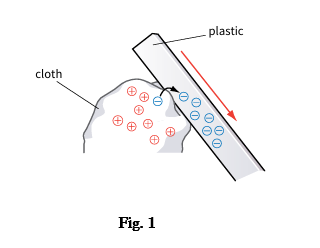
1. Charging by Friction: When two different materials are rubbed together, see Fig1., electrons may be transferred from one material to another. This results in one object becoming positively charged and the other negatively charged. Example: Rubbing a balloon against dry hair causes the balloon to stick to a wall.
2. Charging by Conduction: Charging by conduction occurs when a charged object is brought into direct contact with a neutral conductor. Electrons flow between the objects until charge is redistributed. Example: Touching a charged rod with a metal sphere transfers charge to the sphere.
3. Charging by Induction: Charging by induction occurs without direct contact. When a charged object is brought near a neutral conductor, charges within the conductor rearrange themselves. If the conductor is grounded, it can acquire a net charge. Example: Bringing a charged rod near a metal sphere causes separation of charges within the sphere.
4. Electrostatic Discharge: When a large amount of charge accumulates on an object, it may suddenly discharge in the form of a spark or shock. Examples: - Lightning - Electric shock after walking on a carpet and touching a metal object.
1.3.1 Conservation of Electric Charge
The law of conservation of charge states that: The total electric charge in an isolated system remains constant.
Charge cannot be created or destroyed; it can only be transferred from one body to another.
Example: When two objects are rubbed together, electrons move from one object to the other. One becomes positively charged and the other negatively charged, but the total charge remains unchanged.
1.4 Coulomb’s Law of Electrostatics and superposition Principle
1.4.1 Coulomb’s law
Coulomb’s law describes the electrostatic force between two-point charges. The superposition principle allows calculating net forces or fields from multiple charges by vector addition.
Coulombs law state that; the magnitude of the electrostatic force between two-point charges is directly proportional to the product of their charges and inversely proportional to the square of the distance between them. Mathematically expressed. 
Where:
F = electrostatic force (N)
Q1 and Q2 = magnitudes of the charges (C)
R = distance between the charges (M)
K = Coulomb’s constant (9.0 x N.m2/C2)
Note: The force is Attractive for unlike charges and Repulsive for like charges.
Work examples:
1. An electron is at a distance of 5.0x m away from the center of the proton. Calculate the electrostatic force on it.?
2. A point charge of +3.0× C is 12.0cm distant from a second point charge of −1.50× C. Calculate the magnitude of the force on each charge.
3. What must be the distance between point charge q1=26.0µC and point charge q2= 47.0µC for the electrostatic force between them to have a magnitude of 5.70N.
1.3.1 Conservation of Electric Charge
The law of conservation of charge states that: The total electric charge in an isolated system remains constant.
Charge cannot be created or destroyed; it can only be transferred from one body to another.
Example: When two objects are rubbed together, electrons move from one object to the other. One becomes positively charged and the other negatively charged, but the total charge remains unchanged.